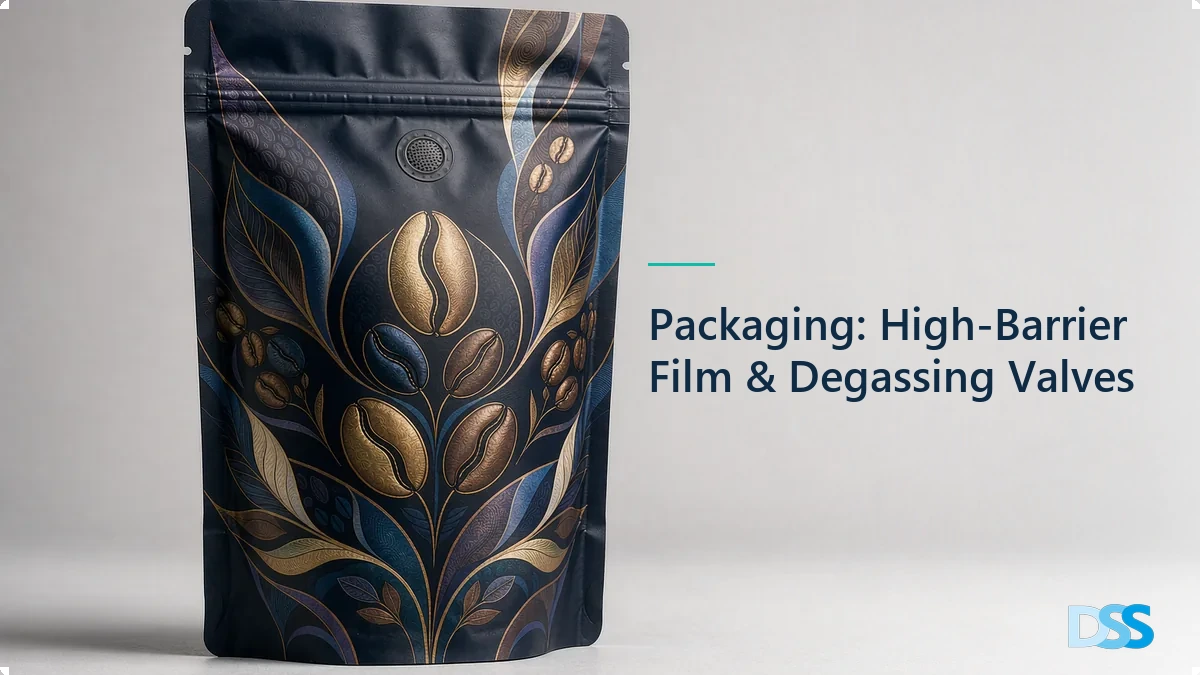
Once coffee has been roasted, packaging has two jobs: manage the carbon dioxide (CO₂) the coffee continues to release and limit its exposure to oxygen, moisture, light and heat. The right solution depends on the coffee, the time between roasting and packing, the desired shelf life, the distribution route and the packing process.
This guide explains the coffee-packaging decisions that matter most: one-way degassing valves, high-barrier film structures, pouch formats and the specifications to include in an RFQ. DSS Pack manufactures flexible coffee packaging as a factory-direct supplier certified to ISO 9001, FDA and BRC.
Key Takeaways
- Freshly roasted whole beans usually need a one-way degassing valve when packed soon after roasting; the final decision should be based on the product’s degassing profile and shelf-life target.
- Foil laminates generally provide the strongest barrier, while metallized-film laminates are a widely used cost-performance option. Package performance depends on the complete structure, seals, valve and handling—not on one layer alone.
- Select pouch format, valve location and filling process together. Flat-bottom pouches can accommodate valves and zippers; rollstock requires a compatible valve-application process.
- Quote on the final structure, print, valve, volume and destination; MOQ and lead time are confirmed once specifications are reviewed.
Why Coffee Packaging Is Different: Managing CO₂ and Oxygen
Coffee continues to change after roasting. Beans release CO₂ most actively in the early period after roasting; the rate then declines over time. Oxygen contributes to oxidation and flavour loss, and moisture, light and heat can also shorten the period in which coffee retains its intended aroma and taste.
That creates a practical packaging challenge. A sealed pack must manage internal gas pressure while limiting the entry of oxygen and moisture. The right combination of degassing valve, barrier structure, filling method and storage conditions is therefore determined case by case, not by one universal bag specification.
Degassing Valves Explained
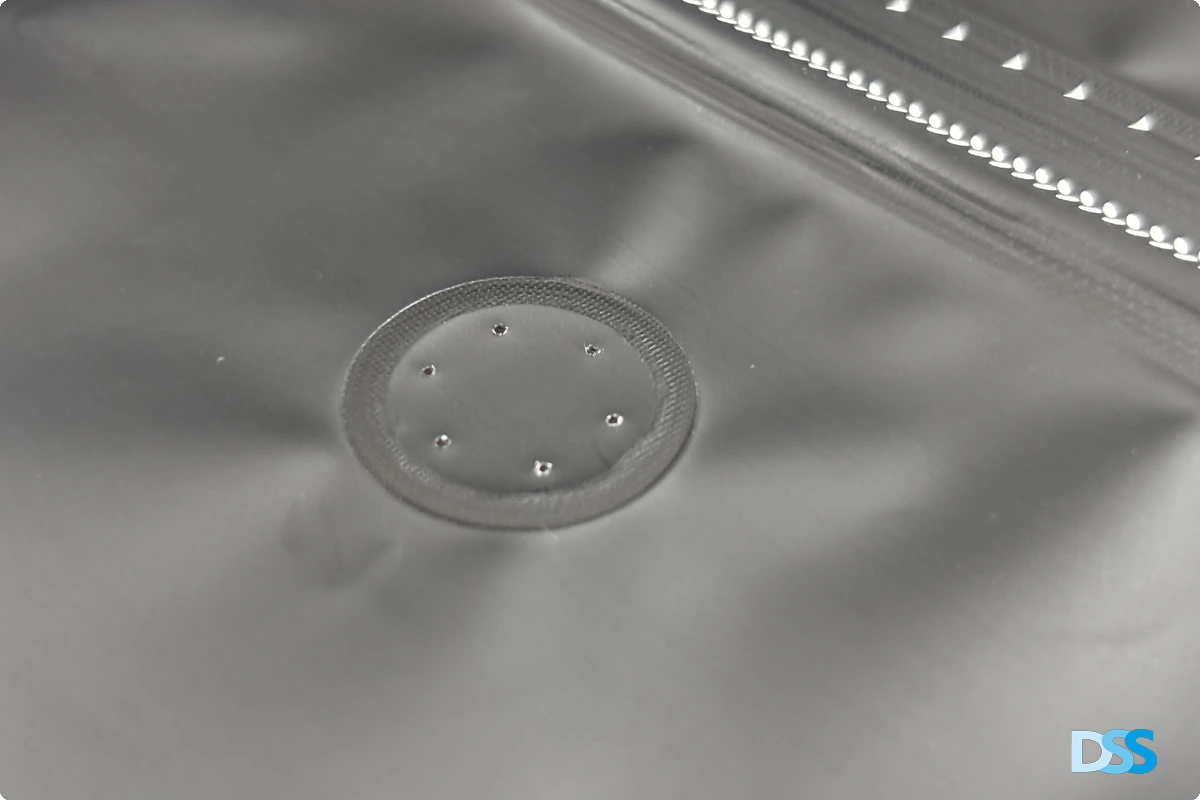
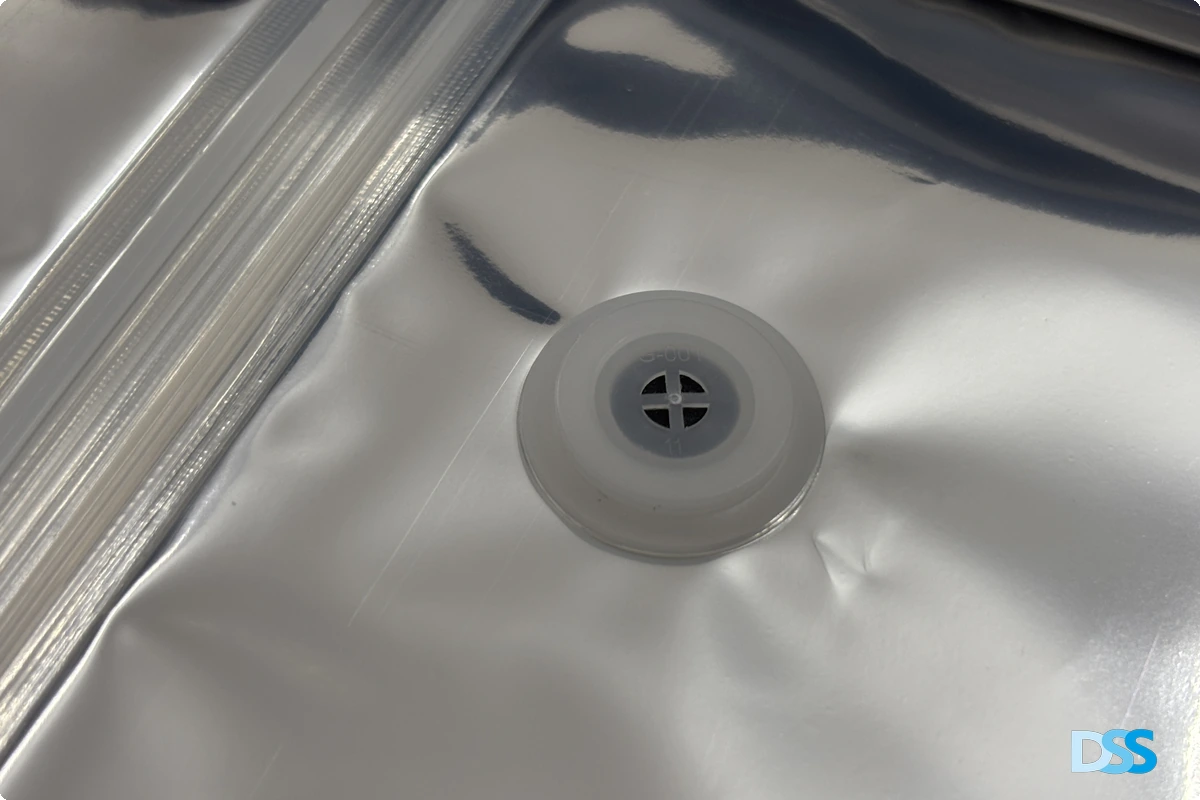
A coffee bag with a one-way degassing valve releases excess internal gas while limiting the entry of outside air. It is commonly used for whole-bean coffee packed soon after roasting.
How a one-way valve works
One-way valves use a pressure-responsive seal. When internal pressure rises sufficiently above ambient, the valve opens to release gas; as pressure drops, it closes again. Internal construction varies by supplier and model — a membrane, filter and lubricant, or an oil-free sealing system.
Valves reduce oxygen ingress but are not a substitute for a suitable high-barrier laminate, good seal integrity or correct handling. Confirm opening pressure and gas-flow performance with the valve supplier and validate them on the finished package.
What happens without a valve
If freshly roasted coffee is packed while it is still releasing significant CO₂ and no suitable gas-management method is used, the pack can swell. This can affect stacking efficiency and increase stress on seals and the package structure. The extent of the effect depends on roast profile, time after roasting, grind, fill weight, headspace, bag construction and storage temperature.
Two common approaches are to let coffee degas before packing, or to pack earlier with a suitable one-way valve. The better route depends on the roaster’s process, product profile and shelf-life target, and should be verified through product and package trials.
Valve placement on the pack
Valve location affects both performance and appearance. Common positions include top-centre, side and corner locations.
- Top-centre is a common option for many pouch formats and can keep the valve clear of key artwork.
- Side placement can suit taller packs or layouts where the front panel is reserved for branding.
- Corner placement is possible on selected formats but requires particular care because folds and creases can affect application.
On flat-bottom coffee pouches and stand-up pouches, the valve should normally be applied to a flat, uninterrupted panel, clear of folds, creases, seals and the folded base, and generally positioned above the product level to avoid product interference. Approve the final location and settings for the specific pouch and valve combination.
Whole bean vs. ground coffee
Whole beans and ground coffee have different degassing behaviour. Grinding increases exposed surface area and can change both the rate and timing of gas release. Fine particles can also create a clogging risk for some valve designs.
For ground coffee, choose between a valve, a filtered valve, controlled pre-degassing, vacuum packaging or gas flushing according to the product, packing process and target shelf life. Confirm compatibility with the valve supplier or converter before production.
Valve plus zipper or tin-tie
Valves can be paired with resealable zippers or tin-ties. These closures serve a different purpose: they let consumers reclose the pack after opening, while the valve manages internal pressure before opening. The valve still needs clearance from closures, folds and seals.
Valve supply and integration
Degassing valves are specialist components supplied by valve manufacturers and integrated by the packaging converter or within a compatible filling process. Buyers should specify valve style, placement, product type and packing conditions, then confirm application capability and quality control with the converter.
The Barrier Stack: Foil vs. Metallized PET
Degassing valves manage gas moving out of a package. Barrier materials help limit oxygen and moisture moving into it. Both are important, but neither alone defines the shelf life of a finished coffee pack.
Oxygen is a key consideration for coffee freshness. Barrier performance depends on the complete laminate structure, layer thicknesses, seals, pouch geometry, valve and handling through conversion, filling and distribution.
- Foil laminate: PET/AL/PE. An aluminium-foil layer provides higher light, oxygen and moisture barrier than metallized film when the laminate stays intact; finished-pack performance still depends on foil gauge, pinholes, flex cracking, seals, valves and handling.
- Metallized-film laminate: PET/VMPET/PE. Vacuum-metallized PET is a widely used barrier layer with strong cost-performance for many retail coffee applications. Assess its barrier level as part of the complete laminate, not from the metallized layer alone.
- Other options include kraft-look laminates with an appropriate barrier layer, as well as matte, soft-touch and gloss finishes for brand presentation.
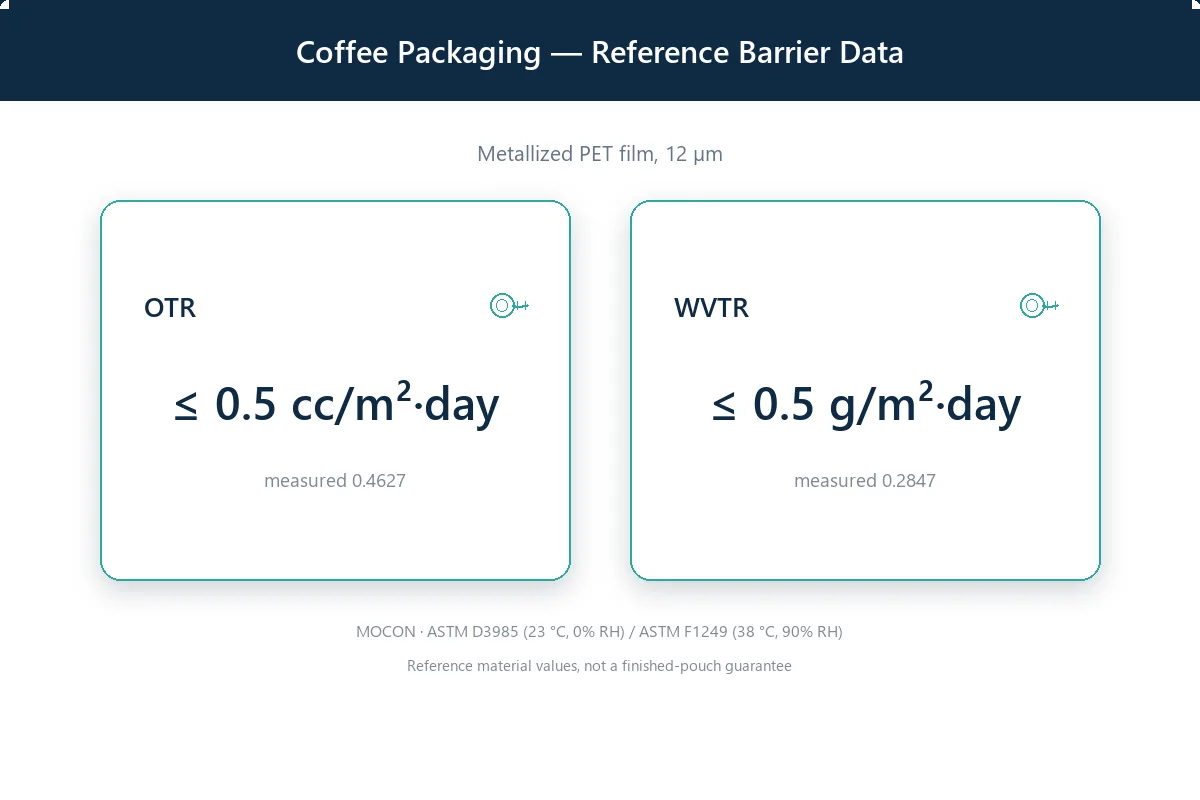
DSS can test barrier performance using MOCON instruments, following ASTM D3985 for oxygen transmission rate (OTR) and ASTM F1249 for water-vapour transmission rate (WVTR).
| Material / structure | Reference barrier data | Test conditions | Important note |
|---|---|---|---|
| Metallized PET film, 12 µm | OTR: 0.4627 cc/m²·day; WVTR: 0.2847 g/m²·day | MOCON; ASTM D3985 (23 °C, 0% RH) / ASTM F1249 (38 °C, 90% RH) | Reference measurements for a single 12 µm metallized PET sample, not a specification for a finished laminate or pouch. |
| AlOx-coated PET | Target values such as OTR ≤1.5 cc/m²·day and WVTR ≤1.0 g/m²·day may be specified by structure and application | Confirm with the material supplier and test report | Performance varies with coating grade, substrate, thickness and converting conditions. |
| Foil laminate, such as PET/AL/PE | Very high barrier when intact | Confirm for the finished structure where required | Foil is not an absolute finished-pack barrier; seals, valves, pinholes and flex damage also matter. |
Lower values indicate lower measured transmission under the stated conditions. These figures are reference values for the material tested — useful for comparing options, not a claim for finished-pouch performance or shelf life. Agree final specifications for the complete laminate and verify by testing the finished pack where relevant.
For coffee, foil laminates are often selected when a very high barrier is needed. Metallized PET laminates are commonly selected where a balance of barrier, appearance and cost is preferred. If recyclability is also a goal, mono-material recyclable pouches may involve barrier and shelf-life trade-offs that need to be evaluated for the particular application.
For general barrier considerations across food categories, see our notes on high-barrier snack & candy packaging.
Choosing a Coffee Pouch Format—and Valve Compatibility
Pouch format affects shelf presentation, filling efficiency, graphics area and valve-placement options. Review the final configuration with your converter and filling-line team.
| Format | Typical use | Valve considerations |
|---|---|---|
| Flat-bottom pouch | Premium retail packs; five printable panels and a box-like base | Can accommodate valves and zippers; keep the valve clear of the folded base, creases, seals and corners. |
| Stand-up pouch | E-commerce and smaller pack sizes; stable base and broad display panel | Often allows straightforward placement on an upper front or side panel, subject to pouch construction and fill process. |
| Rollstock film | Higher-volume roasters using form-fill-seal equipment | Requires a compatible valve-application step and equipment within the converting or filling workflow. |
| Three-side seal / back-seal | Bulk packs, portion packs or value-focused formats | A valve can be used where needed, but these formats are often specified without one for applications with suitable degassing and shelf-life conditions. |
The flat-bottom coffee pouch is a frequent choice for premium retail because its panels support detailed branding and its flat base gives a structured shelf appearance. Stand-up pouches are often selected when flexible sizing, e-commerce suitability or lower unit cost are priorities.
Roasters using VFFS equipment can consider coffee rollstock film. Valve application must be designed into the overall process and verified with the selected machinery, film and valve.
Format and supply form are separate decisions. Our rollstock film vs. pre-made pouches comparison covers the economics of each route, while the stand-up pouch vs. flat-bottom pouch comparison explores two popular retail formats in more detail.
What to Specify in Your Coffee Packaging RFQ
Detailed RFQs help roasters receive more relevant quotations and fewer revisions. For custom printed coffee bags at low MOQ, include the following information.
| Specification | What to state |
|---|---|
| Product details | Whole bean or ground coffee, roast date-to-pack timing, fill weight, desired shelf life and sales market |
| Valve type | Preferred model or style, or a request for the converter to propose compatible options |
| Valve placement | Intended position and panel, with artwork if available |
| Opening pressure and flow | Target values, if already validated for the coffee and packing process |
| Filter | Whether a filter may be needed for ground coffee or fine particles |
| Valve construction | Any requirement for oiled, oil-free or other approved valve construction |
| Closure | Zipper type, tin-tie or no resealable closure |
| Barrier structure | Preferred complete structure, such as PET/AL/PE or PET/VMPET/PE, plus any target test conditions or values |
| Filling method | Pre-degassing, gas flushing, vacuum packing or another process, including residual-oxygen target if relevant |
| Surface finish | Matte, soft-touch, gloss or kraft-look finish |
| Print and quantity | Artwork status, colours, dimensions, order quantity and destination market |
DSS Pack’s usual starting MOQ is 10,000 units for pre-made pouches and 300 kg for rollstock film, although feasibility can depend on the material, dimensions, printing and valve requirements. Gravure cylinder charges, if applicable, typically fall in the range of USD 100–150 per colour, quoted by artwork and colour count.
Production timing is confirmed once artwork, structure, components and order quantity are agreed. For straightforward projects, DSS Pack offers the fastest delivery of 15 days after order confirmation; specialised materials, valves, new cylinders, approvals, shipping and seasonal capacity can affect the final timeline.
Our flexible packaging RFQ checklist covers the broader information a converter may need. The flat-bottom pouch page also shows available valve and zipper options.
When your specification is ready, request a quote and we will review it against your volume, application and target market.
Certifications and Sourcing Confidence
DSS Pack holds ISO 9001, FDA, and BRC certification, and manufactures as a factory-direct supplier with an in-house engineering team. FDA food-contact compliance covers the US market, while BRC is the standard most retail buyers ask for when sourcing from China. That combination matters when barrier performance and valve integration have to hold up order after order. Structure, valve or print questions go straight to the engineers who build the pack.
Frequently Asked Questions
Do all coffee bags need a degassing valve?
No. Many whole-bean coffees packed soon after roasting use a one-way valve because they continue to release CO₂. Whether one is needed depends on the coffee’s degassing behaviour, the time between roasting and packing, pack size, filling method and shelf-life target.
What happens if you seal freshly roasted coffee without a valve?
If the coffee is still releasing significant CO₂, the package may swell and place additional stress on its seals and structure. The outcome varies by product and package design. Suitable alternatives can include controlled pre-degassing or a validated one-way valve system.
Where should the degassing valve be placed on a coffee bag?
It should normally be applied to a flat panel, clear of folds, creases, seals and the folded base, and generally above the product level. Top-centre, side and corner positions can all be used when validated for the selected pouch and valve.
Do ground coffee bags need a valve?
Not always. Grinding changes degassing behaviour and fine particles can affect some valve designs. Depending on the application, options may include a filtered valve, controlled pre-degassing, vacuum packaging or gas flushing. Confirm the best option through product and package trials.
Foil or metallized PET for coffee packaging?
Foil laminates are often selected where a very high barrier is required. Metallized PET laminates are a common cost-performance option for many retail applications. Base the final choice on the complete laminate, desired shelf life, valve and seal design, filling method and distribution conditions. A single 12 µm metallized PET sample measured OTR 0.4627 cc/m²·day and WVTR 0.2847 g/m²·day under the stated test conditions — reference material values, not a finished-pouch guarantee.
What is the MOQ for custom coffee packaging?
DSS Pack’s usual starting MOQ is 10,000 units for pre-made pouches and 300 kg for rollstock film. Practical MOQ, component availability and lead time are confirmed after review of the final dimensions, structure, printing, valve requirements and order quantity. More answers are in the packaging FAQ.
Conclusion
Coffee packaging should be selected as a system. CO₂ management, oxygen and moisture barrier, pouch format, filling method, valve design and distribution conditions all work together.
Whole beans packed soon after roasting often benefit from a one-way valve, while ground coffee requires its own evaluation. Foil laminates can provide very high barrier performance when intact; metallized-film laminates can offer an effective cost-performance balance. In every case, confirm final performance for the finished structure and the actual product.
DSS Pack makes flat-bottom, stand-up, three-side-seal, back-seal and spout pouches, plus rollstock film. Send your coffee type, filling method, target shelf life, structure preference, valve needs and volume to get a quote for a project-specific recommendation.