The packaging format you buy affects more than the appearance of the finished pack. It influences unit cost, filling speed, changeover time, labor, warehouse space, minimum order quantity and shelf presentation.
Most buyers choose between two supply formats:
- Rollstock film, a continuous web formed, filled and sealed on the packaging machine.
- Pre-made pouches, finished bags that arrive ready to open, fill and seal.
Neither format is automatically better. The right choice depends on volume per SKU, changeover frequency, product requirements, equipment and sales channel.
Quick answer
- Stable, high-volume SKUs usually benefit from rollstock film.
- Many SKUs, frequent changeovers, pilot runs or retail-ready features usually favor pre-made pouches.
- Rollstock is most commonly used for pillow bags, back-seal bags and three-side-seal bags. With the right equipment, it can also produce stand-up pouches, but not flat-bottom pouches.
- DSS Pack supplies both formats, with a 300 kg MOQ for rollstock film and 10,000 pieces for pre-made pouches. The fastest delivery is 15 days after order confirmation.
- The best comparison is based on the same product, bag size, structure and annual volume.
What Is Rollstock Film?
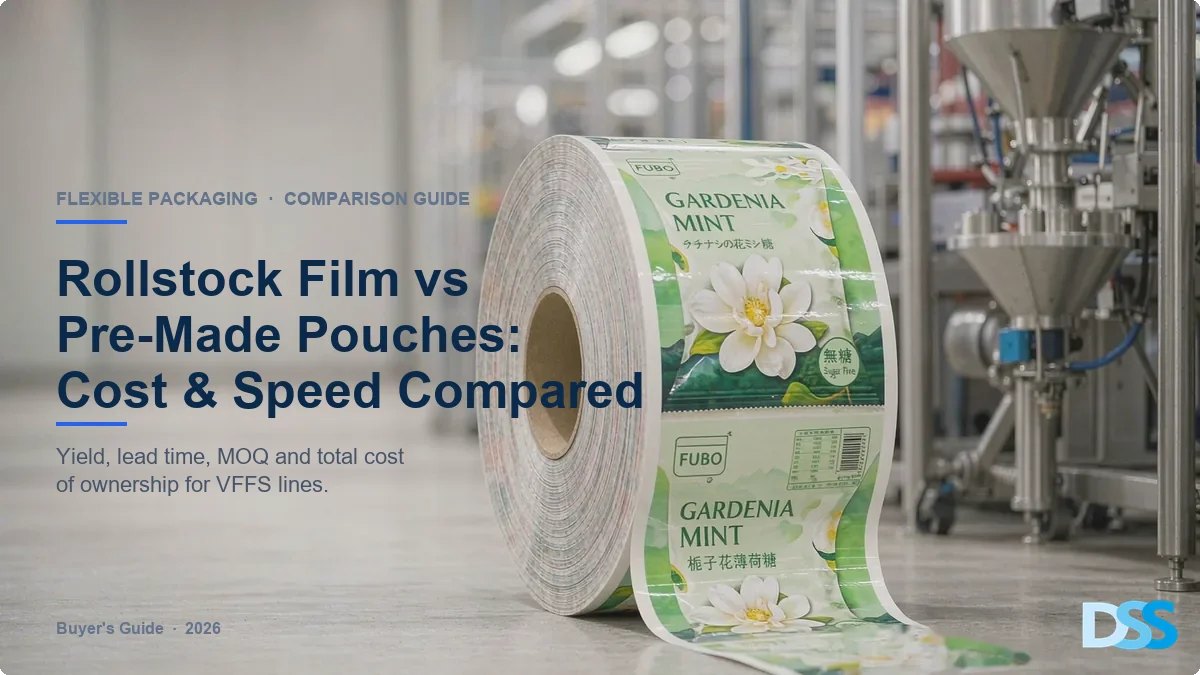
Rollstock film is a continuous web of flexible packaging material wound onto a core. It is used on form-fill-seal equipment, which forms the web into a bag, fills it, seals it and cuts it in sequence. The bag does not exist until the filling process begins.
A converter prints the artwork, laminates the selected structure and slits the film to the width required by the customer’s machine. Typical structures include BOPP/PE, PET/PE, PA/PE and metallized or coated barrier structures. The final specification must match the forming system and the product: film width, gauge, coefficient of friction, print registration and heat-seal layer position all affect machine performance.
Rollstock is therefore not simply “bags on a roll.” It is machine-specific packaging material designed to run consistently on a particular filling line. For an overview of structures, widths and printing options, see the rollstock film range.
How Rollstock Runs on Your Line
Rollstock is used on vertical form-fill-seal (VFFS) or horizontal form-fill-seal (HFFS) equipment.
VFFS
On a VFFS machine, the film passes over a forming collar and becomes a vertical tube. The machine makes the back seal, creates the bottom seal, dispenses the product, seals the top and cuts the bag.
VFFS is widely used for snacks, chips, nuts, dried fruit, granules, frozen food, powders and other free-flowing products. Its most common outputs are pillow bags and gusseted bags. Depending on the machine configuration, it can also produce certain stand-up pouch formats.
HFFS
HFFS forms the film around the product on a horizontal plane. It is suitable for shaped or solid items such as chocolate bars, cookies, biscuits and sticks. The film wraps the product, then the machine seals the longitudinal seam and the ends.
Parameters to confirm before ordering
Rollstock must be matched to the filling machine. Confirm the following with your converter:
- Film width and forming collar or former size
- Bag length and seal allowances
- Core inner diameter and maximum roll diameter
- Print repeat, registration mark and sensor requirements
- Heat-seal layer position
- Coefficient of friction range
- Product weight, density and filling method
These details help the converter supply film that runs reliably during the first machine trial. The flexible packaging RFQ checklist lists everything a converter needs to quote film that runs first time.
What Are Pre-Made Pouches?
Pre-made pouches are finished bags. They are printed, laminated, cut, sealed and inspected before shipment. On the customer’s line, the machine opens the pouch, fills it and seals the top.
Because the pouch is completed before filling, it can include features that are difficult to add inline on a standard FFS machine, including zippers, spouts, tear notches, special gussets and shaped profiles.
Common formats include:
- Stand-up pouches with a bottom gusset for shelf display
- Three-side-seal pouches for flat products and many powder applications
- Back-seal pouches for simple pillow-style packs
- Spout pouches for sauces, liquids and semi-liquid products
- Flat-bottom pouches made as pre-formed bags for a box-like profile
Pre-made pouches are filled on rotary or linear pouch machines. They are often practical for brands, co-packers and importers handling many SKUs because a product change can involve replacing the pouch stack or magazine and adjusting the guides, rather than reconfiguring a complete forming system.
Rollstock Film vs Pre-Made Pouches
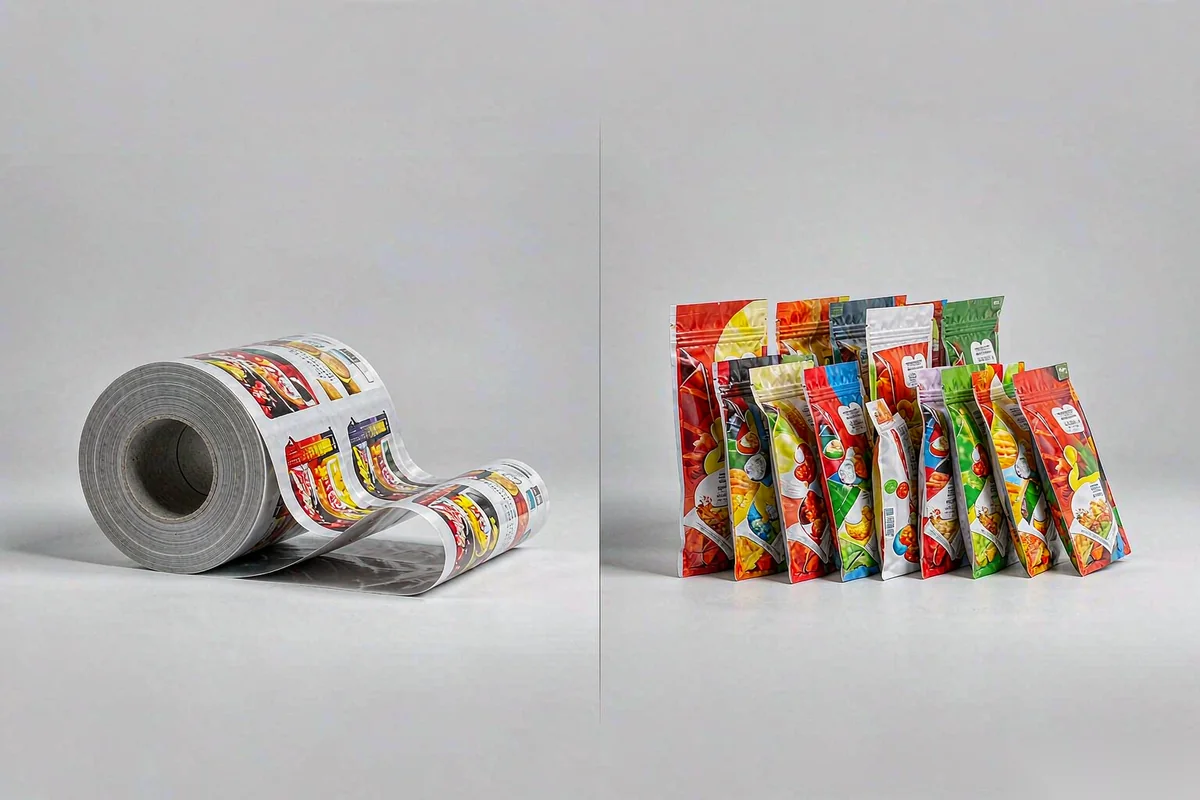
The table below summarizes the main purchasing factors. Actual performance depends on the bag size, material structure, equipment, print complexity and production volume.
| Factor | Rollstock film | Pre-made pouches |
|---|---|---|
| Unit cost | Usually lower per package at comparable volume because the bag-making step is completed inline. | Usually higher per unit because each pouch is cut, sealed and inspected before filling. |
| Filling speed | High. VFFS and HFFS lines can run from tens to hundreds of packs per minute, depending on product and machine. | Moderate. Rotary machines are faster than linear machines, but loading finished pouches adds handling. |
| Labor | Fewer manual handling steps on an automated FFS line. | More handling is usually required to load and manage finished pouches. |
| Changeover | Requires roll replacement, registration adjustment and possible former or seal adjustments. | Often faster for multi-SKU production: replace the pouch stack and adjust guides. |
| Equipment | Requires a suitable VFFS or HFFS machine. | Requires a rotary or linear pouch filling machine. |
| MOQ | Measured by weight. DSS MOQ: 300 kg per structure. | Measured by pieces. DSS MOQ: 10,000 pouches per design. |
| Warehousing | Film rolls are compact and dense for transport and storage. | Pouches ship flat but occupy more volume per finished pack. |
| SKU flexibility | Best for fewer SKUs and longer runs. | Strong for many SKUs, seasonal products and test launches. |
| Shelf presentation | Most common outputs are pillow, back-seal and three-side-seal bags. Stand-up pouches are possible with suitable equipment; flat-bottom pouches are not made from rollstock. | Supports stand-up, flat-bottom, three-side-seal, zipper and spout formats. |
| First-order cost | May include one-time gravure cylinders, roughly US$100-150 per color. | Uses the same print setup and may also include one-time cylinders. |
Rollstock rewards a stable product that can run for a long time on a dedicated line. Pre-made pouches reward variety, fast changeovers, lower equipment commitment and retail-ready formats. Many brands begin with pre-made pouches and move individual high-volume SKUs to rollstock after demand becomes predictable. For format choices inside the pre-made category, our stand-up vs flat-bottom pouch comparison covers the trade-offs in detail.
Cost per Package: Compare the Complete Picture
Rollstock pricing normally includes substrates, printing and lamination. Pre-made pouch pricing includes those same elements plus cutting, sealing, gusseting, zipper or spout application and inspection.
| Cost component | What it covers | Applies to |
|---|---|---|
| Structure and substrates | BOPP, PET, PA, PE, metallized films and coating layers | Both |
| Printing | Ink coverage, colors and registration | Both |
| Gravure cylinders | One-time tooling, roughly US$100-150 per color | Both |
| Lamination | Bonding layers for strength and barrier | Both |
| Bag making | Cutting, sealing, gusseting and feature application | Pre-made pouches |
| Freight and storage | Roll density versus pouch volume | Both |
| Line operation | Labor, machine time and changeover | Both |
Cylinder cost matters most on a small first order. For example, a six-color design may add roughly US$600-900 in tooling. Spread over 10,000 pieces, that cost is visible; spread over 100,000 pieces, its impact per package is much smaller.
Translating 300 kg of rollstock into bags
To compare a 300 kg rollstock MOQ with a piece-based pouch MOQ, estimate the number of bags it can produce:
- Film area per bag = film width × cut length.
- Film weight per bag = film area × film basis weight.
- Estimated bags = 300,000 g ÷ film weight per bag.
For a 170 × 230 mm pillow bag made from PET/PE at approximately 100 g/m²:
- Film width: approximately 360 mm, including a back-seam allowance
- Cut length: approximately 255 mm, including top and bottom seal allowances
- Film area: approximately 0.0918 m² per bag
- Film weight: approximately 9.2 g per bag
- Estimated yield: approximately 32,600 bags from 300 kg
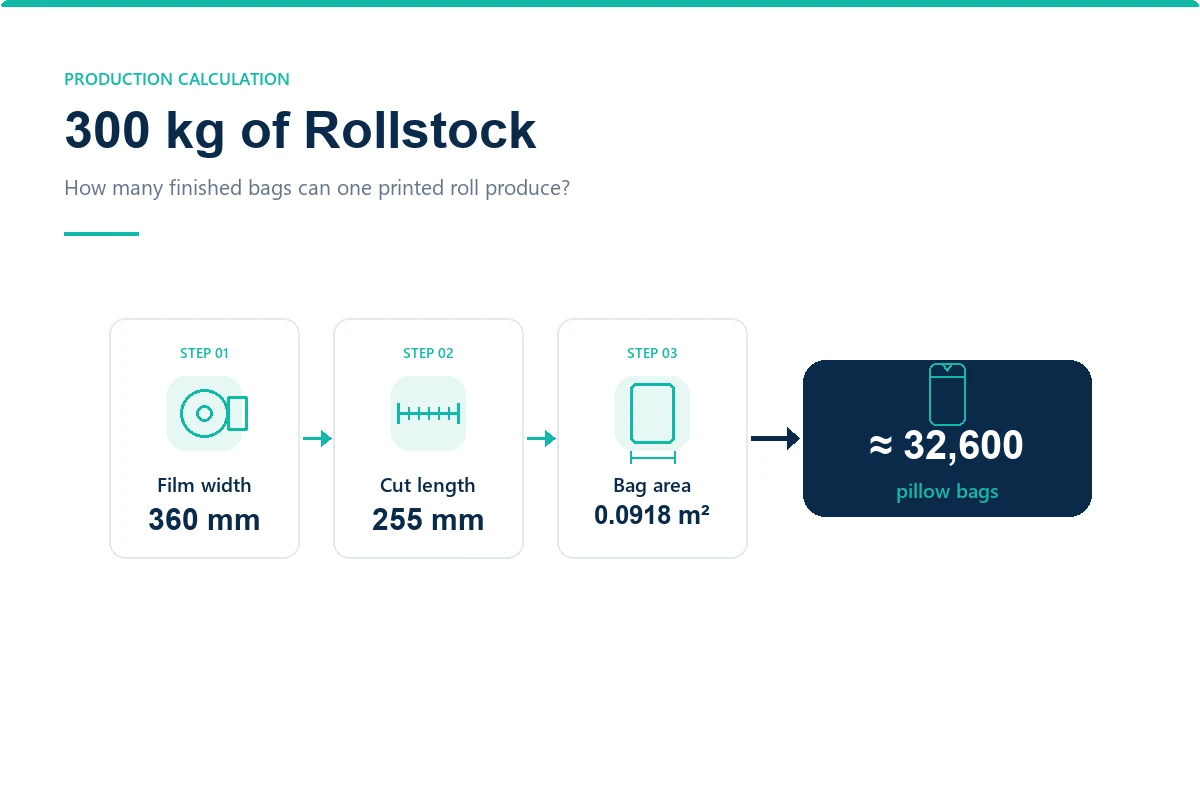
This is a planning estimate. Actual yield changes with trim, registration waste, seal allowances, roll width and the final structure. Ask the converter to confirm the expected yield on your exact specification.
Product × Format: A Decision Table
Format and structure should be chosen together. Different products fail in different ways: moisture pickup, oxygen exposure, aroma loss, oil migration, puncture or leakage.
DSS verifies barrier with MOCON instruments per ASTM D3985 for oxygen transmission rate (OTR) and ASTM F1249 for water vapor transmission rate (WVTR). High-barrier metallized PET runs at OTR ≤0.5 cc/m²·day and WVTR ≤0.5 g/m²·day (production lots measured as low as 0.46 and 0.28); AlOx-coated PET delivers OTR ≤1.5 and WVTR ≤1.0.
| Product category | Suitable formats | Typical structures |
|---|---|---|
| Snacks, chips, nuts and dried fruit | VFFS pillow or gusset at volume; pre-made stand-up pouch for retail | BOPP/PE or PET/PE; metallized PET/PE or AlOx-coated PET/PE when oxygen or moisture is critical |
| Candy and chocolate | HFFS or VFFS pillow/back-seal formats; pre-made stand-up pouch for retail presentation | BOPP/CPP; metallized PET/PE when moisture or aroma protection is needed. See high-barrier candy packaging |
| Frozen food | VFFS pillow or gusset; pre-made stand-up pouch for branded retail | PA/PE for puncture resistance and low-temperature performance. See the frozen food packaging guide |
| Soy sauce and liquid products | Pre-made spout pouch; other pre-made pouch formats where suitable | PA/PE or PET/PA/PE. The final structure may be more complex depending on the contents, aroma, filling temperature and barrier requirements |
| Powders, dry blends and spices | Pre-made three-side-seal or back-seal pouch for many SKUs; VFFS for a stable high-volume SKU | PET/PE or PET/Al/PE; choose the barrier level according to moisture sensitivity and shelf-life target |
| Mono-material recyclable request | Either format, depending on the machine and performance target | PE/PE single-material structures, subject to barrier and seal-performance trade-offs. See mono-material recyclable pouches |
These are typical starting points, not universal formulas. The contents, filling process, shelf life, sealing temperature and distribution conditions can require a different structure. A converter should confirm the structure through product trials and barrier testing.
Changeover and SKU Flexibility
Pre-made pouches often have the advantage when one line handles many products. A changeover may involve removing one pouch stack, loading another and adjusting the guides. This is useful for seasonal products, private-label production, promotions and co-packing.
Use pre-made pouches when you have:
- Many active SKUs on one line
- Short or seasonal production runs
- Frequent weekly or daily changeovers
- Different customers with different artwork
- A need for zippers, spouts or special pouch shapes
- A new product that may change after market testing
Rollstock becomes more attractive when a SKU has stable demand and long production runs. The setup cost and changeover time are then spread across more packages. The decision can be made SKU by SKU rather than for the entire product portfolio.
MOQ Economics
At DSS Pack, the MOQ is 300 kg per rollstock structure and 10,000 pieces per pre-made pouch design. These quantities should not be compared without considering bag size and material weight.
Ten thousand pre-made pouches can be suitable for a test market, seasonal launch or co-packer trial. A 300 kg rollstock order may represent tens of thousands of pillow bags, depending on the bag size and structure. It may be economical for a high-volume SKU, but it also requires a compatible FFS machine and more inventory planning.
Compare the full first-order cost:
Unit price × quantity + cylinders + freight + labor + changeover + equipment requirements
MOQ and delivery depend on the confirmed structure, print complexity and artwork approval. DSS’s fastest delivery is 15 days after order confirmation, subject to structure and print approval. For a deeper look at small-batch ordering, see our low-MOQ custom flexible packaging guide.
Shelf Presentation and Sales Channel
The default output of many rollstock lines is a pillow, back-seal or three-side-seal bag. These formats are efficient, compact and suitable for many food products, but they may not stand upright on a retail shelf.
Stand-up pouches provide a stable base and a larger front display area. They are commonly supplied as pre-made pouches, although some rollstock systems can produce stand-up pouches when the machine has the required forming and bottom-seal functions. Flat-bottom pouches are pre-made bags and are not produced from standard rollstock film.
The sales channel also matters:
- E-commerce: compact packs, durability and shipping cost may matter more than shelf display.
- Cold chain: seal integrity, puncture resistance and low-temperature performance are priorities.
- Premium retail: stand-up, zipper, spout or flat-bottom formats may justify a higher packaging cost.
How to Choose and Switch Formats
- Review the last 12 months of volume by SKU, average run length and changeover frequency.
- Define the target bag size, fill weight, structure, barrier level and print design.
- Send machine parameters with the inquiry. For rollstock, include film width, former size, core diameter, registration and COF. For pouches, include opening dimensions and filler type.
- Run a machine trial and confirm seal strength, dimensional tolerance, filling speed and appearance.
- Move high-volume winners to rollstock one SKU at a time, while keeping flexible or seasonal SKUs in pre-made pouches.
Because DSS makes both formats, the same specification can be priced and tested as rollstock film and as pre-made pouches. In many cases, the material structure can remain similar while the supply form changes.
Frequently Asked Questions
What is the difference between rollstock film and pre-made pouches?
Rollstock is a continuous web formed, filled and sealed on a VFFS or HFFS machine. Pre-made pouches are finished bags opened, filled and sealed on a rotary or linear pouch machine.
Is rollstock film cheaper?
Usually, at comparable volume, because the bag-making step is completed inline and rolls are dense to ship. The comparison should also include FFS equipment, cylinders, MOQ, labor and changeover.
Can pre-made pouches run on a VFFS machine?
No. VFFS equipment pulls a continuous film web through a former. Pre-made pouches require a pouch filling machine that opens, fills and seals each finished bag.
What are the MOQs?
DSS Pack’s rollstock film MOQ is 300 kg per structure. The pre-made pouch MOQ is 10,000 pieces per design. Delivery and final quantity depend on the confirmed structure, print complexity and approval schedule.
When should I switch to rollstock?
Consider the switch when one SKU has stable, repeatable volume, long runs and relatively few changeovers. Keep pre-made pouches for flexible, seasonal or feature-rich products.
Can rollstock film make stand-up pouches?
Some rollstock systems can produce stand-up pouches when equipped with the appropriate forming and bottom-seal functions. However, rollstock cannot produce flat-bottom pouches. In practice, rollstock is more commonly used for pillow bags, back-seal bags and three-side-seal bags.
How much does rollstock film cost?
Price depends on structure, thickness, print colors, ink coverage, quantity and freight. Gravure cylinders may add roughly US$100-150 per color. Request pricing based on the exact bag size, structure and annual volume.
More buyer questions on film, pouches, MOQ and certification are answered in the packaging FAQ.
Conclusion
Rollstock film and pre-made pouches are two supply formats for different production needs. Rollstock is usually strongest for stable, high-volume SKUs on an FFS line. Pre-made pouches are usually stronger for many SKUs, fast changeovers, retail-ready features and lower-volume launches.
The practical approach is to evaluate each SKU separately. Compare the same product specification in both formats, include equipment and operating costs, and run a machine trial before committing to a large order.
DSS Pack makes both formats in the same facility, certified ISO 9001, FDA and BRC, with the fastest delivery of 15 days after order confirmation. Send your product, target volume per SKU and line type to request a quote with both options priced side by side.