If your current pouch is built for shelf life first, switching to a mono-material recyclable pouch can create a trade-off: easier recyclability potential, but sometimes less barrier. The right answer depends on the product, the filling process, and the shelf-life target.
This guide focuses on the pouch itself. It explains which mono-material recyclable pouch structures are commonly used, how barrier is typically recovered, which snack and frozen foods are the best candidates, what the switch can cost, and what evidence you should ask for before placing an order. If you are comparing materials, our flexible packaging material guide is a useful starting point.
Key takeaways
- Mono-material pouches are usually built from one polymer family, mainly PE or PP, so they fit better into existing recycling streams than multi-layer laminates.
- PE-based structures are the most established option for flexible packaging, especially for frozen food and many dry snacks.
- PP-based structures are useful when heat resistance matters, but their recycling infrastructure is less mature in many markets.
- Barrier can be improved with thin functional layers such as EVOH or coatings, but the exact recyclability outcome depends on the total structure and the target market.
- For many products, the best next step is not a full switch, but a pilot with test data, shelf-life validation, and a clear fallback plan.
Why Mono-Material Packaging Matters in 2026
The pressure on flexible packaging has increased across retail, regulation, and brand procurement. Buyers in Europe and the UK increasingly ask suppliers to show a clear recyclability direction. In North America, store drop-off programs are still the main route for many flexible films, even when curbside collection is not available. That means brands now need packaging that is not only technically attractive, but also easier to explain and defend.
Cost is part of the same conversation. Some extended producer responsibility systems charge more for hard-to-recycle multilayer flexible packaging, while structures designed for recycling may sit in a lower fee band. Exact numbers vary by market and by program, so it is safer to treat them as directional rather than fixed. The important point is that packaging design now affects both sustainability claims and commercial cost.
That is why many brands are moving from “Should we test mono-material?” to “Which structure should we test first?”
What a Mono-Material Pouch Actually Is
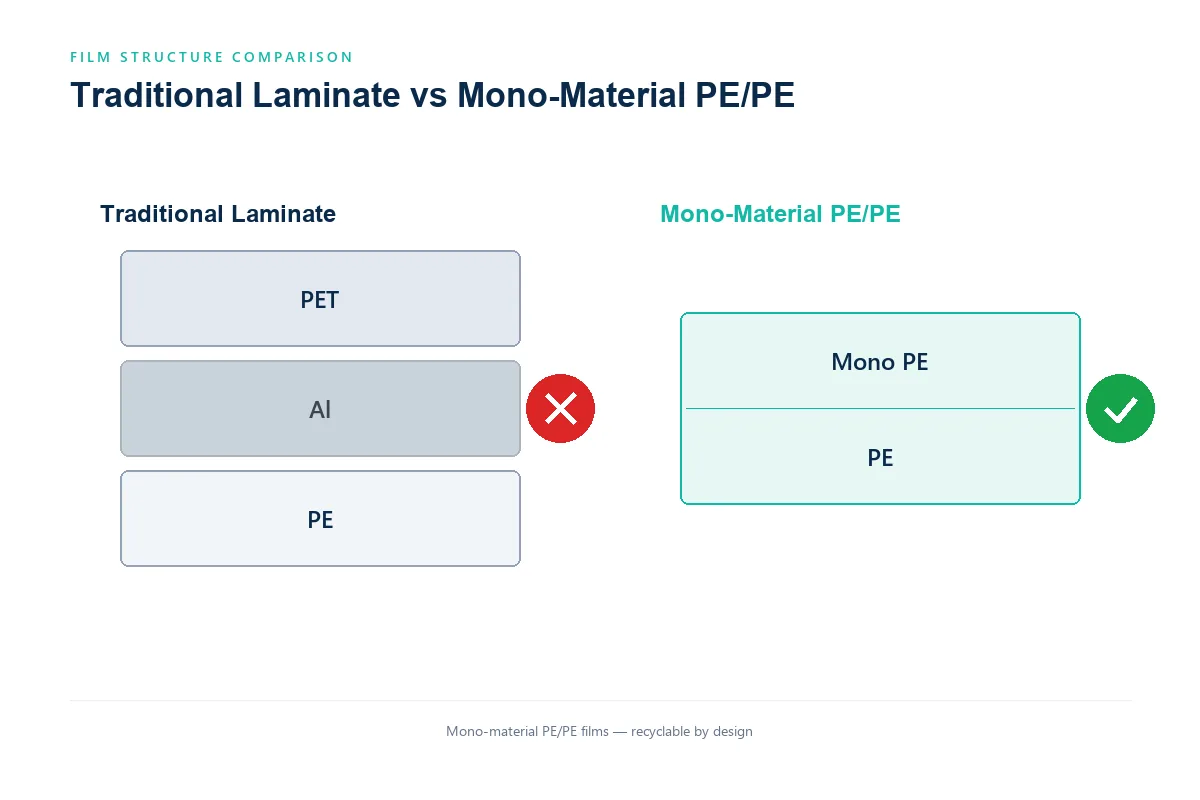
A mono-material recyclable pouch is designed so that the main body of the pack belongs to one polymer family. In practice, that usually means polyethylene (PE) or polypropylene (PP). The goal is to reduce the number of incompatible layers in the finished pouch so the package can be sorted into a more established recycling stream.
That does not mean every mono-material pouch is identical. There are several common paths:
PE/PE: the most established route
PE/PE pouches use polyethylene across the structure. They are flexible, familiar to converters, and well suited to frozen food because PE stays workable at low temperatures. For many brands, PE/PE is the simplest entry point into recyclable flexible packaging.
PP-based structures: useful when heat matters
PP-based structures such as OPP/CPP or BOPP/CPP can offer better stiffness and higher temperature tolerance. They are often considered for products that need hot-fill or retort performance. The trade-off is that PP recycling for flexible packaging is less mature in many markets, so the best structure depends on where the pack will be sold.
Barrier layers and coatings
Mono-material does not mean barrier disappears. Thin functional layers such as EVOH, or coatings such as SiOx or AlOx, are often used to improve oxygen or moisture protection. In some design-for-recycling frameworks, the allowed amount of these non-base layers is limited, so the exact weight percentage matters.
In practical terms, this means two things:
- You should ask for the full layer breakdown, not just the marketing name.
- You should test the exact structure you plan to use, because small changes in sealant, barrier, or thickness can change performance.
Barrier vs Recyclability: What Usually Changes
The most common reason brands hesitate is shelf life. Traditional high-barrier laminates can perform extremely well, especially for oxygen-sensitive snacks or products with long ambient shelf-life requirements. Mono-material candidates can still work, but the product must fit the barrier available.
| Structure | Typical Barrier Level | Recycling Position | Best Fit | Notes |
|---|---|---|---|---|
| Metallized PET laminate | Very high | Not a mono-material solution | Long-shelf snacks, candy | Strong barrier, but multi-layer construction limits recyclability compatibility |
| AlOx-coated PET | Very high | Not a mono-material solution | Premium transparent snacks | Transparent ceramic barrier; OTR ≤1.5 cc/m²·day, WVTR ≤1.0 g/m²·day (DSS specification) |
| PE/PE base structure | Low to medium | Better aligned with PE film recycling | Frozen vegetables, low-sensitivity snacks | Usually the simplest mono-material route |
| PE/PE with EVOH | Medium | Can be compatible in some design-for-recycling systems, depending on total structure | Mid-shelf snacks, nuts, cereals | Barrier improves, but the EVOH share must be checked carefully |
| MDO-PE / EVOH / PE | Medium to high | Often positioned as recyclable when designed within guidance limits | Longer-shelf snacks, nuts, some dry foods | Good balance of barrier and processability |
| PP-based mono structure | Medium to high | Relevant for PP recycling streams where available | Hot-fill, retort, chocolate-adjacent applications | Better heat resistance, but market infrastructure matters |
The right conclusion is not that mono-material is always better or always worse. It is that the structure must match the product. A dry snack with moderate shelf-life may work well in a recyclable pouch. A high-fat chip with a demanding oxygen target may need more testing. A frozen product may be a cleaner fit because low-temperature storage reduces some of the packaging stress.
Which Snack Products Can Switch Today
For snacks, the product’s sensitivity profile matters more than the category name. Oil, oxygen, aroma loss, and moisture pickup all affect the result. Before changing the pack, answer three questions:
- What shelf life do you need in the real market, not only in the lab?
- Is the main risk oxygen, moisture, oil migration, or aroma loss?
- Will the pouch run on the current filling line without major process changes?
| Category | Traditional Structure | Mono-Material Option | Switch Today? | Main Watch-Out |
|---|---|---|---|---|
| Chips / extruded snacks | Metallized PET/PE | MDO-PE / EVOH / PE | Depends | Often needs nitrogen flush and careful shelf-life testing |
| Nuts / roasted nuts | Metallized PET/PE | MDO-PE / EVOH / PE | Yes, often | Oxidation control is critical |
| Cereal / granola | PET/PE | PE/PE or PE/PE with barrier support | Yes | Usually a good fit for recyclable flexible packaging |
| Hard candy / tablets | PET/Al/PE | PE/PE or PP-based structure | Depends | Moisture sensitivity varies by product |
| Chocolate | Metallized or high-barrier laminate | PP-based or other mono-material option | Usually difficult | Heat, aroma, and bloom risk often remain high |
| Jerky / dried meat | High-barrier laminate | MDO-PE / EVOH / PE | Yes, with testing | Oxygen and aroma control matter |
| Popcorn | PE or PP laminate | PE/PE | Yes | Typically a straightforward switch |
| Biscuits / cookies | PET/PE | PE/PE with barrier support | Yes | Product sensitivity is usually manageable |
Dry and low-fat snacks are the easiest place to start. Products with moderate barrier demand can often move to a recyclable stand-up pouch, especially when combined with nitrogen flushing and proper sealing control. If your format is still under discussion, our stand-up vs flat-bottom pouch comparison can help narrow the choice.
For many brands, a recyclable stand-up pouch is the first candidate because it is familiar to consumers, easy to merchandize, and suitable for zippers or tear notches. For some smaller packs, a 3-side-seal pouch may be more efficient.
Which Frozen Products Can Switch Today
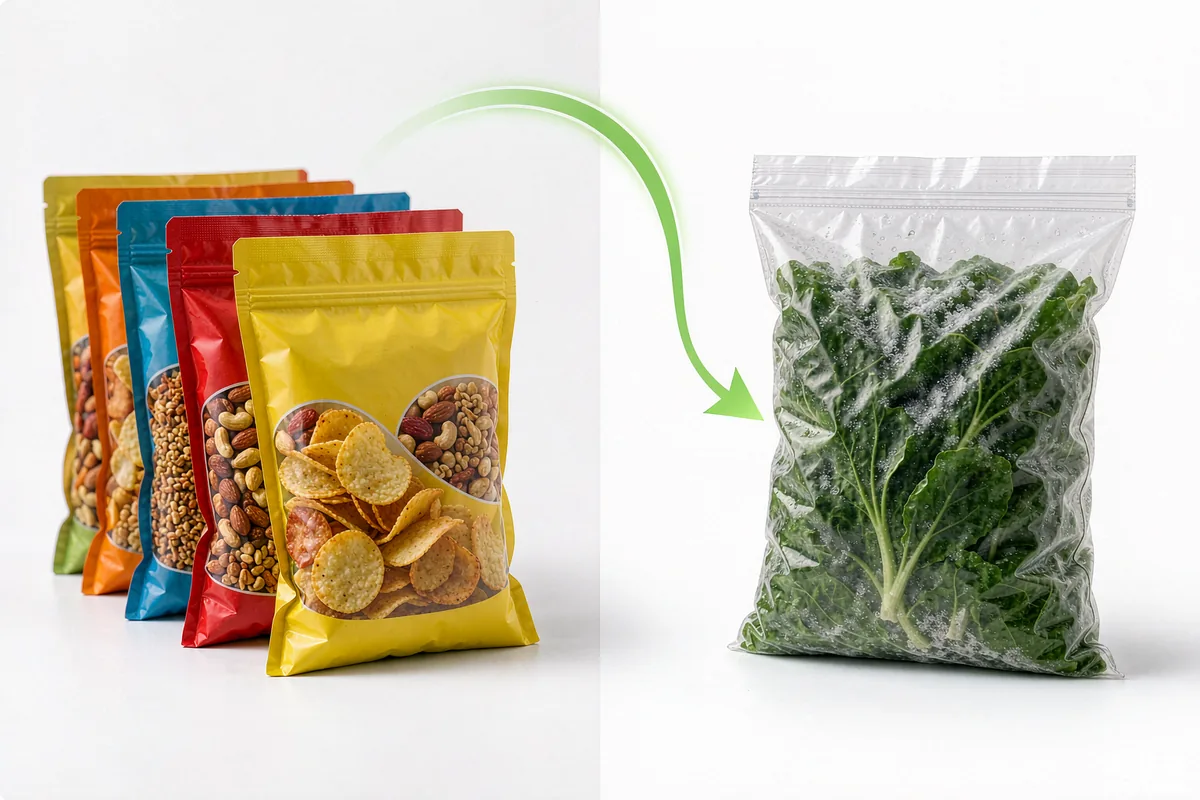
Frozen food is often a better fit than ambient snacks because the product is already stored at low temperature. That lowers some of the stress on the packaging and creates more room for PE-based structures.
| Category | Traditional Structure | Mono-Material Option | Switch Today? | Main Watch-Out |
|---|---|---|---|---|
| Frozen vegetables | BOPP/PE or mixed PE structures | MDO-PE / LDPE or PE-based mono structure | Yes | Moisture and freezer burn control |
| Frozen fruit | PET/PE | PE/PE with barrier support | Yes | Color and oxidation protection |
| Frozen fish / shrimp / bone-in meat | PA/PE or PA-based laminate | PE-based mono structure | Difficult | Puncture resistance and impact at low temperature |
| Frozen dumplings / spring rolls | BOPP/PE | PE/PE or MDO-PE / PE | Yes | Puncture resistance |
| Frozen ready meals | PET/PA/PE or RCPP laminate | PP-based mono structure | Depends | Retort or hot-fill conditions change the answer |
| Frozen bakery / pizza | Mixed laminates | PE/PE or PP-based structure | Depends | Oil and moisture exposure |
Frozen vegetables are often the cleanest win. If the current pack is already PE-dominant, a move to a more consistent PE-based structure may not require a dramatic process change. A recyclable rollstock film is often a good fit for form-fill-seal applications, while back-seal pouches can work for larger frozen packs. For process-specific advice, see our frozen food packaging guide.
Recyclability Labels and What They Really Mean
Recyclability claims should be treated carefully. A pouch may be designed for recycling in one framework but still have limited practical recycling access in a specific market. That is why the label, the design guidance, and the actual collection route all matter.
CEFLEX D4ACE
CEFLEX D4ACE is a widely referenced European design-for-recycling guideline for flexible packaging. It focuses on structure, weight share, density, inks, and adhesives. If your market is Europe, this is one of the first documents to review.
RecyClass
RecyClass provides design-for-recycling guidance and recyclability assessment protocols. It is especially relevant when you want a more formal view of PE films that include thin barrier layers such as EVOH.
How2Recycle
In the US and Canada, How2Recycle is often the most visible consumer-facing label system. For flexible packaging, the Store Drop-Off route is still a key reference point, but actual participation varies by region.
OPRL and local schemes
The UK uses OPRL guidance, and the final label depends on what local collection systems accept. In other words, the same pouch can be technically compatible with a recycling stream but still carry a different consumer label depending on market access.
The practical lesson is simple: always ask which market the claim refers to, and ask for the supporting assessment, not only the marketing summary.
What the Switch Usually Costs
There is no single price for a mono-material pouch. Costs depend on thickness, barrier, print coverage, order size, and target market. Still, the main cost buckets are predictable.
Material premium. A mono-material structure may cost more than a comparable conventional laminate, especially in pilot quantities or when barrier needs are high. Simple PE/PE often sits closer to parity, while structures with EVOH or more complex process requirements can sit higher.
Tooling. Printing cylinders or plates create one-time setup cost. This matters most in small runs, but it is usually manageable if the print design is stable.
Fees and compliance. In some markets, harder-to-recycle structures may face higher fees or less favorable reporting. That can offset part of the material premium, but the exact balance depends on your sales regions.
Testing. This is the cost many teams underestimate. The cheapest switch is the one that is validated before scale-up. Ask for OTR and WVTR on the exact structure, then confirm that the pouch performs on your own line.
If you want to reduce risk, start with a low-MOQ pilot. Our low-MOQ custom flexible packaging guide explains how small-batch ordering works in practice.
A Practical Transition Path
The safest way to switch is to treat it as a test program, not a one-step rebrand.
- Define the product requirements: shelf life, filling method, and storage conditions.
- Shortlist one or two candidate mono-material structures.
- Request structure-specific test data, not just a generic performance table.
- Run a small line trial and compare the result to your current packaging.
- Confirm shelf life with real product testing before scaling.
This approach is especially useful when the product sits near the boundary between “easy switch” and “possible but not guaranteed.”
FAQ
Is a mono-material pouch recyclable everywhere?
No. A mono-material pouch can be designed for recycling, but actual recycling depends on the collection and sorting systems in your market. Always check whether the target region has access to the relevant stream.
PE or PP: which is better?
PE is usually the safer choice for frozen food and many dry snacks because it is flexible and has broader recycling familiarity. PP is often better when heat resistance matters. The right answer depends on product and process, not on a general rule.
Can I replace PET/Al/PE without losing shelf life?
Sometimes. Many dry snacks and some frozen products can move to a mono-material structure with acceptable shelf-life results. High-fat or very sensitive products need more testing, and some will still require a high-barrier laminate.
What data should I ask a supplier for?
Ask for the full layer structure, OTR and WVTR on the exact pack, the EVOH percentage if used, seal performance, and any recyclability assessment tied to the market you sell into.
Conclusion: Test First, Then Switch
Mono-material is not a universal answer, but it is now a practical option for many snack and frozen food brands. PE/PE works well for simpler products and frozen applications. MDO-PE with thin barrier support can help bridge the gap for more demanding ambient snacks. PP-based structures can be useful where heat resistance matters.
The most reliable path is to test the exact structure, confirm shelf life, then scale only after the results are proven.
Request a test-data-backed quote or send your product spec and target shelf life. We can help review the structure, test the barrier, and choose the pouch format before you commit to full production.