Open two snack bags and you may find two different codes printed near the seal. One reads PET/AL/PE. The other reads BOPP/PE. Both are flexible packaging. Both protect food. Yet they behave nothing alike in a humidity chamber, on a filling line, or at end of life.
This guide is about reading those codes and the reasoning behind them. We cover how a flexible packaging structure is assembled, what each layer does, how to read a code such as PET/AL/PE, why OTR and WVTR differ, and our own MOCON tests comparing two finished laminates with different barrier webs.
DSS Pack is a flexible packaging manufacturer certified to ISO 9001, FDA and BRC. Rather than describe barrier performance in adjectives, we publish our test numbers — and the reports behind them.
Key Takeaways
- A flexible packaging structure is layers bonded into one film; the code reads outside-in and the last layer is the sealant.
- In a flexible packaging structure, each layer is selected for functions such as printability, barrier, strength or sealing; in many applications, no single uncoated film covers all of them.
- Barrier is two numbers: OTR for oxygen (23 °C, 0% RH) and WVTR for moisture (38 °C, 90% RH). A structure can be strong on one and weak on the other.
- Two structures sharing a 40 µm CPP inner layer differed sharply: the AlOx web transmitted about one-eighth the oxygen and one-sixth the water vapour of the K-PET web.
- “High barrier” without a transmission value and test conditions is not a specification.
Why a Flexible Packaging Structure Is Built in Layers
No single uncoated film does everything a package needs. PET prints cleanly and tolerates heat, but does not normally heat-seal on its own. PE seals easily and, correctly specified, can provide a suitable food-contact sealant — but gives limited oxygen barrier. Aluminium foil provides very high barrier when intact, but is vulnerable to flex damage.
Laminating solves this: bond films with different strengths into one sheet, and each layer covers the others’ weaknesses — which is why layer order matters as much as the materials.
A flexible packaging structure, then, is that ordered stack: a printable surface, a barrier against oxygen, moisture and light, strength, and a seal that keeps the pack closed.
For individual film types, see our film types reference; this page covers how materials are combined and how to read a structure.
How to Read a Laminate Structure Code
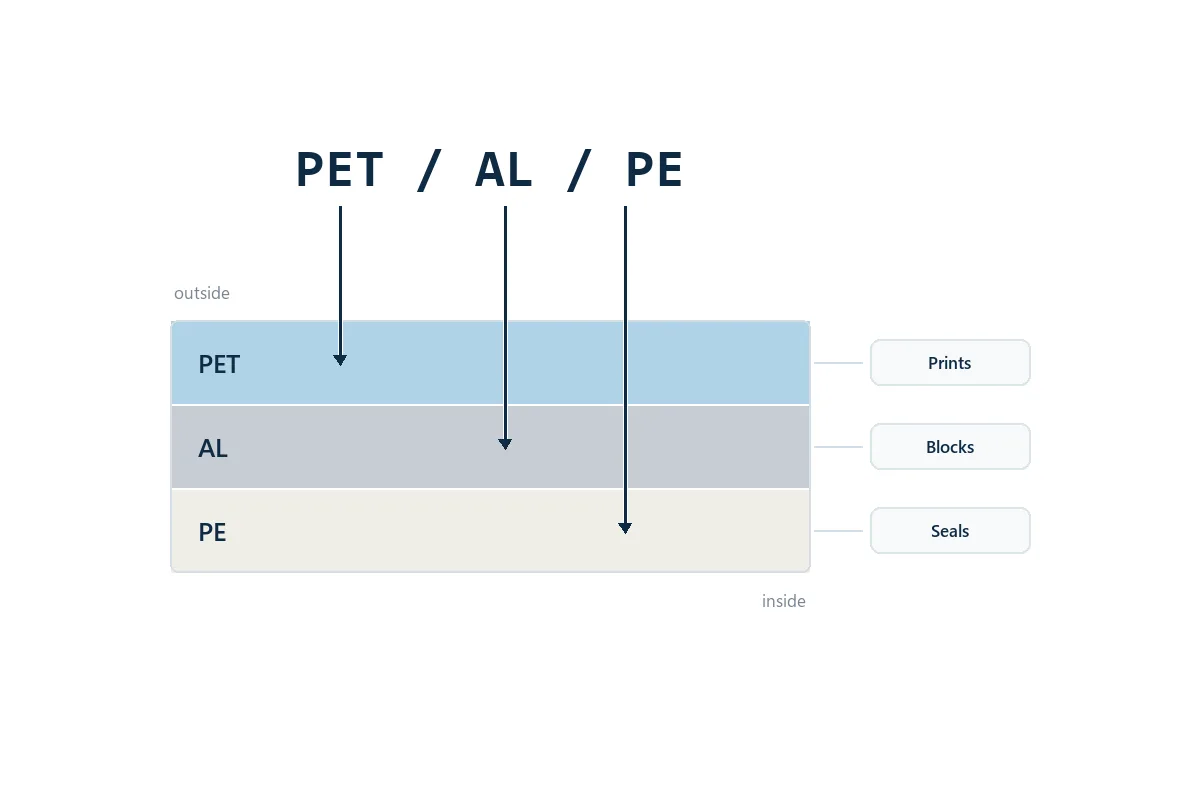
A flexible packaging laminate structure code is a shorthand: the layers listed in order, separated by slashes.
Read Outside-In
The first material after the slash is the outside of the pack, the last is the inside. In PET/AL/PE, PET faces the shopper, AL sits in the middle, and PE faces the product. A thickness, usually in micrometres (µm), applies to that film.
Reading outside-in mirrors how the pack is built: the outer film is chosen for print and handling, the inner film for sealing and product contact.
Worked Examples
| Code | Reading it outside-in |
|---|---|
| PET/AL/PE | Polyester print web / aluminium foil barrier / polyethylene sealant. A classic high-barrier ambient structure. |
| PET/VMPET/PE | Polyester print web / metallized PET barrier / PE sealant. Lighter than foil; common in snacks and coffee. |
| BOPP/PE | BOPP print web / PE sealant. An economical two-layer structure for short shelf life. |
| PA(NY)/PE | Nylon / PE sealant. Nylon adds toughness and puncture resistance; common for frozen and vacuum packs. |
| PET/PA/PE | Polyester print web / nylon strength / PE sealant. Print quality plus high puncture resistance. |
Codes Tell You How It Seals
The last layer is the sealant, and it sets two things: the seal temperature your line will run (PE seals at lower temperatures than cast polypropylene, CPP), and what the film seals to — a sealant seals to itself. If two structures look similar but seal differently, the answer is in the last layer.
What Each Layer Actually Does
Every flexible packaging structure has functional layer positions, plus hidden ones the code never shows.
Outer Layer — Print Web
The outer layer carries the artwork and takes the most abuse — usually PET, BOPP or MOPP, films that hold print registration, resist scuffing and stay stable through heat.
Barrier, Strength & Functional Layers
Aluminium foil, metallized PET, AlOx-coated PET, K-PET and EVOH slow oxygen and moisture by different mechanisms; nylon (PA) adds toughness, and light-blocking or stiffness can also come from these layers. Barrier does not always sit in a separate middle web: it may be a coating on the reverse side of an outer PET web, an internal layer, or part of a coextruded sealant-side structure.
K-PET is one example of a coated barrier web, and buyers often mistake it for other coated PET films. K-coated PET (K-PET) is a PET base film carrying a PVDC (polyvinylidene chloride) coating: the base is PET, the coating is PVDC, and it is the coating — not the base — that provides much of the barrier function.
Inner Layer — Sealant
The inner layer is the sealant, usually PE or CPP. It must heat-seal reliably at line speed, survive contact with the product, and meet FDA food-contact requirements.
The Layers the Code Hides
The code does not show adhesive, tie layers, ink or coatings. Adhesive bonds the films and can affect seal strength and aroma; a tie layer joins materials that do not naturally stick. When two suppliers quote the “same” PET/AL/PE at very different prices, the difference is usually in these hidden layers.
How Many Layers Does a Flexible Packaging Structure Need?
More layers are not automatically better. Two are enough when the product is dry, shelf life is short and distribution is gentle.
Each extra layer buys something specific. A coated barrier layer buys oxygen and moisture protection. Nylon buys puncture resistance and flex-crack tolerance, which matters for frozen and vacuum-packed food (our frozen food packaging guide covers PA(NY) structures). A third structural layer can buy stiffness or better print.
Each layer also costs weight, material, converting steps and harder recycling. The useful question is not how many layers you can get, but which job the product is failing at.
High-Barrier Principles: OTR vs WVTR, and Why a Film Can Be Good at One
OTR vs WVTR, Defined
OTR is the oxygen transmission rate: how much oxygen passes through an area of film per day. WVTR is the water vapour transmission rate: how much moisture passes, also per area per day.
The conditions differ deliberately. OTR runs at 23 °C and 0% RH, on a dry film; WVTR runs at 38 °C and 90% RH, because moisture moves along a humidity gradient.
The numbers are not interchangeable: oxygen and water molecules interact differently with each polymer, so some films pass oxygen readily but resist moisture, and others do the reverse. That is why a structure strong on OTR can still be mediocre on WVTR — and why a high barrier film gets two numbers and their conditions, not one adjective.
Barrier Mechanisms Compared
Which barrier film should you specify for ambient food packaging? The table below compares the options most often chosen.
| Barrier option | How it blocks | Strengths | Watch-outs |
|---|---|---|---|
| Metallized PET (VMPET) | Thin vacuum-deposited aluminium layer | Strong light, oxygen and moisture barrier; cost-effective | Flex-cracking can reduce barrier |
| AlOx-coated PET | Ceramic aluminium-oxide coating | Transparent barrier in suitably designed laminates | Coating can be brittle; retort suitability must be validated for the specific coating, laminate and retort process |
| K-coated PET (K-PET) | PVDC coating on a PET base film | Good moisture barrier with moderate oxygen barrier, all in a clear film; a transparent alternative where PP or PVC would otherwise be used | Grade varies by supplier; verify with data |
| EVOH | High oxygen-barrier polymer | Excellent oxygen barrier when dry | Moisture-sensitive; must sit between moisture-resistant layers |
| Aluminium foil | Continuous metal layer | Near-absolute barrier while intact | Pinholes, flex-cracks and seal failures defeat it |
Why Flex-Cracking & Pinholes Matter
A lab transmission value is measured on a flat, undamaged sample. A finished pack is formed, filled, sealed, dropped and shipped: foil cracks, thin coatings develop pinholes, and seal creases leak. Real performance is lower than the flat-film number, so validate the finished pack. See our work on high-barrier coffee packaging and high-barrier candy packaging for examples.
Mono-Material vs Multi-Layer: The Recyclability Trade-Off
Mono-material packaging is generally designed around one main polymer family, typically PE or PP. It can improve compatibility with relevant recycling streams, but it is not automatically recyclable everywhere: local collection, sorting and recycling infrastructure all matter. Such structures may also include limited compatible functional layers, tie layers or coatings. Many dry foods and biscuits can work well in mono-PE or mono-PP designs.
The trade-off is often performance. Mono-material designs may have lower barrier or heat resistance than a conventional PET/foil/PE combination, so very oxygen-sensitive, retort or long-life products may still require a more complex laminate.
The final choice should be evaluated against the target market’s collection and recycling system as well as product-protection needs. If recyclability is the priority, our guide to mono-material recyclable pouches and our overview of PPWR compliance — the EU Packaging and Packaging Waste Regulation — explain how to design around the constraint.
Same CPP Inner Layer, Two Barrier Webs: What Our MOCON Test Data Shows
What We Tested and How
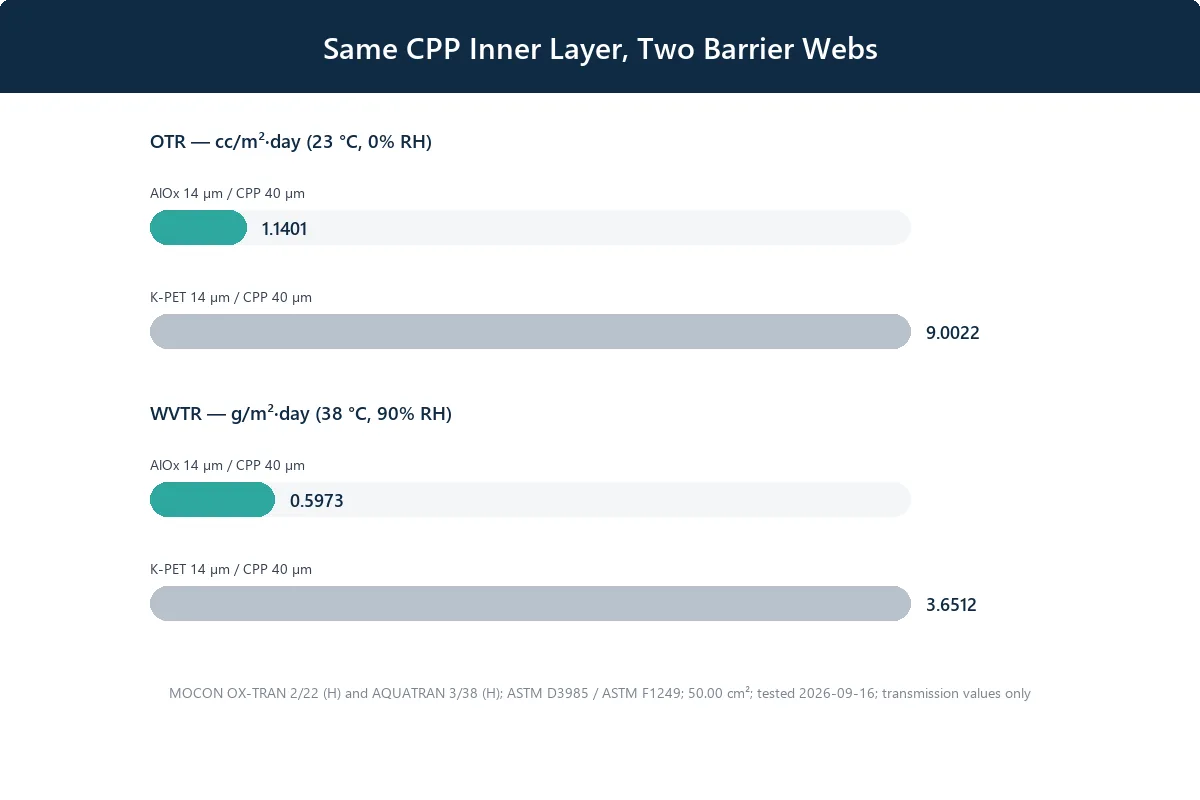
On 16 September 2026 we tested two laminated films with the same 40 µm CPP inner layer. One used a 14 µm AlOx-coated PET web, with the AlOx coating located within the laminate rather than on the package exterior; the other a 14 µm K-coated PET (K-PET) web, a PET base with a PVDC coating. Both were measured on MOCON equipment under identical conditions. With the CPP layer and test conditions held constant, the results indicate that the different barrier webs were the primary driver of the measured difference.
These two films are the only ones tested here. Other barrier films named on this page are reference options, not part of these results.
The Numbers
| Structure | OTR (23 °C, 0% RH) | WVTR (38 °C, 90% RH) |
|---|---|---|
| AlOx 14 µm / CPP 40 µm | 1.1401 cc/m²·day | 0.5973 g/m²·day |
| K-PET 14 µm / CPP 40 µm | 9.0022 cc/m²·day | 3.6512 g/m²·day |
OTR measured on a MOCON OX-TRAN® 2/22 (H), OX-TRAN Test IDs 1981 (AlOx) and 1980 (K), sample area 50.00 cm², test gas and carrier gas 0% RH at 23.0 °C. WVTR measured on a MOCON AQUATRAN® 3/38 (H), AQUATRAN Test IDs 1971 (AlOx) and 1970 (K), test gas 90% RH at 38.0 °C. Values are Transmission rates (OTR/WVTR) only. Tested 2026-09-16; internally reported results, provided as a same-conditions comparison.
What the Numbers Mean
The AlOx structure transmitted roughly one-eighth the oxygen and one-sixth the water vapour of the K-PET structure. Because the CPP layer and test conditions were the same, the comparison indicates a substantial barrier-performance difference between the tested laminate constructions. The result applies to the tested samples only, not as a specification for every AlOx or K-PET film.
For a comparison like this against your own product, send us your product details and target shelf life and we can propose a test plan.
What Was Tested (and What It Was Not)
These figures were measured on finished laminated film: barrier web, adhesive and CPP inner layer tested as one structure. That is not the same as a standalone (single-film) test, which measures one film by itself. In a finished laminate the permeation path runs through the coating, substrate, adhesive and inner film.
So a meaningful comparison holds the structure and conditions constant, changes one variable only, and does not line up numbers from different test objects. Thickness and transmission rate are different data points: the thickness field in a test report is an instrument input, not the physical gauge of the finished laminate, while OTR and WVTR describe measured transmission under stated conditions. Compare OTR and WVTR only when method, conditions, sample type and units are stated.
How to Run This Comparison for Your Own Product
Ask for this comparison before you commit to a print run. Four steps:
- Define product sensitivity. Which factors limit shelf life: oxygen, moisture, light or aroma loss? A dry biscuit and an oily nut have different enemies.
- Set a barrier target. Turn that sensitivity into an order of magnitude for OTR and WVTR, from your shelf-life goal and distribution.
- Ask for a controlled like-for-like comparison. Keep the sealant, adhesive system, coating orientation and conditions fixed where possible, change one barrier variable, and request the numbers with their conditions — ASTM D3985 for OTR, ASTM F1249 for WVTR.
- Validate on your own filling line. A lab result does not test a seal contaminated by product, so run your own fill and seal trial before approving.
We keep MOQ flexible and ship in as little as 15 days after confirmation, so you can test a structure in a real run without committing to a container load.
A Decision Framework for a Flexible Packaging Structure
The sequence is always the same: product sensitivity, the barrier it implies, the layers that deliver it, and the format that fits line and shelf.
| Product sensitivity | Barrier target (indicative) | Structure direction | Format options |
|---|---|---|---|
| Dry, short shelf life | Low oxygen and moisture demand | 2-layer, e.g. BOPP/PE or PET/PE | Printed rollstock film, 3-side seal |
| Oxygen-sensitive, ambient | Moderate-to-high OTR target | Metallized PET or AlOx barrier in a 3-layer structure | Stand-up pouch, flat-bottom pouch |
| Highly oxygen and moisture sensitive | Low OTR and WVTR target | AlOx or foil barrier, or EVOH between moisture barriers | Stand-up, flat-bottom, spout pouch |
| Frozen or vacuum | Strength and flex-crack resistance | PA(NY) in the structure, e.g. PA/PA/PE | Rollstock, vacuum pouches |
Barrier targets here are indicative, not specifications; confirm them against your product and a test report. If you are weighing how to receive the film, our comparison of rollstock film vs pre-made pouches covers that.
What to Ask a Supplier About “High Barrier”
“High barrier” is a description, not a specification. Without a number and a test condition, it tells you nothing you can design against. Five questions:
- Which test was used? Ask for the standard, such as ASTM D3985 for OTR or ASTM F1249 for WVTR.
- Under what conditions? Temperature and relative humidity change the result, so a number without them means little.
- What is the transmission value? Ask for the OTR and WVTR figures themselves, not a description.
- Was the comparison made on the same inner layer? If two structures differ in more than one variable, you cannot tell what caused the difference.
- Can you re-test under our conditions? A supplier who can repeat the test for your product beats one forwarding a generic data sheet.
Our flexible packaging RFQ checklist turns these into a document to send with your enquiry.
FAQ
What does a structure code like PET/AL/PE mean?
A structure code lists the layers of a laminate from outside to inside. PET/AL/PE means a polyester print web outside, an aluminium foil barrier in the middle, and a polyethylene sealant inside facing the product.
What is the difference between OTR and WVTR?
OTR measures oxygen passing through a film per area per day at 23 °C and 0% RH; WVTR measures water vapour at 38 °C and 90% RH. The conditions differ because the tests measure different processes, so the values are not directly comparable.
What is K-coated PET (K-PET) made of?
K-PET is a PET base film coated with PVDC (polyvinylidene chloride). The base film gives strength and printability; the PVDC coating gives the barrier. It is a clear film often used where a metallized or foil layer would block visibility.
How many layers does a flexible packaging structure need?
As many as the product requires, and no more: layer count follows product sensitivity, shelf-life target and distribution. A dry snack may need two layers; an oxygen-sensitive or frozen product may need three or more.
Is a mono-material pouch as protective as a multi-layer laminate?
For many dry products, a well-designed mono-material structure can meet the required protection level. For very oxygen-sensitive, retort or long-life products, a more complex laminate may provide stronger protection. Actual performance depends on the complete structure and the product’s shelf-life requirements.
Why did two structures with the same inner layer give such different numbers?
Barrier is a property of the whole stack, and the barrier web can have a major effect. In our same-conditions tests, the two constructions showed an approximately eight-fold difference in oxygen transmission. You can find more answers on our packaging FAQs page.
What This Means for Your Pack
Reading those two bags now comes down to four decisions: which film prints, which blocks, which strengthens, and which seals. Reading the code tells you what a supplier chose; OTR and WVTR tell you whether those choices fit your product; and a same-inner-layer comparison tells you whether one structure genuinely outperforms another or only looks different on paper.
If you have the product sensitivity, we can help with the structure. Get a quote with your product type, fill weight and target shelf life, and we will return a recommended structure and, where it helps, supporting test data. For a smaller first run, see our low-MOQ custom flexible packaging guide.
Test Report Appendix
One page summarises the four MOCON tests; the four reports follow with full test conditions and instrument details.
- Barrier test summary — AlOx vs K-PET, OTR and WVTR (PDF)
- MOCON OTR test report — AlOx 14 µm / CPP 40 µm (PDF)
- MOCON WVTR test report — AlOx 14 µm / CPP 40 µm (PDF)
- MOCON OTR test report — K-PET 14 µm / CPP 40 µm (PDF)
- MOCON WVTR test report — K-PET 14 µm / CPP 40 µm (PDF)
These reports are redacted copies; unredacted versions are available on request.