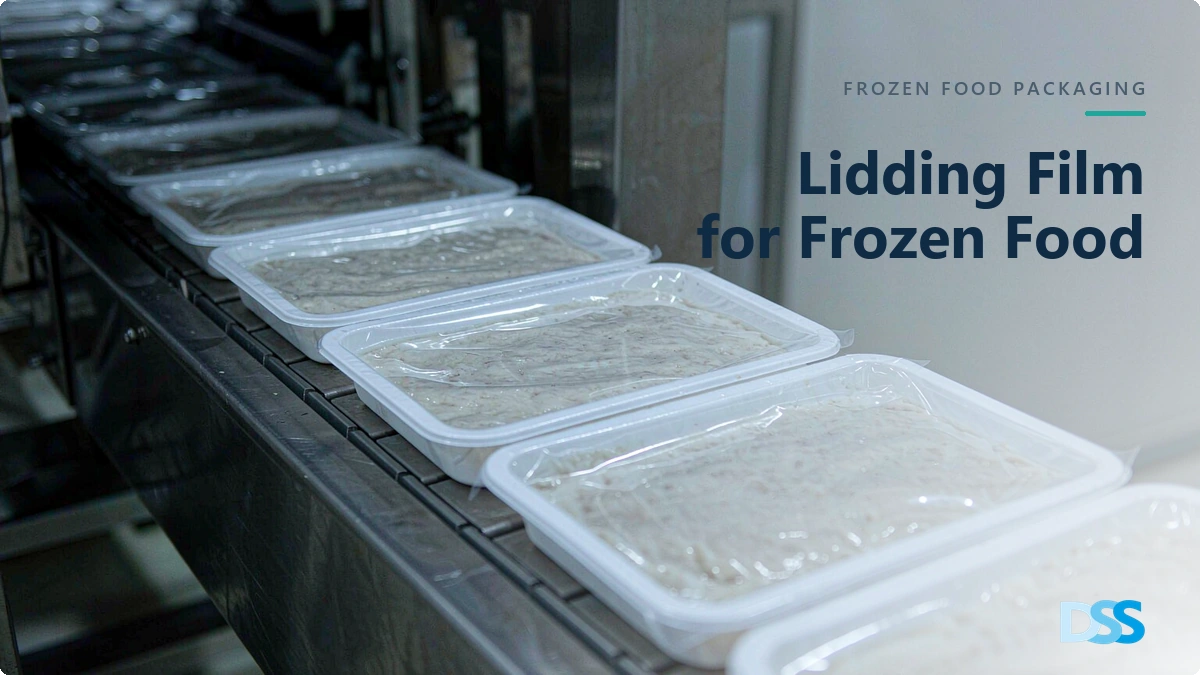
Lidding film for frozen food is a film lid heat-sealed to a tray flange. The tray-and-lid pack must suit its product, cold chain, handling conditions and opening requirements. For many frozen tray applications, seal integrity and cold handling deserve as much attention as barrier performance.
Consider a common pattern, not a specific customer: trays come back from a −30 °C distribution centre with leaks at the same corner of the flange. The line passed its leak test at 23 °C, but the returned packs were never assessed under the same cold conditions.
If packs fail in distribution, reviewing barrier and film thickness alone may miss the cause. This guide covers film structures, peel force and cold validation, alongside our wider frozen food packaging guide.
Key Takeaways
- Evaluate seal integrity and barrier for the actual product and shelf life. Cold storage and distribution can change both.
- Common structures include PET/PE, PET/PP and PA/PE laminates. Suitability depends on the tray, sealant, line and use conditions.
- Peelable versus weld is a performance choice. Specify a target force, test method and test conditions.
- Match the sealing layer to the tray’s sealing surface. PP, PET, CPET, PS and EPS trays may need different compatible grades.
- Validate the finished pack under relevant conditions. ASTM F88 measures seal strength; pick a leak test whose scope fits the construction.
What a Lidding Film Actually Does on a Frozen Line
A lidding film closes a tray: reel-fed, cut to the flange geometry and heat-sealed around the perimeter. The pack needs a continuous seal and an opening that suits the user.
Lidding film vs rollstock vs pre-made pouch
- Lidding film seals onto a tray that already exists: the tray carries the shape, the film forms the lid.
- Rollstock film is reel-fed on form-fill-seal equipment, where the pack is formed from the film itself.
- Pre-made pouches arrive finished and are filled through an opening.
Tray-plus-lid packs suit many frozen ready meals, including products reheated in the tray. See rollstock film vs pre-made pouches.
Still deciding? Our frozen food packaging solutions page compares the formats.
Four frozen categories that use tray lidding
- Frozen ready meals: sauces and reheating instructions shape the tray, lid and seal requirements.
- Frozen meat and seafood: bones and sharp edges raise puncture and impact risks.
- Frozen fruit and vegetables (IQF): moisture, product at the flange and handling affect seal quality.
- Frozen bakery: presentation, condensation and flange design may affect lid selection.
No single lidding film for frozen food fits every product and line.
What changes at −18 °C
Material response can change. Flexibility and opening behaviour depend on the sealant, laminate and test conditions, so a warm result may not predict cold performance.
Components contract differently. Tray and film dimensions shift with temperature, and flange geometry can concentrate stress. Measure the finished pack, not a warm result.
Film Types: Common Structures for Frozen Trays
Choosing lidding film for frozen food means matching laminate, sealant and tray to the application. Foil is rarely used for frozen tray lidding, and metallised structures are also uncommon. Where a metallised layer appears, it is usually selected for opacity and light blocking rather than for barrier performance.
| Structure | Where it may fit | Potential advantage | Check during trials |
|---|---|---|---|
| PET/PE | Selected frozen or chilled tray applications | Stiff outer layer; printable | Cold opening, seal compatibility and use limitations |
| PET/PP | Selected packs requiring reheating | PP sealing layer may suit compatible trays and use conditions | Tray compatibility, heating instructions and process window |
| PA/PE | Applications where puncture or flex performance is a concern | Nylon layer may improve mechanical performance in a suitable structure | Cold seal behaviour, moisture sensitivity, curl and cost |
| Foil / metallised | Rarely used for frozen trays | Metallised mainly for opacity and light blocking | Flex damage, pinholes, seal and heating compatibility |
PET/PE: a commonly used option
Polyester outside, polyethylene sealing layer inside. Performance depends on the exact film and tray grades, flange design, equipment and sealing conditions.
PET/PP: when reheating is required
A PP sealing layer may suit some reheatable packs paired with a compatible tray. Microwave or oven suitability cannot be inferred from the layer names; confirm the complete tray, lid, food and instructions have been assessed.
PA/PE: consider where mechanical resistance matters
A nylon layer may help a laminate resist puncture or flex damage, depending on thickness and construction. Handling, curl, cost and cold seal performance still need checking on the actual pack.
See how multi-layer flexible structures are built for the layer logic.
Foil and metallised layers: an uncommon choice for frozen trays
Frozen products rarely need a high-barrier lid on shelf-life grounds alone, so foil is seldom specified and metallised grades are uncommon. When a metallised layer is used in a frozen pack, its main contribution is visual: an opaque lid that blocks light and hides the product. That is a presentation decision, not a barrier requirement. If either option is under consideration, check flex damage, pinholes, seal compatibility and reheating on the finished pack.
Peelable vs Weld Seal: Decide by Opening and Seal Requirements
| Aspect | Peelable lid | Weld (permanent) seal |
|---|---|---|
| How it opens | Designed to separate along a controlled interface | Designed to resist opening; often cut or torn by the user |
| Measured as | Peel force under stated test conditions | Seal strength and failure mode under a defined method |
| After cold storage | Opening force and failure mode may change; test after conditioning | Integrity and opening method should be checked after conditioning |
| Contamination | Contamination can create channels or inconsistent peel | Contamination can also compromise integrity |
| Where it may fit | Packs intended for consumer opening | Packs intended for secure closure and tool-assisted opening |
What “peelable” means numerically
Peel force is measured under defined conditions: specimen width, method, speed, peel angle, conditioning and reporting basis. A value without those details is not comparable between suppliers.
Avoid applying generic peel-force bands from dairy or snack packs to frozen trays. Set the target with the customer and validate it on the actual tray, film and equipment at relevant temperatures.
When a permanent seal may be appropriate
- Sauce or liquid fill: leakage risk depends on fill, headspace, seal geometry and handling; assess the pack in its intended orientation.
- Stacking and transport: evaluate the loads and orientations expected in the supply chain.
- Tamper evidence: a permanent seal may show visible evidence of opening.
- Large headspace: pressure and deformation during freezing should be assessed with the finished pack.
Three considerations when consumers open packs cold
Opening failure. A seal tuned at room temperature may open differently after cold storage; inspect the opening path and failure mode after conditioning.
Residue on the flange. Sealant transfer may be cosmetic or functional. Define acceptable residue and inspect samples after opening; a leak test does not assess appearance.
Grip and angle. Gloves and limited grip affect opening; evaluate the tab, notch and peel direction.
Matching Lidding Film for Frozen Food to PP, PET, CPET, PS and EPS
Compatibility depends on the actual sealing surfaces, coatings and grades. Confirm it with both suppliers and verify it on your equipment.
| Tray material | Starting point for sealant selection | Window | Items to assess |
|---|---|---|---|
| PP | PP-compatible sealing layer or a qualified universal grade | Grade- and process-dependent | Rim flatness, cold performance and seal consistency |
| PET (amorphous) | PET-compatible grade or qualified universal film | Grade- and process-dependent | Flange design, peel behaviour and cracking during handling |
| CPET | Grade explicitly qualified for the CPET sealing surface | Grade- and process-dependent | Tray formulation, intended heating and seal performance |
| PS | Film grade specifically qualified for the PS surface | Grade- and process-dependent | Tray distortion, stress and cold handling |
| EPS (foam) | Grade qualified for the actual foam tray surface | Grade- and process-dependent | Rim compression, surface skin and sealing pressure distribution |
Sealant chemistry must match the tray surface
- PP and PS trays: a grade qualified for that specific surface; confirm strength and opening mode on the exact tray.
- PET trays: a grade designed for the sealing surface, not inferred from the PET name.
- CPET is a crystallised PET tray material, not a film. Confirm grade and process with both suppliers.
- EPS: foam rims can deform under sealing pressure; assess surface skin, flange support and pressure distribution.
Our packaging material guide covers resin trade-offs.
What freeze-thaw can mean for tray materials
The response depends on resin grade, tray geometry, wall thickness and forming history. Rather than a generic temperature threshold, inspect the actual tray for dimensional change, flange distortion, cracking and seal performance.
Flange flatness and rim warp
A seal depends on contact across the flange. Variation in flatness, rim damage or tray support affects consistency, so measure trays as received and sample across cartons. If failures cluster by carton position, check storage, stacking and handling as well as machine settings.
Sealing Window and Line Setup: Temperature, Pressure, Dwell
There is no universal temperature, pressure and dwell for a named laminate. Use the supplier’s technical data and run trials on the actual tray and machine, recording jaw temperature, pressure, dwell, line speed and results.
| Parameter | What to establish | Why it matters |
|---|---|---|
| Temperature | A validated range for the specific film, tray and sealer | Too little heat may produce weak seals; excess heat may distort the tray or film |
| Pressure | Consistent contact across the full flange | Uneven pressure can leave local weak areas |
| Dwell | Adequate contact time at production speed | Available dwell changes with the sealing system and cycle |
The parameters move together
The seal initiation temperature (SIT) is a laboratory result, not automatically a production setpoint. In trials, establish the lowest condition meeting the agreed seal requirements and the highest before unacceptable distortion, at the intended line speed.
Inline vs rotary: dwell is one constraint
A rotary system may have less dwell than an inline system, but the actual process depends on equipment design and speed. Do not compensate for short dwell by raising temperature without checking tray distortion, seal quality and the supplier’s limits.
Managing contamination in the seal area
Product on the flange causes inconsistent seals. Some films tolerate limited contamination, but no grade should be assumed to seal through arbitrary amounts or types of product. Test with representative contamination and tighten filling control.
Cold Performance: What to Measure at the Intended Storage Temperatures
Evaluate the pack at temperatures and durations that represent its actual cold chain. Retail storage, blast freezing and distribution vary, so take conditions from the product spec and logistics profile.
Impact, flex and the core layer
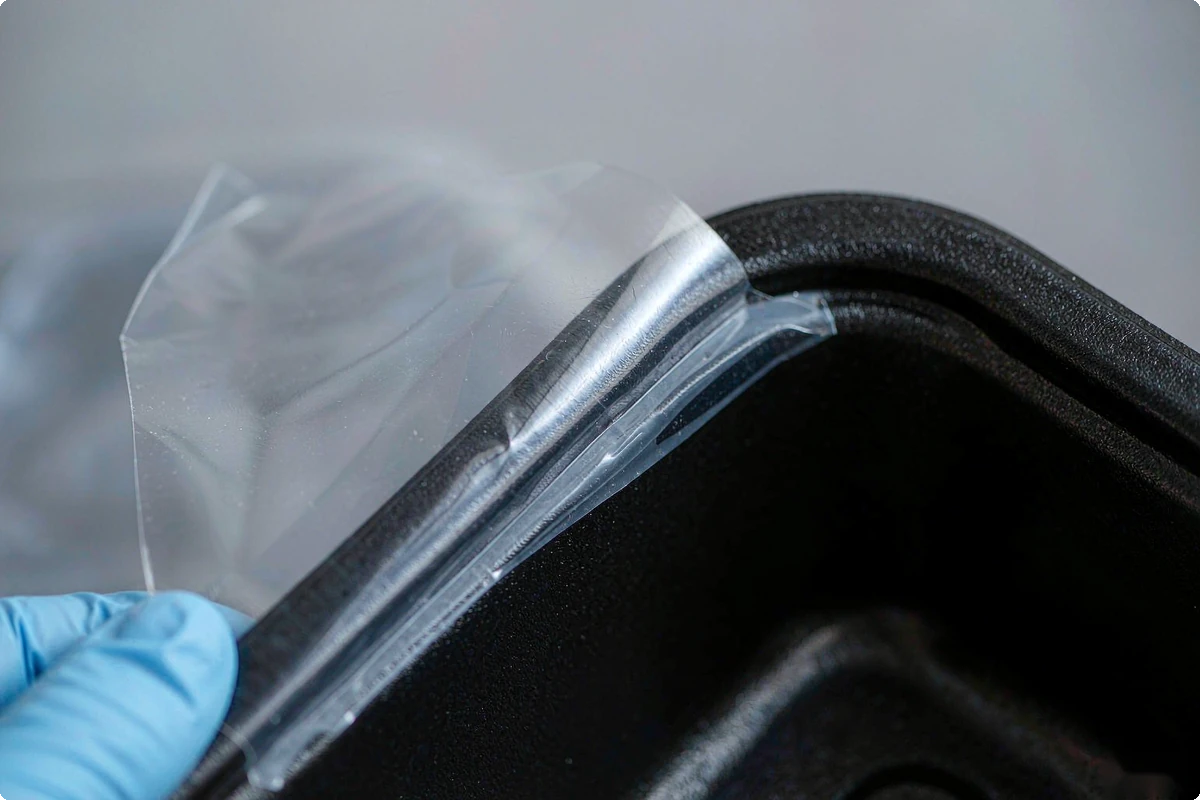
Cold impact and flex performance depend on the full laminate, thickness, seal, tray geometry and test conditions. If the pack faces drops or compression, assess filled packs after cold conditioning. A film-only result can compare materials tested by the same method, but it does not replace finished-pack testing.
The ASTM D1709 dart impact test measures a film’s impact resistance using a free-falling dart under the method’s conditions. Report method, specimen and conditioning when comparing results, and pair it with a distribution test built around the actual product. A dart result for a monolayer film does not describe a different laminate.
Seal strength and package integrity after freezing
The ASTM F88 seal strength test measures the force required to separate a seal specimen and identifies its failure mode. Samples can be conditioned at a defined cold temperature, but report that separately and use consistent procedures.
Choose a leak test appropriate to the construction. ASTM F1929 covers certain seals between transparent material and porous sheet material, not plastic tray-and-lid packs. Agree method, acceptance criteria and sample plan with the laboratory, and compare like-for-like structures and conditioning.
Seven Failure Modes on Frozen Lines
Use a stepwise investigation: inspect the pack and flange, review process records, and select a leak or strength test suited to the construction before changing supplier.
| Symptom | Possible cause | Check first | Possible action |
|---|---|---|---|
| Lid lifts at one corner | Contamination, flange warp or uneven pressure | Inspect flange and seal; use a suitable integrity test | Improve fill control or nest alignment |
| Fogging under the lid | Condensation or unsuitable anti-fog performance | Confirm when and where fogging appears | Trial a suitable anti-fog grade and layer |
| Lid shatters when opened | Seal design or opening behaviour changes after cold storage | Assess peel force and failure mode after conditioning | Adjust the grade or opening design and revalidate |
| Pinholes after distribution | Film damage, sharp edges or handling impact | Inspect the complete pack after representative handling | Review film structure, flange finish and pack protection |
| Leaks climb late in the shift | Process drift, wear or contamination | Review temperature, pressure and seal records over time | Recalibrate equipment and replace worn components |
| Lid curls or will not lie flat | Film tension, orientation or excess process heat | Check whether curl follows machine direction and when it forms | Review web tension, temperature and cooling |
| Product on the flange | Overfill, product movement or tray tilt | Check fill height and line handling | Adjust fill control or add a suitable wiping step |
Multiple symptoms may share a process cause. More troubleshooting guidance is in our packaging FAQ.
A Five-Step Selection Framework
Answer these five questions before finalising the film specification.
- Product. Record fat, water, sauce viscosity, particulate size, sharp edges and fill temperature.
- Cold chain. Define the lowest expected temperature, duration, freeze-thaw cycles, stacking and transport conditions.
- Tray. Confirm material, sealing surface, flange width and flatness, corner radii and supplier.
- Seal type and opening force. Decide whether the pack needs a peelable or permanent seal, then agree on the test method, conditions and target.
- Line. Record sealer type, dwell at production speed, pressure capability and contamination controls.
Then choose thickness and print within the selected structure. More thickness alone will not fix an incompatible sealing surface or an unstable process.
Ready to run a trial matrix? Send the tray, the fill and your line speed, and request a quote; we can propose a structure and test plan.
Twelve Questions to Ask Before You Order
Answers in writing give you a clearer basis for a trial; our flexible packaging RFQ checklist covers the paperwork. Three carry particular weight: performance after cold conditioning, the exact tray tested, and the validated process range at your line speed. Treat a room-temperature result, an unspecified “standard tray” or a single setpoint as incomplete information.
| Question | What a useful answer includes | Follow up if missing |
|---|---|---|
| Which structure are you quoting, layer by layer? | Named layers, thicknesses and sealant grade | “PET/PE” with no grade or details |
| What opening force do you expect after cold conditioning? | Result, method, specimen width, speed and conditioning | Room-temperature data only |
| Which tray did you test on? | Material, supplier, sealing surface and flange details | “A standard tray” |
| What process range did you establish on my machine? | Conditions validated at the intended dwell and line speed | One recommended setpoint |
| What is the impact result for the quoted film? | Test method, specimen thickness and conditioning | “Very strong film” |
| Do you supply anti-fog, and on which layer? | Product-side layer and any effect on sealing | Added “as standard” without details |
| Is the complete pack suitable for microwave reheating? | Assessment covering film, tray and intended use | “Microwave safe” without conditions |
| What quality and food-contact documents can you provide? | Current site certificates and documents relevant to the target market and use | A certificate from another site or generic claim |
| What is the MOQ for a first order? | A figure and the cost steps behind it | Low MOQ with no trial option |
| What is the lead time after artwork approval? | A dated schedule including print and lamination | A number with no stated start point |
| Who signs off the trial, and against which criteria? | Agreed pass/fail criteria and sample plan | “We will see how it goes” |
| What happens if the first lot fails? | A documented complaint, investigation and remedy process | No defined process |
Follow-up prompts are not, by themselves, proof of a supplier problem.
FAQ
Can you freeze trays sealed with lidding film?
Many tray-and-lid packs are designed for frozen foods, but suitability depends on the tray, film, seal and cold-chain conditions. Validate the finished pack after conditioning at the intended temperatures. Choose an integrity test that is suitable for the package construction; ASTM F1929 applies only to its defined material and seal configuration.
What thickness of lidding film do I need for frozen food?
Thickness is one part of the specification, not a stand-alone predictor of performance. Different structures and sealants behave differently. Compare data for the quoted finished laminate, then validate the complete pack for cold opening, impact and seal integrity.
Is PA/PE better than PET/PE for frozen food?
It depends on the application and specific film grades. A PA/PE laminate may be worth evaluating where puncture or flex resistance is important. PET/PE may suit applications with different cost, stiffness or print priorities. Compare both structures on the same tray and under the same test conditions.
Do I need anti-fog film for frozen products?
Only if condensation or fogging affects the product’s presentation or use. The need depends on fill temperature, product moisture and temperature changes. Identify the layer carrying the anti-fog treatment and confirm that the selected grade still meets seal requirements.
Why does my lidding peel off in the freezer?
Possible causes include a sealant and tray mismatch, flange distortion, contamination, process variation or a change in opening behaviour after cold storage. Inspect the failure and use a leak or seal test appropriate to the package before changing materials.
Can a frozen lidding film go straight into the microwave?
Only if the complete pack is designed and validated for the intended heating conditions. The film, tray, food and instructions all matter. Do not infer microwave suitability from PET/PP, CPET or any other layer name alone.
What MOQ and lead times should I expect?
They vary by structure, print and production schedule. DSS Pack offers a flexible MOQ for first orders and trials, with shipping in as little as 15 days after confirmation. Artwork approval and a trial run affect the schedule.
For the ordering sequence, see how low-MOQ custom packaging works.
Conclusion
Lidding film for frozen food must be selected for the product, tray, cold chain, sealing process and opening requirements. Barrier performance matters where the food and shelf-life target require it; seal integrity and cold handling also need validation on the finished pack.
Five decisions guide the specification: structure, sealing surface, seal type, process range and validation plan. Choose the structure for the product and distribution conditions, then validate the pack as it will actually be handled: cold opening, seal strength at a stated conditioning, and impact. For the wider picture, the wider frozen food packaging guide covers the cold-chain pack.
Request a quote → — flexible MOQ, with shipping in as little as 15 days after confirmation.