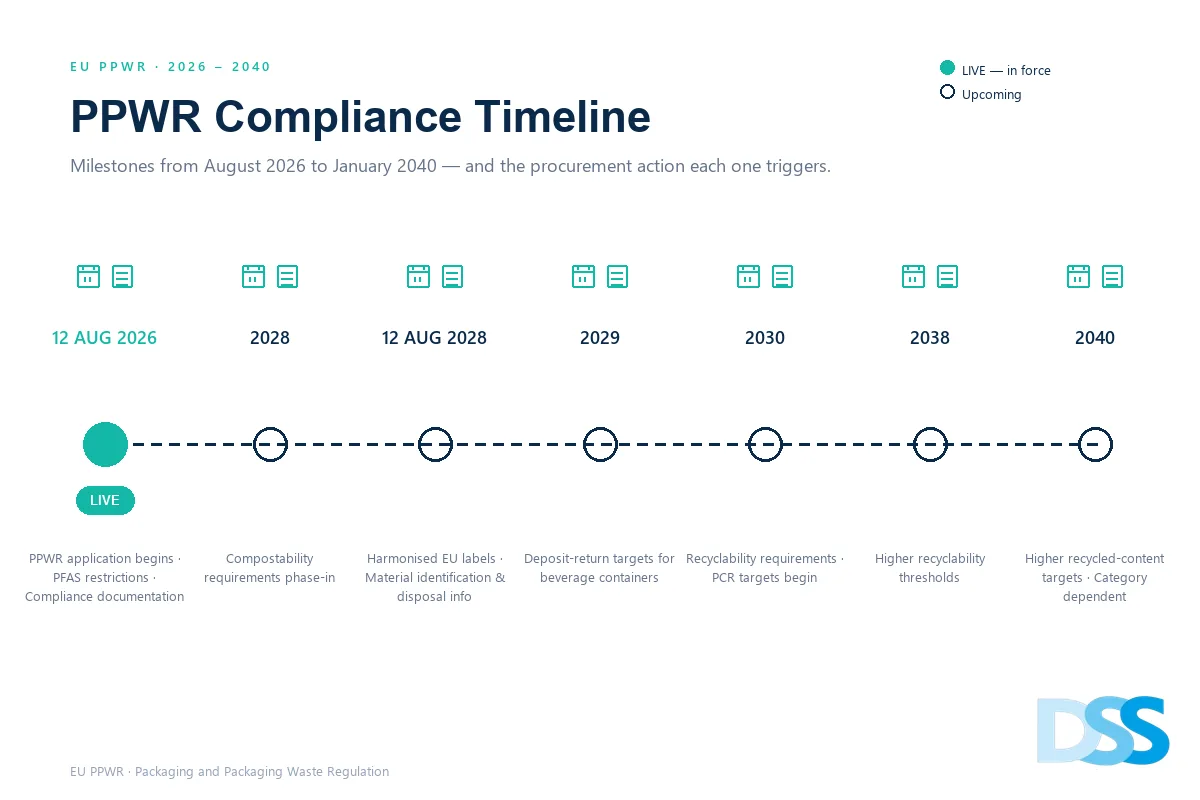
What Changed on 12 August 2026 — and What Didn’t
PPWR food packaging compliance rolls out in stages — here’s when each requirement kicks in and what procurement does about it.
Three obligations are live today. First, substance limits: PFAS restrictions for food-contact packaging took effect immediately, with the heavy-metal caps (how the regulation defines its PPWR substance limits and obligations).
Second, each packaging specification placed on the EU market needs appropriate supporting documentation, including a Declaration of Conformity where required. Compliance teams felt the squeeze early — more than 100 related inquiries a week in the run-up (FruitNet).
Third, a unified EPR framework and identification marks now apply across the EU (the European Commission’s packaging waste policy overview).
But don’t panic about what is not due yet. The unified label arrives in August 2028, recyclability grades bind in 2030, and recycled-content minimums also start in 2030.
One common fear is unfounded: PPWR does not replace existing food-contact material regulations. Depending on the packaging application, companies may still need to consider relevant food-contact requirements alongside PPWR. PPWR also does not mandate a Digital Product Passport the way the ESPR and battery rules do — packaging identification plus the DoC is the requirement, with a GS1 Digital Link QR as the practical carrier (dpp.gs).
One relief out of Brussels: stock produced before 12 August but not yet placed does not have to be destroyed. The Commission confirmed it in an 11 August implementation notice, and the updated official FAQ (v2, 3 August) backs that up (WasteTrade). The “wait and see” option is gone.
Table 1. Procurement compliance timeline for food packaging
| Date | Regulation milestone | What your procurement team does |
|---|---|---|
| 12 Aug 2026 (PPWR application begins) | Initial obligations: PFAS-related restrictions and compliance documentation requirements | Request DoC, PFAS tests and material declarations now; inventory every EU SKU |
| 2027–2028 | Packaging identification information develops; future data requirements should be considered in artwork planning | Reserve QR space in every new artwork layout |
| 12 Aug 2028 | Unified classification label | Update artwork; plan old-stock sell-through |
| 1 Jan 2029 | Deposit-return schemes ready in member states | Watch package design for deposit-bearing categories |
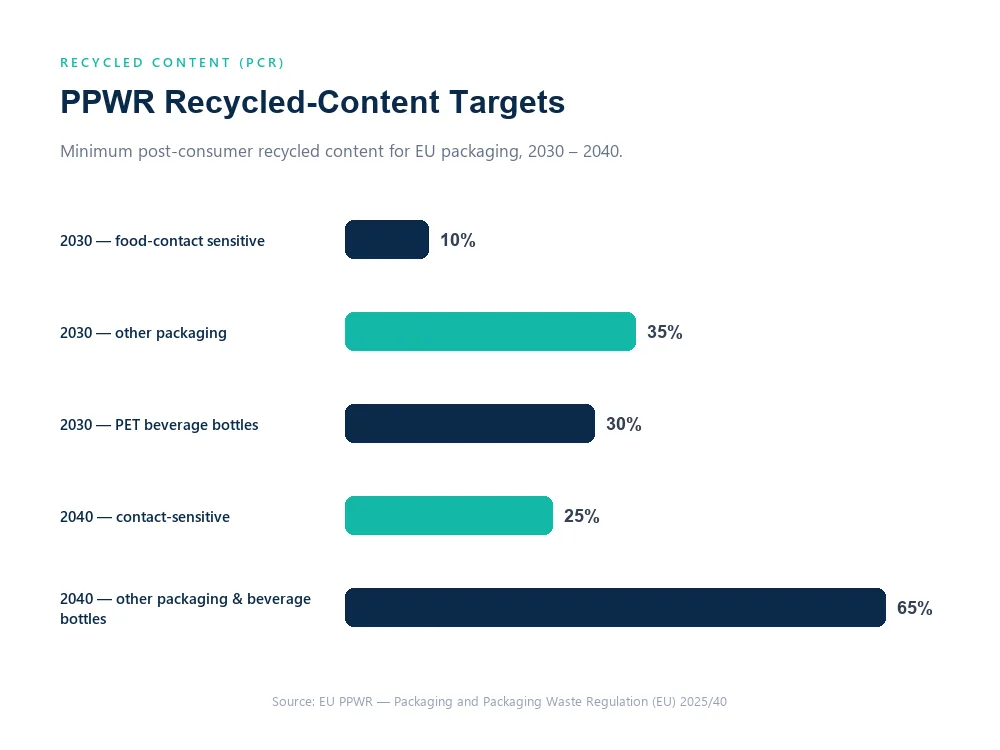
| 1 Jan 2030 | Recyclability ≥ grade C; PCR 10%/35%/30%; empty space ≤50%; some single-use bans | Complete mono-material switch; lock PCR supply; run annual supplier review |
| 1 Jan 2038 | Stricter recyclability requirements expected | Continue improving packaging design performance |
| 1 Jan 2040 | Higher recycled-content targets (category dependent); waste −15% | Sign long-term supply agreements; secure PCR certifications |
Dates cross-checked against VAT Compliance, Legal Clarity, Packgine and PPWR Connect. Rules are still being clarified; always check the latest official FAQ before major artwork commits.
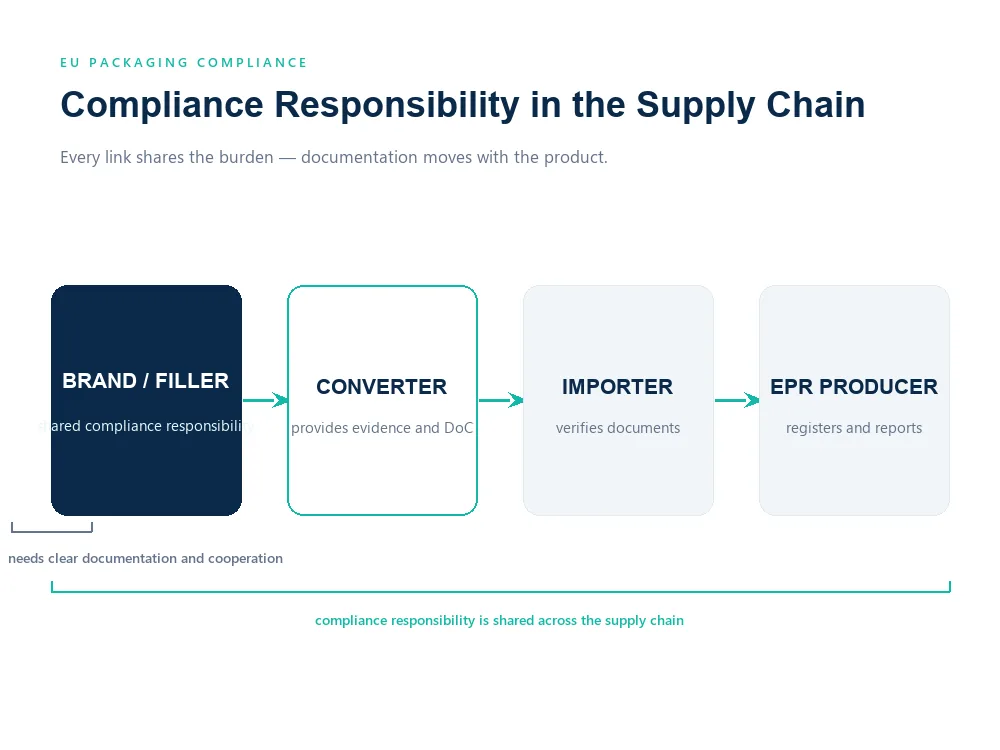
PPWR Turned Packaging into a Supplier-Evidence Chain
Here is the shift that matters most for buyers: under PPWR, compliance responsibilities extend across the packaging supply chain. Food brands, fillers and packaging converters all need clear documentation and cooperation to demonstrate compliance. Stora Enso puts it plainly: the statutory manufacturer isn’t always the actual producer (FoodBev). Different actors in the packaging supply chain may have different documentation responsibilities depending on their role (Packgine).
That flips the purchasing relationship. Brands must verify compliance across the whole supply chain, not just against their direct supplier (Obsidian Regulatory Intelligence). But a brand can’t conjure its own DoC. Article 16(1) (the full text of the Packaging and Packaging Waste Regulation (EU) 2025/40) makes the supplier hand over the supporting information — and if total fluorine is above 50 ppm, you can demand proof of where it came from (Packgine). In practice: no supplier data = no DoC = no market access (OPTEL).
Buying outside the EU? Your supplier — and you — need an authorised representative in the destination country.
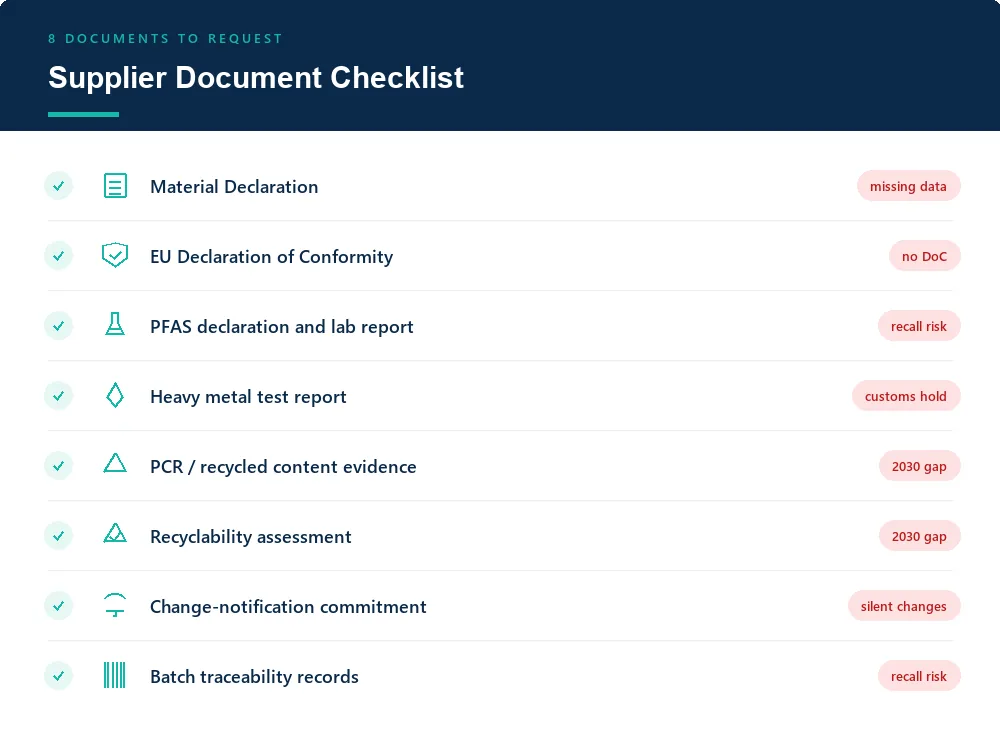
8 Documents to Request from Every Flexible Packaging Supplier
The fastest read on a supplier’s PPWR readiness: ask to see one complete, SKU-specific evidence file — attached to your product, not their brochure. Ask for the eight items below in writing, each tied to the specific product you’re buying. And remember: a DoC is issued per unique specification, so a change of ink, adhesive or barrier means a different DoC (DPP-Tool).
Here are the 8 documents to request from every flexible packaging supplier.
Table 2. Document checklist — what to request and what happens if it’s missing
| Document | What it must show | If it’s missing |
|---|---|---|
| Material declaration | Every layer, resin, grammage and structure | No auditable DoC can be built |
| EU Declaration of Conformity | Manufacturer info, packaging ID, conformity statement, signature | Packaging cannot legally be placed on the EU market; customs holds |
| PFAS declaration + lab report | Evidence of compliance with applicable EU PFAS restrictions, testing methods and detection limits | Market access denied; recall risk |
| Heavy-metal test report | Pb + Cd + Hg + Cr(VI) total ≤ 100 mg/kg | Breach of substance limits |
| PCR / recycled-content evidence | % recycled content, source and certification (e.g. GRS) | Misses 2030 recycled-content targets |
| Recyclability assessment | Target recycling stream and self-assessed grade | Higher EPR fees; 2030 phase-out risk |
| Change-notification commitment | Advance notice of any material/coating/ink/origin change | File goes stale silently |
| Batch traceability records | Test reports ↔ batch ↔ production date | Fails spot checks |
Structure follows GVPAK, Packa and Bioleader; DoC content per PPWR Connect.
If a supplier hesitates on any of these eight, treat it as a warning sign. Want to see a complete file set in practice? Our team prepares material declarations and test reports for every pouch we ship — request a quote and compliance file samples.
What to Switch To: Mono-Material & Foil-Free Barriers
The default direction for new launches is mono-material-oriented packaging. Industry design guidelines increasingly favor structures that maximize compatibility with existing recycling streams, and mono-material was the theme at Interpack 2026 (Gozen Packaging, Towards Packaging). For snacks, cereal, coffee and pet food, PE-based or PP-based structures can handle many applications, with compatible barrier solutions such as AlOx or EVOH considered where shelf-life requirements demand additional protection.
Barrier doesn’t have to mean aluminium foil. Bobst’s capability centre reports dual-material all-polyolefin structures reaching OTR ≤ 0.1 cc/m²/day and WVTR ≤ 0.1 g/m²/day, and AlOx-coated PET hitting OTR < 1 cc (FTA, PW Consulting). That’s the engineering inside our mono-material stand-up and back-seal pouches.
The honest boundary: retort, high-sensitivity products and extreme shelf-life cases still need case-by-case testing (BluePack). And watch the CEN EN 18120 series (published April 2026) — it’s becoming the technical skeleton behind the 2028 requirements (Adapa Group). See our PPWR compliance guide for the full technical breakdown.
Table 3. Common food pouch formats and their 2030 PCR requirements
| Packaging format | Recommended material route | 2030 PCR target | Recyclability route |
|---|---|---|---|
| Dry snacks / cereal stand-up pouch | All-PE or All-PP (+ AlOx/EVOH barrier) | Food-contact sensitive: 10% | PE/PP streams, RecyClass-certified |
| Coffee / pet food back-seal pouch | Mono-PE + AlOx or MDO-PE | 10% if direct food contact | Mono-material recycling stream |
| Frozen food bag | Mono-PP (cold-temp) / MDO-PE | 10% | Mono-material recycling stream |
| Sauce / condiment pouch | EVOH co-extruded mono-PE | Other packaging: 35% (end-use dependent) | Needs EVOH-sorting solution |
| PET barrier tray / film | AlOx-coated PET | 30% (PET-bottle tier) | rPET-stream compatible |
PCR figures per VAT Compliance, Fuld & Company and Adapa Group. Glossary: AlOx = aluminium oxide coating; MDO-PE = machine-direction oriented PE; EVOH = ethylene vinyl alcohol.
The Real Cost Picture: EPR Fees, Material Premiums, Testing
Compliance costs real money. Budget for it now, not when a shipment is stuck.
EPR fees move with design. Eco-modulated fees reward recyclable packaging — grade A pays less, grade C pays more (Fuld & Company, VAT Compliance). For a quick answer on whether compliant packaging is always pricier, see our packaging FAQ for cost answers. Material substitution is pushing raw-material costs up roughly +10–30% (CCPIT), and AlOx barriers carry a premium of around +30–60% vs standard transparent film (IndexBox).
Switching takes time — budget 4–9 months to qualify a compliant supplier, test structures and lock specs (VAT Compliance).
Expect food-grade recycled resin to stay tight for the next few years. The 2030 targets are pulling demand for food-grade rPET/rPP faster than recyclers can build new capacity (Fuld & Company). Brands that lock PCR supply early — like the Mondi–Dreco 50% PCR detergent pouch — avoid the scramble (SinoFlexPack).
The most expensive path is inaction. Penalties already reach €200,000 in Germany (Deutschland in English), and national rules can push fines toward 4% of annual turnover (CCPIT). As one guide puts it bluntly, the most expensive route is waiting for customs to confiscate your goods (Jieyu Plastics).
How to Vet a Flexible Packaging Supplier (Including Overseas Suppliers)
Supplier selection is where PPWR becomes a procurement skill. Ask these five questions before you commit:
- Can you issue a DoC per SKU specification — a real one, matched to our exact structure, not a generic catalogue certificate?
- Which PFAS test method and which named laboratory? Look for the total-fluorine screening path (below 50 ppm = directly compliant) (Tencent News).
- Do you have mono-material and foil-free barrier capability — all-PE/all-PP pouches with AlOx or EVOH at commercial scale?
- Do you commit to change notification and batch traceability? In writing, per purchase order.
- What are your MOQ and lead time during a switch? A compliant supplier you can’t get product from is not a supplier.
Red flags are easy to spot once you know them: generic website certificates, a badge claiming official EU approval (there is no such thing — PPWR is a law, not a certification), no named laboratory on test reports, or documents that can’t be mapped to a specific SKU (Bioleader, GVPAK, Zhongxin).
Sourcing outside the EU? Add one more check: does the supplier have an authorised representative in your destination country, and can your importer audit their documents? (OPTEL, PPWR Connect). Compliance files are only as good as their audit trail. See our own documentation and audit workflow to benchmark what file-ready looks like.
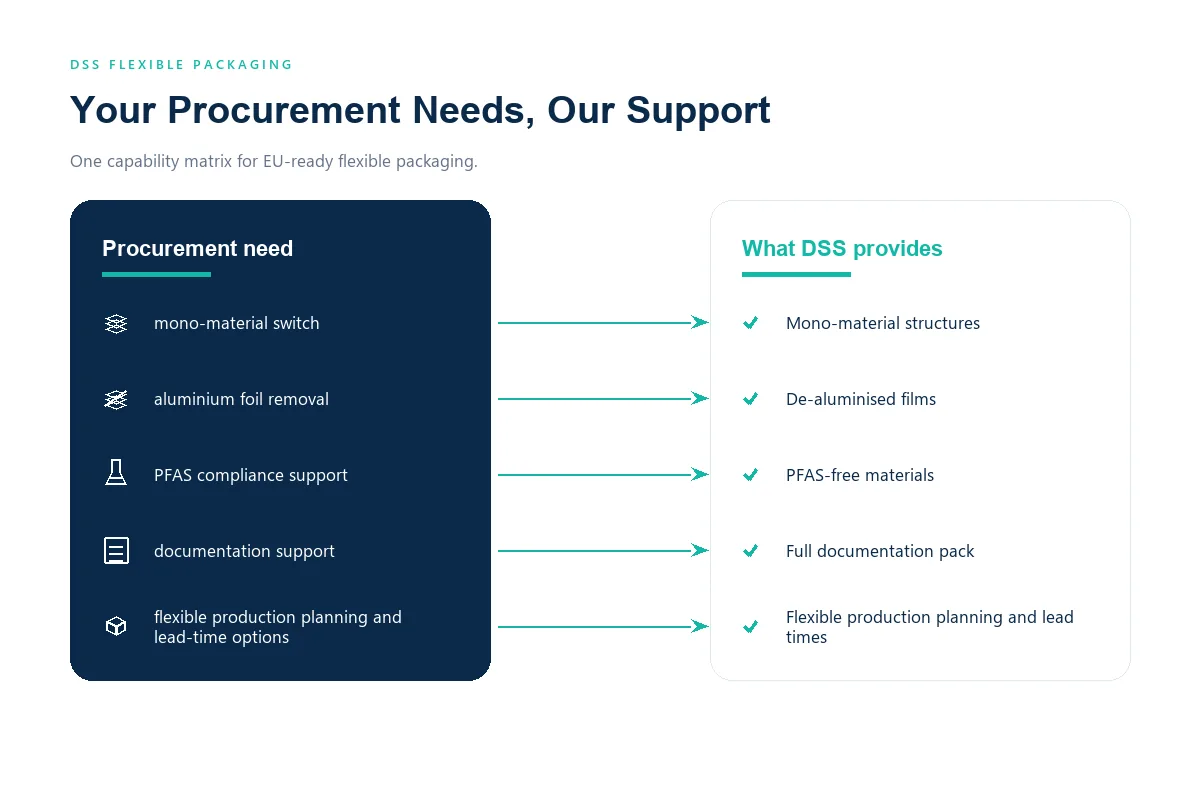
How DSS Helps Food Brands with PPWR food packaging compliance
We are a Chinese flexible-packaging manufacturer, and we are not going to overclaim: DSS is systematically preparing for PPWR compliance and helping customers comply together. No self-certifications, no invented approval badges — just the engineering and documentation work that makes your compliance job easier.
Table 4. What DSS can prepare for your switch
| Your procurement need | What DSS provides |
|---|---|
| Switch to mono-material | All-PE / all-PP stand-up and back-seal pouches, with barrier options |
| Drop aluminium foil | AlOx barrier structures replacing foil (see the technical requirements behind the AlOx switch) |
| PFAS compliance | PFAS compliance support through material selection and relevant testing documentation |
| Documentation support | Material declarations and test reports to support your compliance files |
| Switch economics | Flexible production planning and lead-time options depending on project requirements |
That last row is more than it sounds. Many buyers expect their ideal supplier to provide documentation before it becomes a problem. That’s the standard we’re building toward — see DSS’s production and compliance capabilities. Ready to test us? Start with our stand-up pouch and back-seal pouch lines — and request a quote with your specs.
Your 90-Day Action Plan
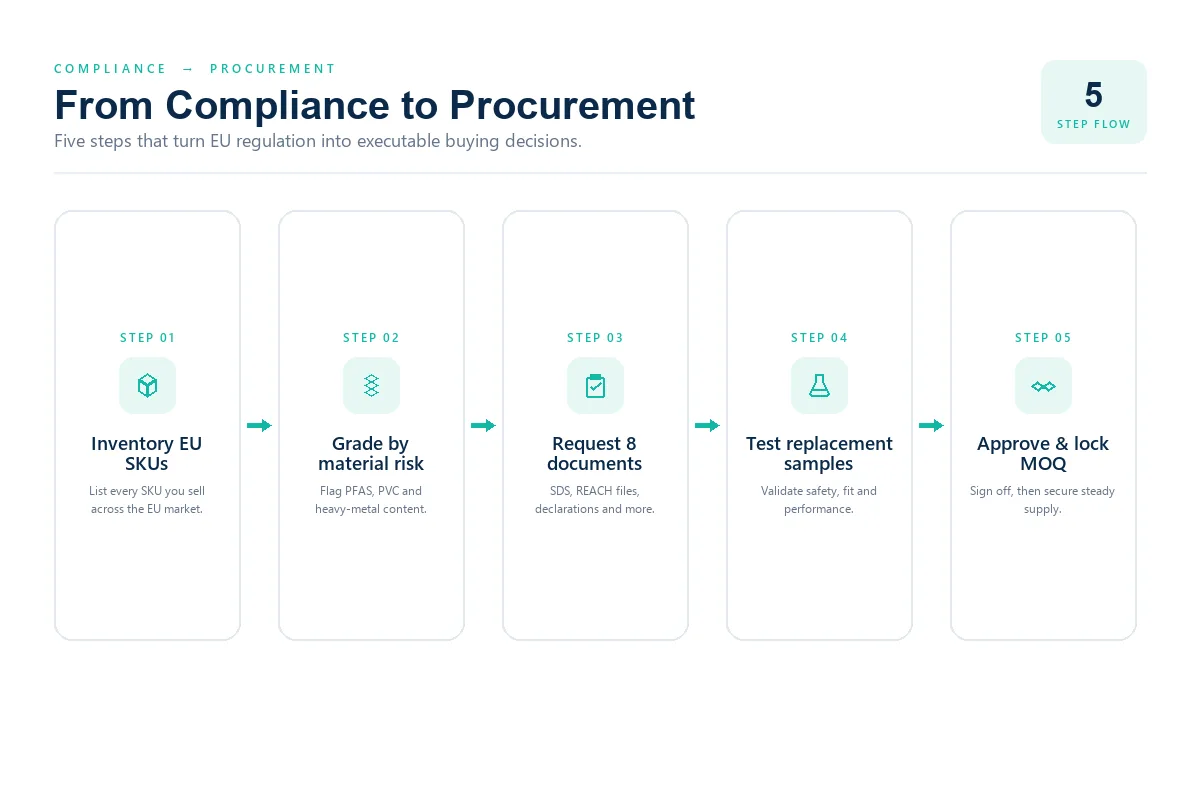
PPWR food packaging compliance is easier to buy than to argue about later. Here is a 90-day plan for flexible packaging, adapted from Bioleader’s buyer framework:
- Days 1–15 — Inventory every EU-bound SKU; record structure, resin, supplier and DoC status.
- Days 16–30 — Grade SKUs by material risk (multilayer and foil-based = high; mono = low).
- Days 31–45 — Send the Table 2 document checklist to every supplier; log who answers completely and who stalls.
- Days 46–60 — Test replacement mono-material/AlOx samples with your real product — hot-fill, sauces, freezing, stacking.
- Days 61–75 — Check labels, claims and QR space; align artwork with the 2028 unified-label plan without premature redesign.
- Days 76–90 — Approve replacement SKUs, lock MOQ and lead times, and schedule the next annual supplier review.
FAQ
Does PPWR ban all plastic food packaging? No — it sets conditions: recyclability grades, substance limits, recycled content and EPR registration. Compliant plastic packaging stays on the market.
Will mono-material shorten my shelf life? Not necessarily — high-barrier AlOx and EVOH mono-material structures reach OTR ≤ 0.1 cc in tests, close to foil on many applications (FTA). Retort and extreme-shelf-life products still need validation.
Is compliant packaging always more expensive? Not always. Eco-modulated EPR fees can offset part of the material premium for recyclable designs (Fuld & Company) — but budget for the switch.
Can a Chinese supplier issue a DoC? Yes, if they are file-ready. PPWR food packaging compliance requires material declarations, named-lab PFAS tests, and per-SKU traceability. That is the documentation standard we are preparing at DSS.
Should I change labels now for 2028? Reserve QR space and design flexibility, but don’t print the unified label early — requirements finalise closer to the date. More answers on our packaging FAQ page.
Conclusion
PPWR food packaging compliance turned packaging law into a purchasing decision. Three steps carry you through: ask for the eight documents, switch to mono-material and foil-free barriers, and vet suppliers against a written checklist. Do it on a 90-day cadence and compliance becomes routine, not a crisis.
The window that opened on 12 August 2026 is closing. Brands that move first lock in compliant supply and PCR allocations — and earn the trust. Those that wait pay for the scramble. DSS is systematically preparing for PPWR compliance and helping customers comply together. Send us your pouch specs for a quote and sample compliance files →
For the regulatory deep-dive, revisit our full PPWR compliance guide or browse more packaging insights.