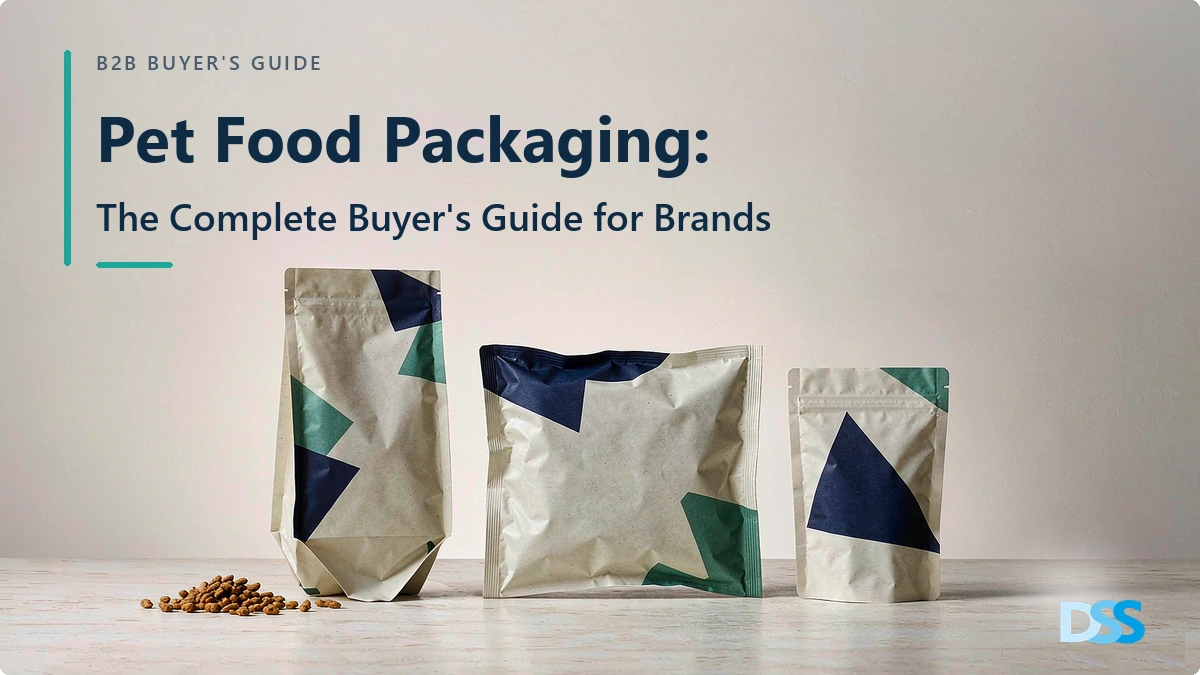
Packaging can influence product quality over time, but shelf life depends on the formulation, processing, residual oxygen, seal quality and storage as well as the pack, so validate the complete package before making shelf-life claims. Pet food packaging is not a wrapper bought on price per thousand; it is the system that protects kibble from oxygen, moisture, light and handling, and should be specified for performance, not price alone.
This guide covers how packs fail, why each format differs, how to read OTR and WVTR, and what to confirm before you order. See these structures in production on our pet food packaging solutions page.
DSS Pack supplies printed pouches and rollstock to pet food brands worldwide — this guide helps whether or not you buy from us.
Key Takeaways
- Different demands per type: dry fights oxidation and moisture, wet fights heat and seals, treats fight puncture and moisture — packaging affects all three, so the shelf-life effect must be validated.
- OTR (oxygen) and WVTR (moisture vapour) are results for a defined specimen and test conditions — compare like with like, and validate the finished package.
- Freeze-dried products commonly need moisture protection; frozen products also need low-temperature toughness and seal validation; retort conditions are product- and process-specific.
- Match format to product and line: stand-up for shelf presence, flat-bottom for stability, rollstock for compatible automatic lines.
- Compliance is a gate: US labelling follows applicable FDA and state requirements, with AAFCO model regulations as reference; in the EU, Regulation (EC) No 767/2009 applies.
Why Pet Food Packaging Is Different
Pet food packaging must protect the product, present it on shelf, withstand distribution and meet food-contact requirements that vary by market. Quality can change before obvious spoilage appears: oxidation, moisture changes and aroma loss may affect sensory and nutritional quality, depending on the recipe, processing and storage.
Three Product Types, Three Sets of Physical Demands
- Dry kibble is low in moisture but high in fat; its enemies are oxygen (which oxidises the fat) and moisture (which invites mould), so the job is barrier plus a reliable seal.
- Wet, retort-processed food is processed in-pack under a scheduled thermal process, so the packaging must be validated for heat, pressure, seals and handling.
- Treats and chews may need puncture resistance, moisture control and resealability; freeze-dried products need strong moisture protection and may also need oxygen and aroma protection; frozen products need toughness and seal integrity at the specified temperatures.
Why Human-Food Packaging Logic Doesn’t Transfer
Human-snack logic transfers only partly: premium pet foods often carry higher fat loads, and a bag may stay open for weeks, so a resealable feature optional on crisps is functional here.
How Pet Food Packaging Fails: Rancidity & Moisture
Know how a pack fails, and you can specify against it.
Lipid Oxidation & Rancidity
Fats react with oxygen in a chain reaction: free radicals, then peroxides, then aldehydes and ketones — the compounds that smell and taste rancid. It also degrades fat-soluble vitamins A, D, E and K. Oxygen is the accelerator packaging controls directly.
Moisture Ingress & the Desiccant Effect
Kibble is dried to limit microbial growth; moisture entering through the material or a leaking seal softens texture and can reduce shelf stability, depending on formulation, water activity and storage. Moisture moves by a different mechanism from oxygen, so a film can be an excellent oxygen barrier and a poor moisture barrier, or the reverse — specify both separately. Map the failure mode first with our flexible packaging structure guide.
Light, Odour & Puncture
Three quieter failure routes. Light drives photo-oxidation of fats and degrades vitamins, so light-blocking layers help where exposure is high. Odour travels both ways: pet food absorbs off-notes and strong aromas escape. Puncture is the most underrated — kibble corners, bone fragments and hard treats abrade the film from inside, and one pinhole undoes an expensive barrier.
Match the Format to the Product: Dry, Wet & Treats
Three product families, three specification profiles. Whether you make dry dog food, cat food or treats, the logic starts with the failure mode.
Dry Kibble
What fails: rancidity and moisture uptake, plus vitamin degradation and aroma loss.
What you specify: a good-to-high oxygen barrier, a solid moisture barrier, a strong continuous seal, and enough puncture resistance to withstand transit.
Format notes: stand-up and flat-bottom bags dominate; resealability helps at larger sizes.
Wet (Retort) Food
What fails: seal failure, delamination and puncture during and after the scheduled thermal process at 121–135 °C; oil migration and oxidation on storage.
What you specify: a laminate designed and validated for the scheduled process, often with a retort-grade sealant such as RCPP. Confirm seal width, pouch construction, adhesive, inks and material grades for the actual temperature, time, pressure and cooling; PA (nylon) may add toughness. A general-purpose pouch should not be assumed retort-suitable — a sealant not validated for the scheduled process may soften or lose seal performance, so confirm suitability for the complete laminate before a trial.
Treats, Chews & Freeze-Dried
What fails: puncture and tearing for some treats and chews; moisture pickup and texture loss for freeze-dried products; brittleness or seal damage for frozen products exposed to low-temperature impact.
What you specify: for treats and chews, match puncture resistance and moisture protection to the product; for freeze-dried, prioritise moisture protection and assess oxygen and aroma needs; for frozen, validate impact toughness, cold-crack resistance and seal integrity.
Format notes: small stand-up and resealable packs; flow-wrap and rollstock on high-speed treat lines.
★ Product Categories at a Glance
| Attribute | Dry kibble | Wet (retort) food | Treats & chews | Freeze-dried | Frozen |
|---|---|---|---|---|---|
| Primary deterioration | Lipid oxidation + moisture uptake | Seal/heat failure, oil migration | Puncture, tearing, moisture pickup | Moisture pickup, texture or aroma loss | Low-temperature impact and seal damage |
| Barrier priority | Oxygen ↓, moisture ↓ | Oxygen ↓ + seal survival | Product-dependent | Moisture ↓; oxygen as required | Product- and storage-dependent |
| Key physical demand | Puncture/abrasion, seal continuity | Scheduled-process survival, seal integrity | Puncture resistance, resealability as needed | Crush protection, seal integrity | Impact, cold-crack, seal integrity |
| Sealant layer | PE-based sealant | Retort-grade sealant, often RCPP | PE or CPP by format | PE or CPP by format | Low-temperature grade |
| Typical structure (indicative) | PET/PE; PET/VMPET/PE | PET/PA/retort-grade CPP, or PET/AL/PA/retort-grade CPP (validate) | PET/PE; BOPP/CPP | Laminate with strong moisture protection | Selected for low-temperature toughness |
| Common format | Stand-up, flat-bottom | Retort flat/stand-up pouch | Small stand-up, flow-wrap, rollstock | Stand-up pouch, rollstock | Pouch or rollstock |
| Resealable? | Often valuable (large packs) | Usually no | Often useful | Often useful | Product-dependent |
Indicative only — validate the right laminate for the specific product, process and distribution conditions with your converter.
Weighing two structures for a recipe? Send us the details and we will recommend one — request a pet food packaging quote, or start from our low MOQ flexible packaging guide if you are still trialling.
Barrier 101: OTR, WVTR & How to Specify Them
Barrier is where pet food packaging specification gets technical and vague conversations cause the most expensive mistakes.
- OTR — Oxygen Transmission Rate: how much oxygen passes through a given area per day, typically cm³/m²·day; lower is better for oxidation protection.
- WVTR — Water Vapour Transmission Rate: how much moisture vapour passes through per day, typically g/m²·day; lower is better for moisture protection.
These are rates measured on a defined specimen under stated conditions; thickness, temperature, relative humidity, test method and specimen type all affect interpretation, so compare like with like. Single-layer data can guide material selection, but for package design assess the finished laminate and validate the finished pack, since seals, folds, pinholes and handling affect performance.
Reading a code helps: in PET/VMPET/PE, PET is the outer printable layer, VMPET a metallized barrier web and PE the sealant; in PET/PA/CPP, PA adds toughness and CPP is the sealant. For retort, the CPP must be a suitable retort grade and the structure validated for the scheduled process — see our flexible packaging structure guide.
How DSS Pack Validates Barrier
We measure barrier on selected film and laminate specimens using MOCON instruments and applicable ASTM methods — ASTM D3985 for OTR, ASTM F1927 for OTR at controlled relative humidity, ASTM F1249 for WVTR and, where applicable, ASTM F3299 for WVTR. State the method and test conditions with each result: a result applies to the test specimen and conditions reported and does not by itself establish finished-pack performance or shelf life.
For your RFQ, state your product, target shelf life and distribution conditions, then ask the supplier to propose structures with OTR/WVTR values plus the test conditions and method used — that filters out suppliers who are guessing.
Choosing the Structure: Film Codes by Product Type
Once you know your failure mode and barrier targets, structure selection for pet food packaging is mostly mechanical. Compare the table against your product profile; our packaging material guide goes deeper.
| Product / need | Indicative structure | Why it is chosen |
|---|---|---|
| Dry kibble — standard | PET/PE | Robust, economical, good seal; moderate barrier |
| Dry kibble — higher barrier | PET/VMPET/PE | Metallised PET adds oxygen and light barrier at moderate cost |
| Light-sensitive dry food | Opaque/metallised layer option | Limits photo-oxidation where light exposure is high |
| Wet food — retort | Retort-grade structure, e.g. PET/PA/retort-grade CPP | Designed for the specified retort process; validate the full laminate and package |
| Wet food — higher barrier retort | Retort-grade structure with foil, e.g. PET/AL/PA/retort-grade CPP | High oxygen and light barrier when correctly designed and validated |
| Treats — general | PET/PE; BOPP/CPP | Toughness and print quality for small formats |
| Resealable large format | Structure + zipper/slider closure | Supports repeated opening while limiting air ingress |
Indicative only. Selection must account for process temperature and time, fill weight, distribution and shelf-life target; retort applications require validation of the complete laminate and finished pouch against the scheduled process.
Every added layer raises cost and can change how the film runs. The right structure is the simplest that meets your validated target, not the longest code you can afford.
Bag Format Selection: Stand-Up vs Flat-Bottom vs Rollstock
Format is a commercial as much as a technical decision: it affects shelf presence, packing speed, freight efficiency and per-unit cost.
| Format | Best for | Strengths | Watch-outs |
|---|---|---|---|
| Stand-up pouch | Retail shelf, kibble and treats in suitable sizes | Strong shelf presence, barrier options, resealable features | Base stability and cost depend on size and construction |
| Flat-bottom (box) pouch | Medium-to-large retail or bulk packs | Strong shelf stability, structured appearance, efficient use of shelf space | Material and tooling cost depend on size and construction |
| Rollstock | Automatic filling lines compatible with the film | Can support high throughput and efficient material use | Requires compatible filling equipment; finished packs may need secondary handling |
Resealability matters most on large kibble packs left open for weeks: a zipper or slider limits the repeated air and humidity exposure that drives oxidation and moisture pickup — functional, not cosmetic. Single-serve retort pouches generally do not need it. See stand-up pouch vs flat bottom pouch and rollstock film vs pre-made pouches; for flat-bottom or spout pouches, see the product pages.
Freeze-Dried and Frozen Products
Frozen pet foods add a low-temperature challenge: some films become brittle or lose seal integrity under impact. Set the target using actual storage, transport and handling temperatures, then validate toughness, cold-crack resistance and seals. Freeze-dried products may be stored at ambient temperature and commonly need strong moisture protection, with oxygen and aroma barrier selected for the recipe and shelf-life target. See our frozen food packaging guide.
Shelf Life: What Packaging Can (and Can’t) Do
Clear thinking on which shelf-life inputs you control separates a realistic spec from an expensive mistake.
Packaging can slow oxygen ingress and moisture uptake, block light, reduce leakage risk, protect physical integrity and limit aroma loss. Packaging cannot reverse deterioration already begun, substitute for correct formulation and processing, or compensate for poor storage.
Dry kibble shelf-life targets vary by formulation, processing, antioxidant system, initial quality, packaging, distribution and storage. Periods such as 12–18 months unopened or 4–6 weeks after opening are product-specific guidance, not universal packaging guarantees; establish shelf life through product-specific validation and follow label requirements. The packaging contribution is greatest while the pack stays sealed.
If a brand switches a large kibble pack to a thinner or lower-barrier structure without checking the product and distribution conditions, it may raise the risk of quality loss — assess any cost-saving change through comparative testing and shelf-life validation before broad rollout.
Compliance & Specifications Buyers Must Confirm
Compliance is a gate, not a detail: get it wrong and a product can be kept off a shelf entirely.
- United States: pet-food labelling is subject to applicable federal requirements, including FDA 21 CFR Part 501, and state feed laws; AAFCO model regulations are widely used but are not themselves regulatory.
- European Union: pet food labelling follows Regulation (EC) 767/2009, with FEDIAF guidance as the industry reference.
- Food-contact: packaging compliance is separate from labelling rules and depends on the destination market, intended food type and conditions of use — ask the supplier for documentation for the complete construction, including the contact layer, inks and adhesives.
On certifications, be precise: DSS Pack holds ISO 9001 and BRC certifications and can share relevant food-contact documentation for applicable FDA requirements on request; FDA food-contact compliance relates to specific materials and conditions of use, not a general certification of a factory. Ask to see the certificate before finalising artwork.
A Decision Framework
Five steps take you from “we need packaging” to “a spec worth quoting”; each constrains the next.
- Categorise the product. Dry, wet (retort), or treat/freeze-dried/frozen? This sets the physical demands.
- Identify the dominant failure mode. Oxidation, moisture, seal failure, puncture or cold-crack? Specify for the dominant one.
- Set barrier and seal targets. Translate the failure mode into OTR/WVTR directions and a seal-integrity requirement, with test conditions agreed up front.
- Choose format and functional features. Stand-up vs flat-bottom vs rollstock, plus resealability or other features that match how the pack is used.
- Define acceptance criteria. Decide which tests, on the finished composite, at what conditions, and what counts as a pass.
Working through this on a real product? Send us your category, shelf-life target and distribution, and we will come back with a recommended structure and its reasoning.
Questions to Ask Every Pet Food Packaging Supplier
These ten questions surface capability gaps fast and make quotes comparable; for a version you can email out, see our flexible packaging RFQ checklist.
- Which structures do you recommend for my product, and why? A supplier who only quotes price is not specifying.
- How do you measure barrier (OTR and WVTR), and at what conditions? If they cannot state conditions and method, be cautious.
- What specimen was tested: a film, a laminate or a finished package? Compare results only when method, conditions, specimen and units match.
- What is your seal-integrity validation approach? Seal failure is a common cause of failures.
- Can the structure withstand my process? Retort temperature, filling line and handling each impose their own demands.
- What is your MOQ, and how flexible is it? Flexible MOQ matters for new SKUs and trials.
- What is your realistic lead time after confirmation? DSS Pack can ship in as little as 15 days after confirmation; ask every supplier to be specific.
- What food-contact and certification documentation will you provide? Ask for the actual documents.
- How do you handle artwork, print quality and repeatability across runs? Consistent brand colour is a production discipline, not a promise.
- Who is my technical contact when something goes wrong? Direct access to engineers shortens every problem.
FAQ
What materials are used in pet food packaging? PE-based laminates for dry food (PET/PE; PET/VMPET/PE for higher barrier); a retort-grade structure for wet food (PET/PA/retort-grade CPP or foil variants); PET/PE or BOPP/CPP for treats.
Is aluminium foil necessary? Not always. Foil gives very high barrier when intact and suits demanding shelf-life targets; metallized PET (VMPET) offers a useful balance at lower cost. Choose by requirement, not habit.
How do I prevent rancidity in dry dog food? Reduce oxygen and moisture: a genuine oxygen barrier, a reliable continuous seal, controlled headspace and light protection where exposure is high. Resealable packaging helps after opening.
What is a retort pouch? A flexible pack processed with the food inside under a scheduled thermal process, so the product is shelf-stable until opened; 121–135 °C is a common range, not universal. Validate the complete laminate, sealant, adhesive, inks and pouch construction; retort-grade sealants often include RCPP.
Do bags need to be resealable? Not universally, but often yes for large dry-food packs, where resealability limits the repeated air and humidity exposure of daily opening. Single-serve retort pouches usually do not; treat and freeze-dried packs do.
How is freeze-dried pet food packaging different? Moisture protection is usually key to preserve texture, with oxygen and aroma protection depending on the recipe. Frozen products separately need impact, cold-crack and seal validation.
What certifications should I look for? A documented quality system and food-contact compliance for the intended use. DSS Pack holds ISO 9001 and BRC certifications and can provide relevant food-contact documentation for applicable FDA requirements on request.
What MOQ and lead times are realistic? It varies by supplier, structure and print method. DSS Pack offers a flexible MOQ for new SKUs and trials, with shipping possible in as little as 15 days after confirmation. Be cautious of a very low MOQ with no quality process, or a lead time promised without checking your artwork.
Conclusion
Pet food packaging is one factor in product quality over time: the recipe, processing and storage all matter, and the package helps manage exposure to oxygen, moisture, light and handling. Assess its contribution with the product and distribution conditions.
Focus on four decisions. Category: identify the product’s main risks. Barrier: request OTR and WVTR results with specimen and test conditions stated, then validate the relevant laminate or finished pack. Format: match it to how the pack is filled, shipped and used. Compliance and acceptance criteria: confirm them for the target market before production.
To work through the framework on your product, our team in Shantou can recommend a structure and quote direct from the factory. Request a pet food packaging quote →