A vague RFQ quietly raises your price. When a buyer sends an incomplete flexible packaging RFQ, suppliers have to price in risk and uncertainty. The result is a higher quote, a slower response, and two or three rounds of clarifying emails before anyone talks numbers. The fix is simple: send complete specifications the first time. Think of it as the RFQ checklist our engineers read before they quote you.
This guide covers the full spec checklist, a copy-paste packaging RFQ template, the seven mistakes that delay quotes, the trade terms worth specifying, and the certifications to ask for. Do it right and you get accurate, comparable flexible packaging quotes in a single round. This is the same checklist DSS Pack’s engineering team uses internally. We are a Chinese flexible packaging manufacturer certified ISO 9001, FDA, and BRC, supplying custom pouches and rollstock film to food brands across the US, EU, and Australia. When you are ready to put the checklist to work, send your RFQ and get a structured response from our engineers.
Key Takeaways
- A complete flexible packaging RFQ gets you accurate, comparable quotes in one round. Vague RFQs add 2 to 5 days of back-and-forth and quietly inflate prices.
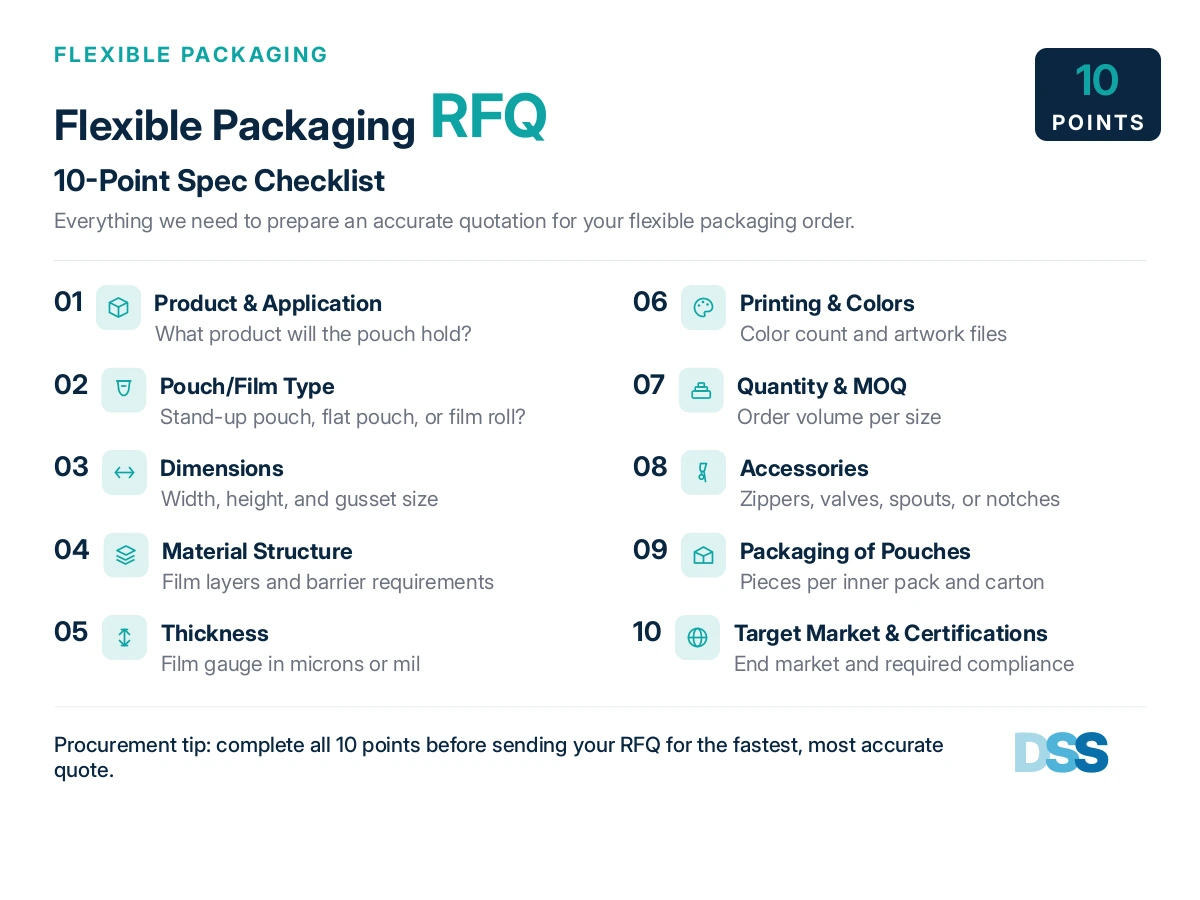
- The 10-point spec checklist covers product, pouch type, dimensions, material structure, thickness, printing, quantity, accessories, packaging, and target market.
- Gravure cylinders cost roughly $100–$150 (USD) per color as a one-time tooling fee, so a 6-color design adds about $600–$900 to the first order.
- DSS Pack works from MOQs of 10,000 units for pouches and 300 kg for rollstock film, with the fastest delivery of 15 days after order confirmation.
- Always state your target market and certification needs (ISO 9001, FDA, BRC) so the supplier engineers a compliant structure from the start.
Why a Complete RFQ Saves You Time and Money
An incomplete RFQ costs you four ways at once.
Clarification rounds. Every missing spec means another email and another wait. In practice, a sketchy brief adds 2 to 5 days to your timeline before a single number is quoted. Inflated quotes. Suppliers hedge against unknowns. If they do not know your dimensions, barrier needs, or target market, they price in the worst case. Incomparable quotes. If one supplier quotes a PET/PE stand-up pouch and another quotes a BOPP/PE flat bottom, you are not comparing the same product. Wrong materials. The most serious cost of all: a structure engineered without real requirements can become a food-safety and compliance risk once it reaches your shelf.
A snack brand’s founder once sent us a one-line RFQ: “need 100k pouches.” Three suppliers returned three wildly different prices, and none of the quotes described the same bag. After he spent twenty minutes completing the specs (product, dimensions, structure, print, market), the quotes converged and the best supplier became obvious. The spread between the highest and lowest quote narrowed sharply, and the winning quote was confirmed without further negotiation drama. No factory changed its pricing. The change was the brief.
The cost of clarity is small. The payoff is accurate pricing, a faster delivery timeline, and fewer surprises at the sampling stage. That is why this checklist exists: so your next flexible packaging quote is based on facts, not guesswork.
The Complete Flexible Packaging RFQ Checklist
Here are the 10 things every complete flexible packaging RFQ should include. Work through them in order and your supplier has everything needed to quote accurately on the first pass.
| # | Spec to include | Why it matters |
|---|---|---|
| 1 | Product & application | Drives material structure and barrier needs |
| 2 | Pouch / film type | Determines format, tooling, and cost |
| 3 | Dimensions | The biggest cause of back-and-forth |
| 4 | Material structure | Sets barrier, strength, food-contact properties |
| 5 | Thickness | Affects stiffness, durability, and price |
| 6 | Printing & colors | Sets artwork, cylinders, approval time |
| 7 | Quantity & MOQ | Directly drives per-unit cost |
| 8 | Accessories | Zippers, spouts, valves, easy-open features |
| 9 | Packaging of pouches | Affects cost and logistics |
| 10 | Target market & certifications | Determines compliance requirements |
If a section does not apply to your project, write “to be advised” instead of leaving it blank. That one word tells the supplier you expect a recommendation, not an omission.
1. Product & Application
Tell the supplier what goes inside the pouch. Product type, weight, portion size, target shelf life, storage condition (frozen, ambient, or refrigerated), and retail channel (e-commerce versus store shelf). All of these drive material structure and barrier requirements. A frozen dumpling bag and a dry snack bag need completely different films, and a supplier cannot make that call without knowing the application. If your product is frozen, our frozen food packaging guide walks through structures that hold up at low temperature. For shelf-life-sensitive snacks, see how high-barrier pouches protect candy and snacks.
2. Pouch / Film Type
Pick the format that fits your product and your filling line. Each type has a different machine format, tooling profile, and cost structure.
| Pouch / film type | Best for | Typical products |
|---|---|---|
| Stand-up pouch | Self-standing base, premium shelf presence | Snacks, coffee, pet food |
| Flat bottom pouch | Wide base, maximum display area | Premium coffee, nuts |
| 3-side seal pouch | Flat bag, cost-effective | Spices, dried goods |
| Back-seal pouch | Pillow-style, high-speed filling | Candy, single-serve items |
| Spout pouch | Resealable pour spout | Liquids, sauces, detergents |
| Rollstock film | Fill and seal on your own line | High-volume food lines |
| Lidding film | Peelable lid for trays | Ready meals, fresh produce |
| Thermoforming film | Vacuum skin and MAP | Meat, cheese, seafood |
Quick format notes: stand-up pouches, flat bottom pouches and 3-side seal pouches give you the strongest shelf and cost options. Back-seal pouches run fastest on high-speed lines. Spout pouches suit liquid lines, while rollstock film is the choice when you fill and seal in-house. Lidding film and thermoforming film are the two newer categories: if your product sits in a tray or moves through a vacuum skin machine, ask whether these formats fit your line before you settle on a pouch. If you are choosing between the two most common formats, our stand-up vs flat-bottom pouch comparison walks through the trade-offs. When in doubt, name the filling equipment you use; the supplier can match the format to your machine.
3. Dimensions
Give width x height, and add the gusset depths. Stand-up pouches need a bottom gusset depth; flat bottom pouches need side gussets. Provide the actual filled size, not just the pouch size, because a bag that looks right flat can be too tight when full. Include your tolerance expectations so there is no surprise at sampling. If you are unsure, tell the supplier the filled weight and the product’s shape. The engineering team can recommend dimensions that fill cleanly and stand correctly. For more on sizing, see our packaging material guide.
4. Material Structure
If you know the structure, state it. If you do not, describe the product, storage condition, and target shelf life, and let the supplier recommend. For frozen food, use the PA-based structures (PA = Nylon = NY); for snacks that need a long shelf life, metallized PET or AlOx gives the barrier without the weight of a foil layer.
| Structure | Typical use | Notes |
|---|---|---|
| BOPP/PE | Dry snacks, confectionery, light goods | Cost-effective, good print surface |
| MOPP/PE | Biscuits, crackers, low-moisture items | Matte, scratch-resistant finish |
| PET/PE | General purpose, moderate barrier | Strong, glossy, versatile |
| PA(NY)/PE | Freezer and puncture-prone products | PA = Nylon = NY; tough at low temperature |
| PET/PA/PE | Heavy contents, high puncture risk | Adds strength and barrier together |
| PA/PA/PE | Frozen food, large formats | Extra nylon for cold-temperature durability |
| Metallized PET / AlOx | Snacks, candy, coffee, high barrier | OTR / WVTR down to 0.5 or below |
Our high-barrier metallized PET film tests at OTR ≤ 0.5 cc/m²·day and WVTR ≤ 0.5 g/m²·day under MOCON testing (ASTM D3985 / ASTM F1249); AlOx structures test at ≤ 1.5 / ≤ 1.0. If your product needs numbers like these, put the target in your flexible packaging RFQ and ask for the test report with the quote.
5. Thickness
Most pouches fall in the 60 to 180 micron range. Heavy-duty or frozen formats may need more. If you are not sure, let the supplier engineer it, but state any drop, puncture, or impact concerns. A 2 kg dog food bag and a 30 g spice sachet should never share the same thickness, and the price difference shows it.
6. Printing & Colors
State the number of colors and any Pantone codes. This determines the number of gravure cylinders, the tooling cost, and the approval timeline. Gravure is the standard for print quality on large runs; digital printing fits low quantities. Gravure cylinders run roughly $100–$150 (USD) per color as a one-time tooling cost, so a 6-color design adds about $600–$900 to your first order. Larger repeat orders spread that cost across more units.
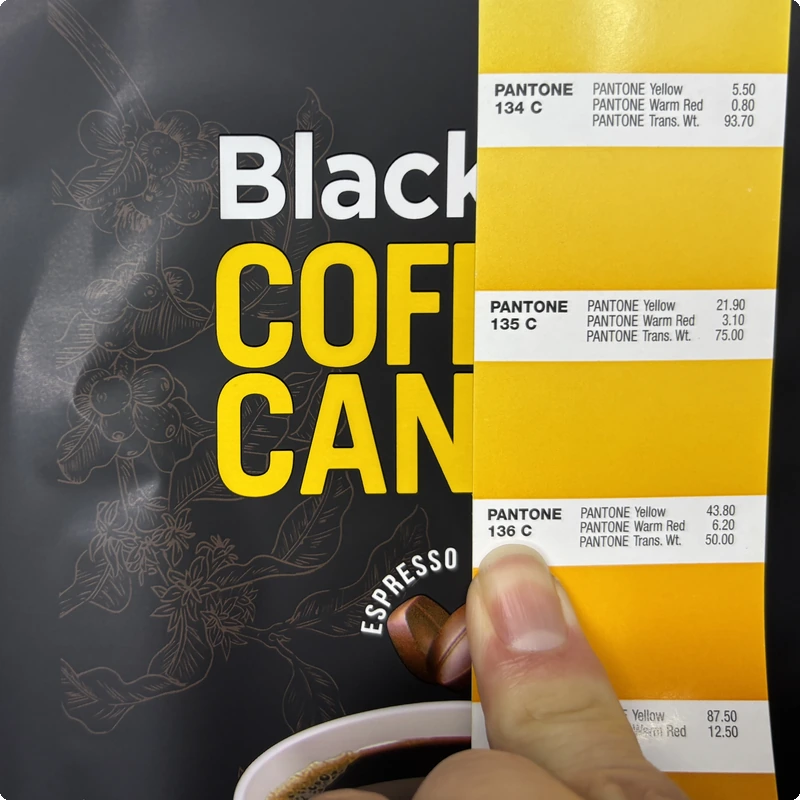
Send artwork as vector AI or PDF with bleed and a dieline. If you do not have a dieline, DSS’s in-house team can create one with you before production. Getting the file format right at the RFQ stage is the difference between a two-day art approval and a two-week one. One brand we worked with saved $900 on tooling by trimming a 6-color design to 4 with process shades — worth asking your designer about before you lock the art.
7. Quantity & MOQ
State your target quantity and ask about the MOQ. At DSS Pack, the MOQ is 10,000 units for pouches and 300 kg for rollstock film. Larger quantities lower the per-unit cost because cylinder tooling and setup amortize across more pieces. If you are testing a new product with a small first run, our low MOQ custom packaging guide explains how to keep a custom pouch price quote reasonable at entry volumes.
8. Accessories
List every extra feature you need: press-to-close or slider zipper, tear notch, hang hole, euro slot, spout, and easy-open features. Resealable zippers matter for snack and pet food lines. A one-way degassing valve belongs in coffee bean packaging — and in the rare food that keeps off-gassing after sealing — where it lets CO₂ escape without letting oxygen in; it adds cost and is unnecessary for most products. For tray products, specify the required lidding peel strength. Every accessory changes tooling and price, so list them all up front.
9. Packaging of Pouches
Bulk bags of 100, 500, or 1,000? Retail-ready individual boxes? Specific export carton sizes? This is the spec most buyers forget, and it affects cost and logistics. If your warehouse needs a certain carton weight or pallet layout, write it in. Getting this wrong at the quoting stage means repacking fees later.
10. Target Market & Certifications
State where the finished product will be sold: US, EU, AU, UK, or elsewhere. This drives the certification requirements for your packaging. DSS Pack holds ISO 9001 for quality management (ISO 9001 standard), FDA compliance for US food contact (FDA food-contact substances), and BRC for the UK and EU retail market (BRCGS packaging materials). Ask the supplier which certifications apply to the exact structure you are quoted, not just the factory as a whole. The cheapest quote without the right compliance is the most expensive quote you will ever accept.
7 Flexible Packaging RFQ Mistakes That Delay Your Quote
Avoid these seven and your quote arrives faster and stays accurate.
- Omitting dimensions. The biggest cause of back-and-forth. Without width, height, and gussets, no supplier can quote accurately.
- Not stating the product or application. If the supplier does not know what goes inside, they cannot engineer the right structure.
- Forgetting print details. Missing color count, Pantone codes, or file format delays artwork approval and adds revision rounds.
- Ignoring MOQ. A quantity below the MOQ triggers a requote or a price shock. Check the MOQ before you send the RFQ.
- Not specifying target market or certifications. Wrong compliance is a food-safety and legal risk, not a paperwork issue.
- Over- or under-specifying the barrier. Metallized film for everything wastes money; standard film for everything risks shelf life. Match the barrier to the product.
- Not asking about lead time and trade terms. Delivery and Incoterms surprises are the most common post-quote complaints.
If you are reading this before sending your first request, treat it as a checklist for what to include in a packaging RFQ. Fix these seven and the remaining work is filling in a form.
Sample RFQ Template You Can Copy
Here is a ready-to-use packaging RFQ template. Fill in what you know and leave the rest blank for supplier recommendations.
[Company] / [Contact] / [Email]
Product to be packed: [product, weight, portion]
Pouch/film type: [stand-up / flat bottom / 3-side seal / back-seal / spout / rollstock / lidding / thermoforming]
Dimensions: [W x H (+ bottom/side gusset)]
Material structure: [if known]
Thickness: [if known]
Printing: [colors, Pantone codes, file format]
Quantity: [pcs or kg]
Accessories: [zipper, tear notch, hang hole, spout, valve]
Packaging of pouches: [bulk / retail-ready]
Target market & certifications: [US/FDA, EU/BRC, AU]
Expected delivery: [date]
Trade terms: [EXW / FOB / CIF / DDP]
That template is the core of how to write a packaging RFQ. Fill what you know, describe what you do not, and let the supplier fill the gaps. Do not worry if some lines stay empty; a capable supplier treats blanks as engineering questions, not missing information. When you submit your complete RFQ to DSS Pack, the engineering team completes the missing specifications and confirms them with you before a single number is quoted.
Trade Terms You Should Specify
Choose an Incoterm and put it in the RFQ so the quote means the same thing on both sides.
- EXW (Ex Works): you arrange all logistics from the factory door. Lowest product price, most work for you.
- FOB (Free on Board): the seller covers transport to the port of loading and loading onto the vessel. Common for sea freight buyers.
- CIF (Cost, Insurance, Freight): the seller covers freight and insurance to the destination port. Useful when you want one party to handle the shipping leg.
- DDP (Delivered Duty Paid): the seller handles everything, including duties and customs clearance, up to your door. Easiest for the buyer.
For a first order, DDP is often the smoothest choice for overseas buyers because it removes customs complexity and gives you a landed cost up front. If you already work with a freight forwarder, FOB or EXW may be cheaper. Whichever you choose, name it in the RFQ. A quote without an Incoterm is a quote you cannot compare, no matter how detailed the rest of the spec is. The official rules are published by the International Chamber of Commerce.
Certifications & Documentation
Three certifications matter most when sourcing flexible packaging from China.
- ISO 9001: the quality management system that keeps production consistent and traceable.
- FDA: US food-contact compliance for the materials that touch your product.
- BRC: the benchmark for UK and EU retail. This is the one brand owners ask about most when sourcing from China.
When you request a quote, also ask for documentation: certificates that apply to the exact structure, test data such as OTR and WVTR where barrier matters, material declarations, and migration test reports for food contact. A certificate for a factory is not the same as a certificate for your structure. DSS Pack holds all three certifications, and the documents accompany each order.
After You Send a Complete RFQ to DSS Pack
When your RFQ lands in our inbox, the engineering team reviews your specs and recommends the structure and format if you left anything blank. You receive a quotation within days. After confirmation, we move to samples and production, with the fastest delivery of 15 days after order confirmation. To speed things up, include the product details, portion size, and shelf-life target in your first message. That context lets the engineer skip the obvious questions and go straight to the material structure. Send your RFQ →
Conclusion
A complete flexible packaging RFQ is the difference between guessing and knowing. It gets you accurate quotes, faster responses, and genuinely comparable options from different suppliers. Use the checklist, fill in the template, and state your market and trade terms. Then get an accurate quote → from a manufacturer certified ISO 9001, FDA, and BRC, with an MOQ of 10,000 pouches or 300 kg of rollstock and the fastest 15-day delivery after order confirmation.
Frequently Asked Questions
What is a flexible packaging RFQ?
A flexible packaging RFQ is a formal request for quotation that specifies your pouch or bag requirements, including product, dimensions, material structure, printing, quantity, and target market. It is the document a supplier needs to price your order accurately.
What information does a packaging supplier need to quote?
A supplier needs your product details, pouch or film type, dimensions, material structure (or product description), thickness, printing specs, quantity, accessories, packaging, and target market and certifications. The 10-point checklist above covers all of it.
Can I get a quote without knowing the material structure?
Yes. Describe your product, storage condition, and target shelf life, and a good supplier will engineer the structure for you. DSS Pack’s engineering team routinely fills this gap before quoting.
What is the MOQ for custom pouches?
DSS Pack’s MOQ is 10,000 units for pouches and 300 kg for rollstock film. Larger quantities lower the per-unit cost as cylinder tooling and setup amortize across the run.
Do I need to provide artwork for printing?
Print-ready vector artwork (AI or PDF) with bleed is preferred. If you do not have a dieline, DSS’s in-house team can create one for you before production.
See the full FAQ for more on ordering custom flexible packaging.