The most common way frozen food packaging fails is not a leak. It is a crack that appears the moment a bag is dropped at -25°C. Cold-chain handling is hard on film: pallets get bumped, cases get stacked, and bags that flexed fine at room temperature shatter once they turn brittle. Failures in frozen food packaging follow a predictable order: cold-crack first, impact second, seal failure third. Freezer burn matters, but it shows up later, after the mechanical damage has already happened.
This guide covers what actually breaks frozen food packaging, the film structures that survive deep freezing, the pouch formats that work on automated lines, and the test standards to demand from a supplier. It is written for brand owners, production managers, co-packers, and procurement teams who need packaging that survives the cold chain.
DSS Pack is a Chinese flexible packaging manufacturer certified to ISO 9001, FDA, and BRC, supplying direct from our own factory.
Key Takeaways
- Cold-crack resistance is the number-one priority for frozen food packaging. Standard PP films embrittle at freezer temperatures; the right laminate stays flexible down to -40°C.
- Mainstream structures are BOPP/PE, MOPP/PE, PET/PE, and PA (Nylon / NY)/PE. Premium upgrades add a second nylon layer, as in PET/PA/PE and PA/PA/PE.
- Metallized PET and aluminum foil are not needed for most frozen food: they heat-seal poorly at low temperature, cost more, and rarely pay back.
- Industrial formats lead: 3-side seal pouches, back-seal (center-seal) pouches, and rollstock film. Stand-up and flat-bottom pouches serve retail display only.
- Verify cold performance with ASTM D1790, ASTM D1709, ASTM F88/F2096, ASTM F392, and a cold drop test, then confirm certifications (ISO 9001, FDA, BRC).
Why Frozen Food Packaging Fails: Cold-Crack, Impact & Seal Problems
Ask a packaging engineer what kills frozen bags, and they will not start with oxygen or water vapor. They will start with the freezer. These are the failure modes that drive returns, in order of importance.
Cold-Crack & Low-Temperature Embrittlement
Every polymer has a glass transition temperature. Below it, film stops flexing and behaves like glass. Polypropylene is the worst offender: OPP films embrittle badly at low temperature, which is why a single-layer OPP bag should never be used for long-term frozen storage. The outer BOPP layer on a frozen bag must always be laminated to PE or PA so the composite keeps flexing at -18°C, -30°C, and even -40°C blast-freezing conditions.
A frozen dumpling exporter in northern China learned this the hard way. Their single-layer PE bags looked fine in the warehouse at 20°C. Three weeks into a -25°C export shipment, pallets shifted inside the container, and an alarming share of the bags cracked along the fold lines. The product stayed frozen, so nobody noticed until the bags were opened at retail. The fix was not a thicker film. It was a BOPP/PE laminate with a low-temperature sealant layer that keeps its flexibility below freezing.
Impact & Drop at Freezer Temperature
A bag that survives a drop at room temperature can shatter at -25°C, because frozen product is heavy and rigid and the impact lands directly on the film. The vulnerable moments are line transfers, case packing, pallet stacking, and forklift contact. This is where impact strength, measured by falling dart energy or a cold drop test, separates packaging that survives from packaging that costs you a recall.
Seal Failure & Leakage
Seals fail before the film does, and they fail silently. At low temperature, the seal layer embrittles and micro-channels open along the heat-seal line without a visible tear, so brine and drips escape. Seal strength must be verified at freezer temperature, not at 23°C lab conditions.
Freezer Burn — A Moisture Problem, Not a Barrier Problem
Freezer burn is real, but it is a moisture migration problem, not an oxygen problem. Ice sublimates to vapor at -18°C and escapes through the film, leaving pale, dry patches. The fix is water-vapor control plus a tight seal with minimal headspace. You do not need a five-layer EVOH barrier for a standard frozen vegetable or dumpling.
Frozen Food Packaging Materials & Bag Formats: The Real-World Structures
Most frozen food packaging on a supermarket shelf uses one of a handful of laminates, none of them exotic. The industry consensus is a short list of structures built around low-temperature toughness.
How to Read a Film Structure
Every laminate has three functional layers. The outer layer carries print, stiffness, and scuff resistance. The middle layer provides mechanical performance such as puncture resistance. The inner sealant layer faces the food, forms the heat seal, and must stay flexible at low temperature. Read the structure from the outside in: BOPP/PE means a BOPP outer film and a PE sealant.
BOPP/PE & MOPP/PE
BOPP/PE is the economical mainstream for frozen dumplings, spring rolls, vegetables, and everyday frozen foods. BOPP prints well and gives stiffness; PE delivers a flexible, low-temperature seal. MOPP/PE is the same idea with a matte outer film for a premium appearance. Both survive -18°C retail storage when the PE sealant is properly formulated. Never use a single-layer OPP film on its own: it embrittles at low temperature and must be laminated with PE or PA.
PET/PE
PET/PE is the general-purpose structure for ready meals and lighter frozen items: PET adds stiffness and print quality, PE seals at low temperature, and the result is a glossy, dependable bag at a moderate price.
PA (Nylon / NY)/PE
PA, Nylon, and NY all refer to the same material, a polyamide film and the workhorse of frozen meat and seafood packaging. PA adds high tensile strength, puncture resistance, and low-temperature impact toughness for fish bones, shrimp shells, and bone-in cuts. PA/PE is also the standard starting point for vacuum packaging. If your product has sharp edges, PA is the layer doing the heavy lifting.
PET/PA/PE & PA/PA/PE
When the product is heavy, sharp, or stored long, step up to a three-layer premium structure. PET/PA/PE combines print quality and stiffness with nylon’s toughness, a common choice for frozen seafood and prepared meals. PA/PA/PE uses two nylon layers for the highest strength in the lineup, suited to bone-in meat and long cold-chain journeys.
Why Not Metallized PET or Aluminum Foil?
It is tempting to assume frozen food needs the maximum barrier you can buy. It usually does not. Metallized PET (VMPET) and aluminum foil have two problems in the freezer: their low-temperature heat-seal performance is weak, so they run poorly on high-speed lines and fail at the seal; and they cost significantly more. For a product already stored at -18°C, that is low cost-performance. A rare long-shelf-life specialty product might justify foil, but conventional frozen food is better served by a well-built BOPP/PE, PET/PE, or PA/PE laminate. For genuinely high-barrier needs, see our high-barrier pouch guide.
Film Structure Comparison
| Structure | Cold-crack resistance | Impact strength | Puncture resistance | Relative cost |
|---|---|---|---|---|
| BOPP/PE, MOPP/PE | Good (with PE sealant) | Moderate | Low | Low |
| PET/PE | Good | Moderate | Moderate | Moderate |
| PA (Nylon / NY)/PE | Excellent | High | High | Moderate |
| PET/PA/PE | Excellent | High | High | Higher |
| PA/PA/PE | Excellent | Highest | Highest | Highest |
Materials × Food Type
| Structure | Best for | Why it works |
|---|---|---|
| BOPP/PE, MOPP/PE | Dumplings, spring rolls, vegetables, light frozen foods | Low cost, good print, flexible low-temp seal |
| PET/PE | Ready meals, lighter frozen items | Stiffness, gloss, dependable all-rounder |
| PA (Nylon / NY)/PE | Meat, seafood, bone-in cuts, sharp edges | Puncture resistance, low-temp impact strength, vacuum-capable |
| PET/PA/PE | Frozen seafood, prepared meals, longer storage | Print quality plus nylon toughness |
| PA/PA/PE | Bone-in meat, heavy loads, long cold-chain journeys | Maximum mainstream strength and puncture resistance |
Not sure which structure fits your product? Tell us what you pack, how it is stored, and how it moves through the cold chain, and our engineers will shortlist two or three options with the trade-offs spelled out. Start the conversation →
Pouch Formats for Frozen Food — 3-Side Seal, Back Seal & Rollstock Do the Heavy Lifting
Three formats carry the volume in industrial frozen food: 3-side seal pouches, back-seal (center-seal) pouches, and rollstock film for automated lines. Stand-up and flat-bottom pouches have their place, but it is retail display, not production efficiency.
3-Side Seal Pouches
The 3-side seal pouch is the economical workhorse. A flat pouch sealed on three sides is cheap, seals strongly, and is the most common frozen food pouch for seafood, vegetables, and single-serve portions. It is also the easiest to print across a full face. See our 3-side seal pouch options for single-serve and portion-pack designs.
Back-Seal (Center-Seal) Pouches
Back-seal pouches, also called center-seal or fin-seal pouches, are sealed down the back with the seal oriented to the side. The geometry gives better lateral pressure resistance and a lower damage rate in transit, which matters when bags turn brittle in the freezer. For frozen dumplings and packed-tight products, back-seal is one of the two most common pouch types precisely because it survives stacking and palletizing. For high-volume, hard-handled product, specify it. See back-seal pouch options →
Rollstock Film
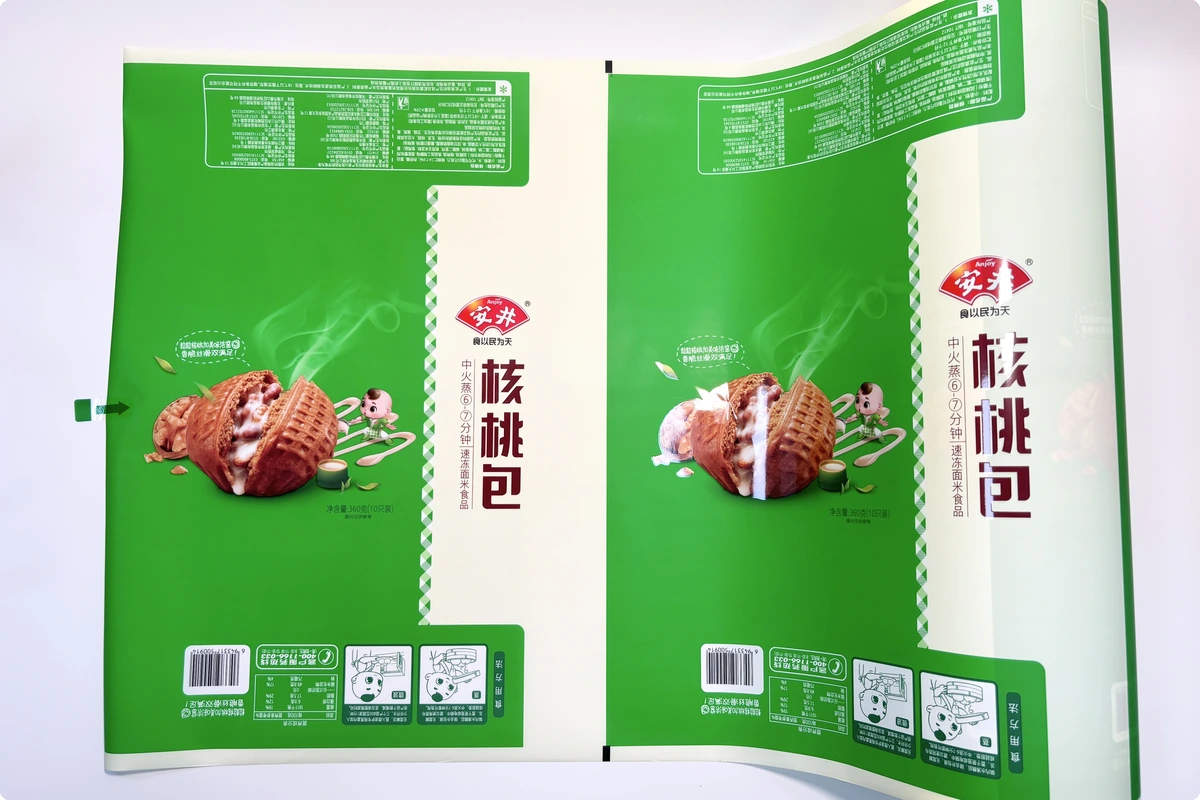
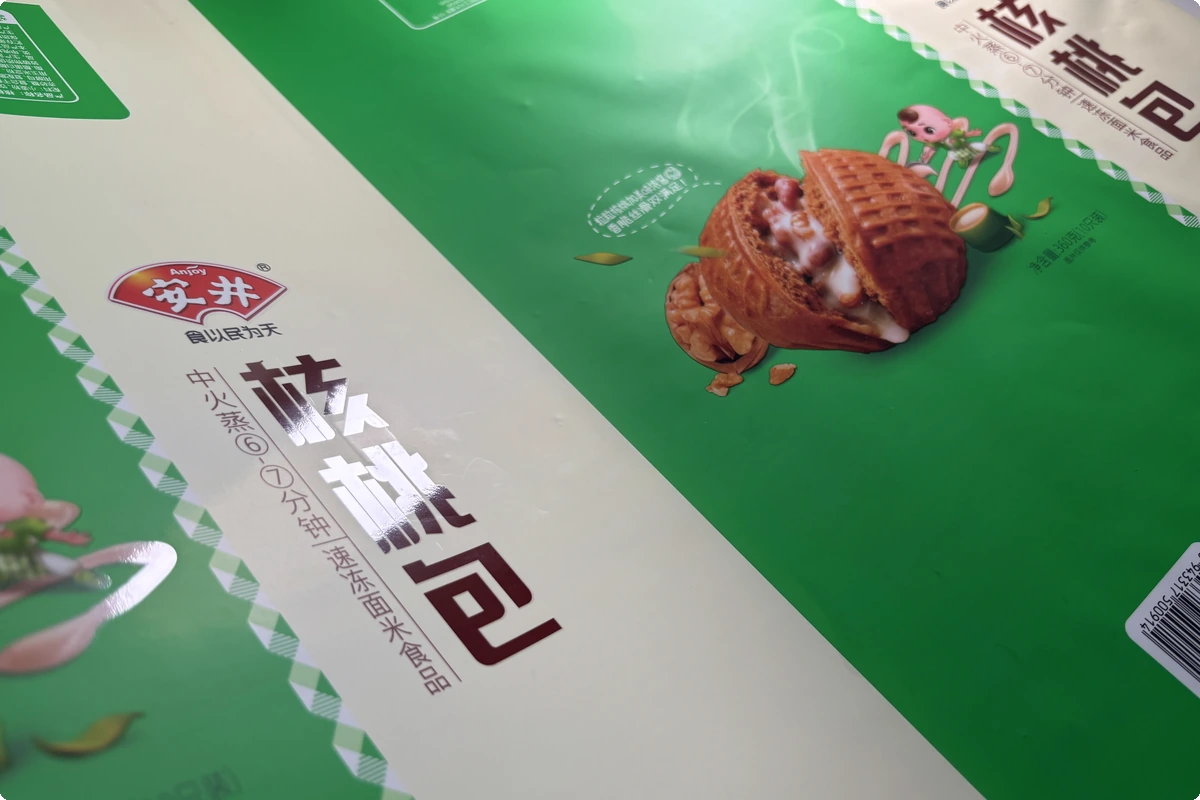
Rollstock film, also called reel film, is the entry product for frozen food packaging. It runs on vertical form-fill-seal (VFFS) or horizontal form-fill-seal (HFFS) machines, forming, filling, and sealing the bag in one continuous line. It is the fastest, cheapest way to package frozen product at scale. DSS supplies rollstock from a 300kg minimum order, with a fastest 15-day delivery after order confirmation. Explore rollstock film →
Retail Display Formats
Stand-up and flat-bottom pouches add shelf presence, so they belong on retail-display products where the bag has to sell the food. For most frozen food they are the secondary choice: more material, more cost, and more dead space in the cold chain. If retail display is the goal, a stand-up pouch or flat-bottom pouch can be the right call. See our stand-up vs. flat-bottom comparison for the details.
Vacuum Pouches
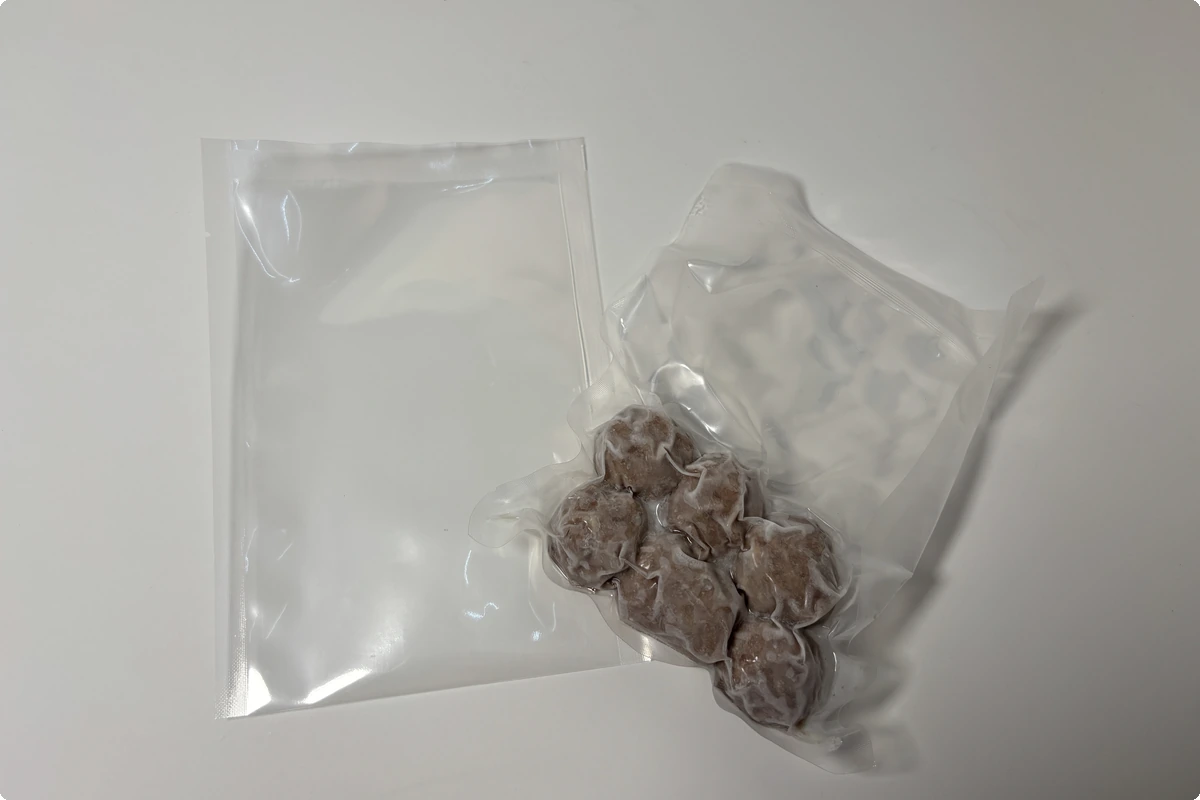
For premium frozen meat and seafood, vacuum packaging removes oxygen and presses the film tight against the product, extending shelf life. A PA (Nylon)/PE vacuum pouch gives the low-temperature toughness and puncture resistance that raw cuts and fillets need. The tight skin contact also reduces freezer burn, because no air pocket remains for moisture to escape into.
Pouch Format × Product
| Product | Primary format | Why |
|---|---|---|
| Frozen dumplings, spring rolls, buns | Back-seal or 3-side seal | High speed, low damage rate, cost-efficient |
| Frozen vegetables, seafood portions | 3-side seal | Economical, strong seals, full-face print |
| Large-volume frozen product | Rollstock (VFFS/HFFS) | Continuous automated lines, lowest unit cost |
| Premium frozen meat, seafood | Vacuum pouch | Extended shelf life, anti-freezer-burn skin contact |
| Retail display products | Stand-up / flat-bottom | Shelf presence on the frozen aisle |
Cold-Crack Resistance & Impact Strength — The Tests That Matter
Very few packaging suppliers publish cold-performance test data. That is the gap to exploit when qualifying a supplier. These are the standards the industry uses to prove a film survives the freezer.
ASTM D1790 Brittleness Temperature
ASTM D1790 measures the temperature at which a film up to 1mm thick becomes brittle under impact. A specimen is cooled in stages and struck repeatedly until a set percentage fails, giving the brittleness temperature: the lowest temperature at which the film still absorbs impact instead of shattering. For a bag seeing -18°C retail or -40°C blast freezing, ask for the brittleness temperature of the complete laminate, not just the base resin.
ASTM D1709 Falling Dart Impact (F50)
ASTM D1709 quantifies impact strength by dropping a dart onto a clamped film and finding the weight at which 50% of specimens fail, reported as F50. Method A uses a smaller dart and lower drop height for thin films; Method B uses a larger dart and a 1.5m drop for heavier films. A heavy-duty frozen bag needs a higher F50 than a light snack bag, and the number should come from a test report, not a brochure.
ASTM F88 Seal Strength & ASTM F2096 Leak Test
Seal strength is measured with ASTM F88, a 180° peel test that records the maximum force a seal can take in N/15mm or N/25mm. The industry reference for a dependable frozen bag seal is at least 14N/15mm, with heavier formats running higher. ASTM F2096 is the bubble emission leak test: the bag is pressurized underwater, and escaping air reveals micro-channels a visual check would miss. Together they answer two questions: can the seal hold, and is the package airtight?
ASTM F392 Gelbo Flex for Low-Temperature Flexibility
Where does “the film stays flexible in the freezer” come from? The standard way to test it is ASTM F392, the Gelbo flex test: a film specimen is twisted and flexed repeatedly at low temperature, then checked for pinholes and cracks. It simulates the creasing and flexing a bag endures in transit far better than a static cold test. Ask your supplier for F392 results at -18°C or -30°C, not just at room temperature.
Cold Drop Test
The cold drop test is the most practical check of all. Condition filled bags at the temperature they will actually see, -18°C retail or -40°C blast freezing, then drop them from 1 to 1.5 meters and check for breaks and leaks. A typical industry reference is ten drops from 1.5m with no break and no leak. One detail matters: complete the drops within one to five minutes of leaving the cold chamber, because a warmed surface will pass a test the cold bag would fail.
What to Ask Your Supplier
When you shortlist a frozen food packaging supplier, ask for the brittleness temperature of the laminate, the falling dart impact F50 with the test method stated, seal strength at freezer temperature, a cold drop report at -18°C or -40°C, and the puncture resistance in newtons. A supplier that can produce these numbers is engineering for the cold chain. A supplier that cannot is selling you a guess. Get a quote with test documentation →
Lidding Film for Frozen Food Trays
Lidding film is the sheet heat-sealed onto the flange of a PP or PE tray to close a frozen meal or seafood pack. It is a growing segment of frozen food packaging, because trays give brands premium presentation and easy portion control.
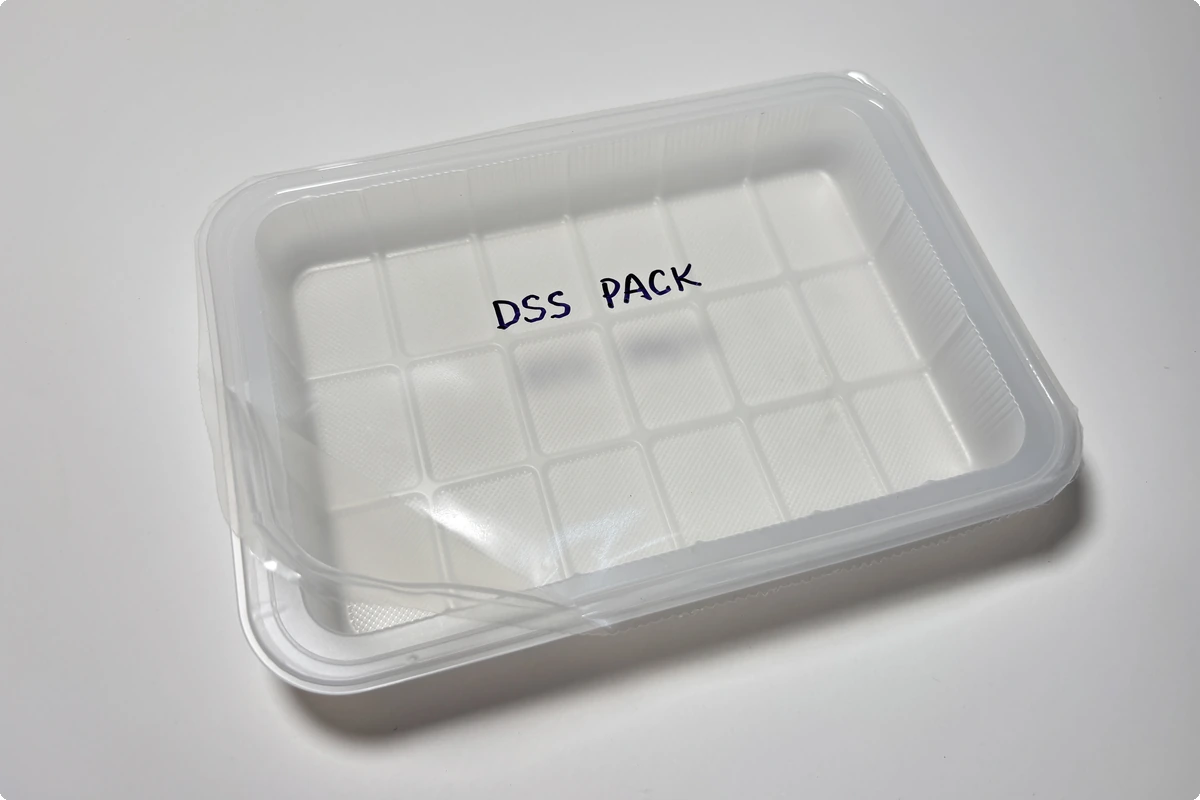
DSS produces lidding film with proven structures for different tray materials. PET/PE is the general-purpose option for most frozen applications. PET/PP is the non-frozen option where higher heat resistance is needed. PA/PE is the easy-peel structure for PE and PP trays, opening cleanly without tearing the flange.
The key metric is peel strength. For easy-peel lids, the typical industry range is 5 to 15N/15mm, tuned so the lid opens smoothly but does not pop open in transit. Getting this right matters more at freezer temperature, because a peel force set at room temperature behaves differently on a frozen tray.
For frozen food, lidding film must hold its seal integrity at -18°C and below, resist moisture loss to prevent freezer burn, and, for ready meals, survive the trip from freezer to microwave or oven. Ask how peel strength is calibrated at low temperature, not just at 23°C.
Thermoforming Film & Vacuum Skin Packaging for Frozen Food
Thermoforming and vacuum skin packaging use two films, not one, and both have to survive the freezer.
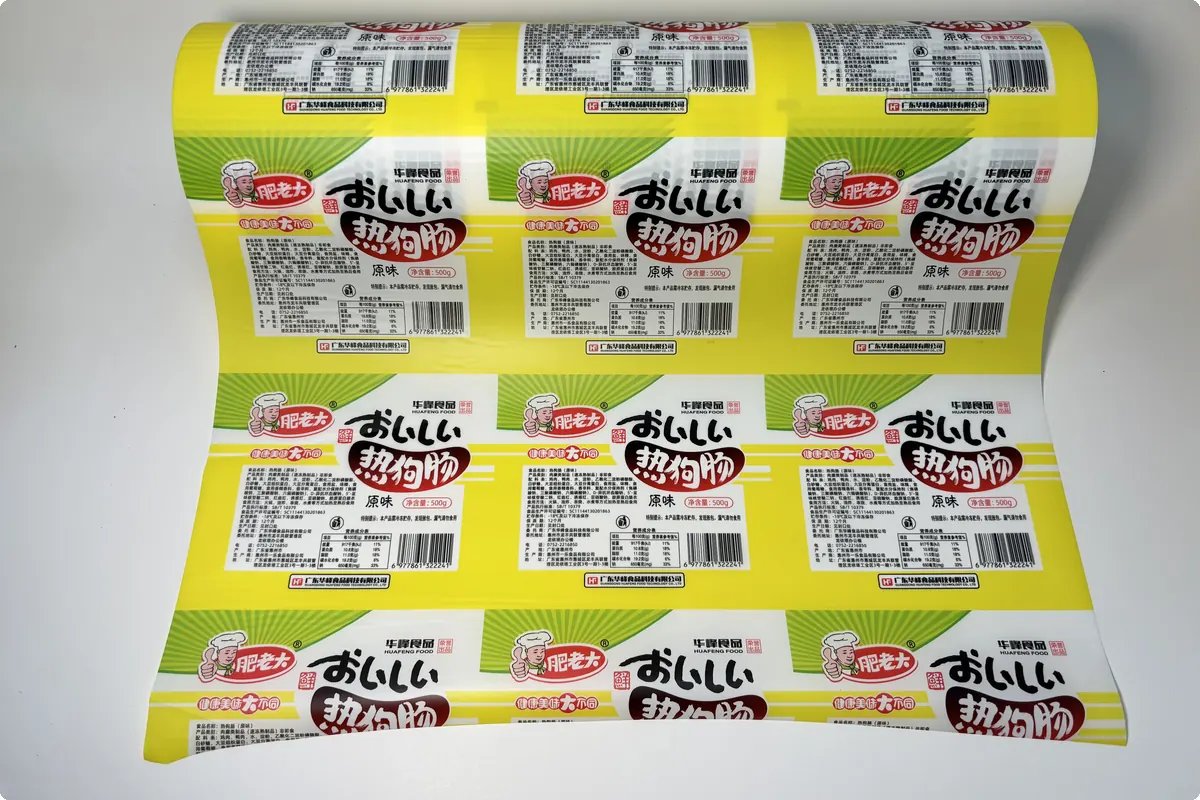
The bottom forming film is a multi-layer co-extruded film heated and drawn over the product in the forming station. One side stays flat while the other takes the product’s contour, forming a deep cavity around a fillet or cut. The top film seals over it, either as a flat lidding web or, in vacuum skin packaging, as a skin film that shrinks tightly around the product.
DSS supplies proven top film structures. PA/PE is the general-purpose top film for frozen meat and seafood, combining toughness with a flexible low-temperature seal. PA/RCPP handles 121°C retort processing for shelf-stable products that also pass through frozen distribution. PA/PE (easy-peel) gives a controlled peel for consumer packs. All three resist embrittlement at -18°C and take punctures from fish bones, shrimp shells, and bone-in cuts.
The frozen-food benefit is the tight skin contact. When the film hugs the product, no air pocket remains for moisture to escape into, suppressing freezer burn and ice crystals. For frozen meat, seafood fillets, shrimp, and bone-in cuts, this format is worth serious consideration.
Preventing Freezer Burn — Moisture Control, Not High Barrier
Freezer burn is the pale, dry, leathery patch that appears when ice sublimates directly to vapor and moisture leaves the product. It is a water-vapor transmission problem, so the lever is WVTR control: a film that keeps moisture in, a genuinely tight seal, and minimal headspace in the pack.
Here is the part that surprises most buyers: conventional frozen food does not need high oxygen barrier, EVOH, or metallized film. The product is stored at -18°C, where microbial growth and oxidation are already slowed dramatically by temperature. Adding oxygen barrier adds cost, not protection.
For freezer burn prevention, the levers are the ones above: moisture control, seal integrity, and headspace management. When do you upgrade to a higher barrier? If you are vacuum-packing premium frozen meat or seafood for a long shelf life, a structure with nylon and, in rare cases, an EVOH layer starts to make sense. That is a deliberate decision for a shelf-life target, not a default. For everything else, focus your budget on cold performance, seal integrity, and moisture control. See our high-barrier pouch article for genuinely high-barrier needs.
Compliance & What to Verify
Frozen food packaging is food-contact packaging, so certification is non-negotiable. At minimum, confirm three things before you commit to a supplier.
ISO 9001 covers quality management, meaning documented, audited production processes. FDA certification confirms the materials are food-contact safe for the US market, a requirement for US and AU retail chains. BRC is the retail gold standard in the UK and Europe, and the certification most brand owners look for first when sourcing from China. DSS Pack holds all three. See the BRCGS Packaging Materials standard for what the certification covers.
Beyond certificates, verify food-contact safety in the details: low-migration inks and coatings, no odor transfer to the product, and a sealant layer approved for direct food contact. For US-market sales, check the FDA food-contact regulations. For export orders, ask how the factory documents compliance on the specific structure, not just the company.
Before you place an order, run this checklist: certificates on file (ISO 9001, FDA, BRC), cold test data for the proposed structure, an MOQ that fits your scale (DSS: 10,000 units for pouches, 300kg for rollstock), and a lead time you can plan around (DSS: fastest 15-day delivery after order confirmation). If your volume is small, see our low-MOQ custom flexible packaging guide.
Frequently Asked Questions
Why does frozen food packaging crack in the freezer?
Films crack when they pass their glass transition temperature and become brittle. A drop or sharp fold then creates a crack instead of a flex. Polypropylene embrittles worst, which is why frozen bags use PE or PA sealant layers that stay flexible at -18°C, -30°C, and -40°C. That is why cold-crack resistance is the first priority in frozen food packaging.
Which material is best for frozen food bags?
For strength and puncture resistance, PA (Nylon / NY)/PE is the best all-rounder, especially for meat, seafood, and sharp edges. For economical packaging, BOPP/PE and MOPP/PE deliver the best value. PET/PE is the general-purpose choice, and PET/PA/PE or PA/PA/PE covers premium or long-storage applications. The right answer depends on your product and its shelf life.
How do I prevent freezer burn?
Control moisture loss: use a film with good water-vapor transmission performance, keep the seal tight, and minimize headspace. For premium frozen meat and seafood, vacuum packaging presses the film against the product and eliminates the air pocket altogether. You do not need high oxygen barrier to prevent freezer burn on conventional frozen food.
Is metallized film needed for frozen food?
Usually not. Metallized PET and aluminum foil heat-seal poorly at low temperature, cost more, and deliver low cost-performance for a product already stored at -18°C. They are justified only for rare long-shelf-life specialty products. For conventional frozen food, a well-built BOPP/PE, PET/PE, or PA/PE laminate is the right choice.
What is the difference between back-seal and 3-side seal for frozen food?
A 3-side seal pouch is flat and sealed on three sides; it is economical, seals strongly, and suits single-serve frozen products. A back-seal (center-seal) pouch is sealed down the back, giving better lateral pressure resistance and a lower damage rate in transit. For brittle frozen bags and densely packed dumplings, back-seal survives stacking better.
What certifications does DSS Pack hold?
DSS Pack holds ISO 9001 (quality management), FDA (US food-contact safety), and BRC (retail standard for the UK and European markets), all documented on the structures we supply.
Can lidding film be used on frozen food trays?
Yes. PET/PE is the general-purpose lidding film for frozen trays, PET/PP suits non-frozen applications, and PA/PE provides an easy-peel seal for PP and PE trays. For frozen ready meals, confirm the peel strength is calibrated at freezer temperature, not just room temperature.
Have more questions? Browse our full packaging FAQ →
Conclusion
Frozen food packaging fails in a predictable order, and the fix follows it: cold-crack resistance first, impact and drop resistance second, seal integrity third, then moisture control for freezer burn. Choose a mainstream structure that works: BOPP/PE, MOPP/PE, PET/PE, or PA (Nylon / NY)/PE, upgraded to PET/PA/PE or PA/PA/PE for heavy or sharp product. Pick the industrial format that fits your line: 3-side seal, back-seal, or rollstock. And qualify the supplier on data: cold test reports plus the ISO 9001, FDA, and BRC certificates behind them.
DSS Pack builds frozen food packaging around exactly these priorities, with a 10,000-unit MOQ for pouches, 300kg for rollstock, and a fastest 15-day delivery after order confirmation. Request a quote →
For the full picture of how we support the frozen food sector, see our frozen food packaging industry page.