Pick the wrong pouch and you’re either overpaying per unit or underselling your brand on the shelf. I’ve seen both happen — a startup that burned through their launch budget on a format that was overkill for e-commerce, and a premium brand that lost retail placements because their pouches didn’t stand out. Here’s how the stand-up pouch vs flat bottom pouch comparison plays out in real cost, shelf presence, and capacity. Let’s break down the stand up pouch vs flat bottom pouch matchup across cost, shelf presence, and capacity — so you can pick the right format.
Key Takeaways
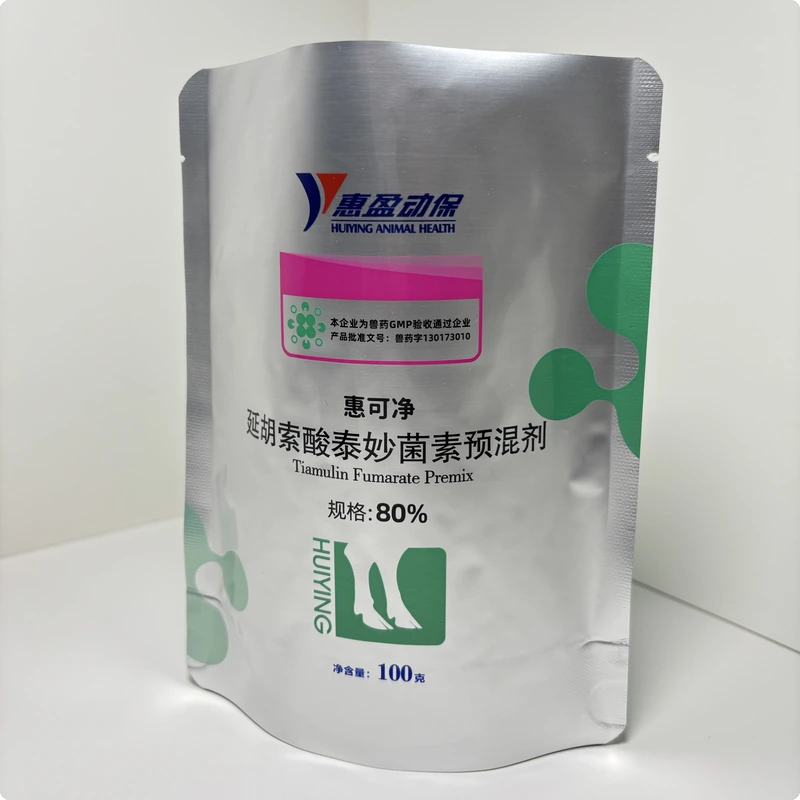
- Stand-up pouches (doypacks) use 10–20% less film — more affordable per unit, ideal for cost-sensitive and e-commerce-first brands.
- Flat bottom pouches offer 5-panel printing, stand independently, and hold 15–30% more at the same height — ideal for premium retail.
- Both formats are available at DSS Pack with ISO 9001, FDA, and BRC certifications at an accessible MOQ of 10,000 units.
- For retail coffee, we recommend the flat bottom pouch — better valve compatibility, better shelf stability, and that premium box shape.
- DSS Pack manufactures both with in-house engineering to help you pick the right format for your product dimensions, weight, and channel.
What Is a Stand-Up Pouch?
Structure & Design
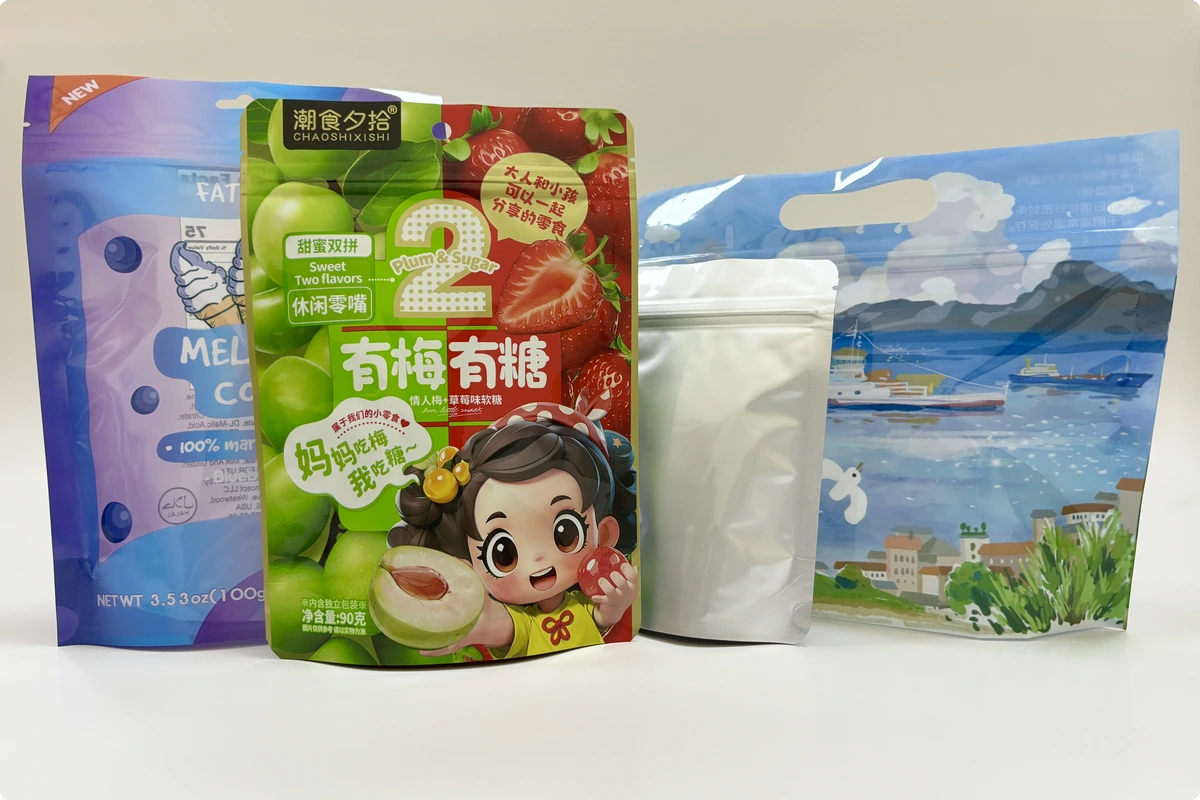
A stand-up pouch (or “doypack,” as most of the industry calls it) is a flexible bag with a bottom gusset. Fill it up, and the gusset opens into a flat base — that’s what makes it stand up. The body is made from multiple film layers (barrier materials like PET metallized film, aluminum foil, or transparent high-barrier coatings), heat-sealed at top and bottom.
Stand-up pouches typically offer 2 to 3 printable surfaces: front, back, and sometimes the bottom gusset. That’s less material and less cost than a flat bottom pouch.
Common Applications
Walk down any grocery aisle and you’ll see stand-up pouches everywhere:
- Snacks — chips, nuts, trail mixes, dried fruit
- Powders — protein powder, flour, drink mixes, spice blends
- Liquids — sauces, beverages (with spout fitments)
- Pet treats and food — dog treats, supplements
- Supplements — gummy vitamins, tablets, powdered greens
These pouches work best for products under 1 kg, where their lightweight construction translates directly into cost savings.
Key Features Available at DSS
DSS Pack manufactures custom stand-up pouches with a full range of customizable features:
- Resealable zipper — press-to-close or slider options
- Tear notch — easy-open for consumer convenience
- Hang hole — euro slot or punch hole for pegboard display
- Premium gravure printing — up to 10 colors with Pantone matching
Every stand-up pouch ships with ISO 9001, FDA, and BRC certifications. MOQ is 10,000 units with the fastest 15-day delivery after order confirmation.
What Is a Flat Bottom Pouch?
Structure & Design
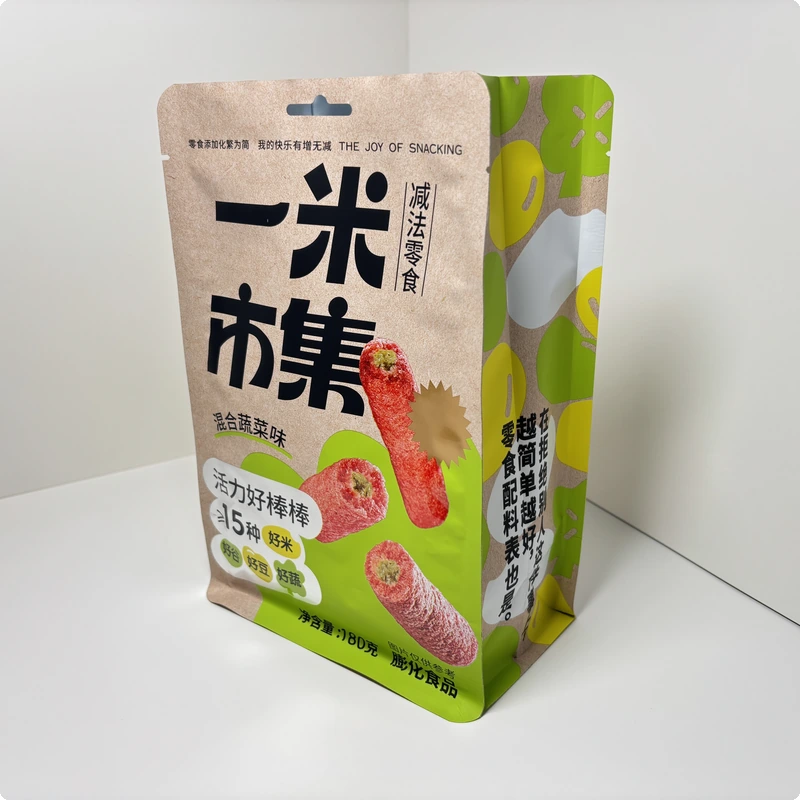
A flat bottom pouch (also called a box pouch or block bottom pouch) has a wide, flat base and side gussets that create a box-like shape when filled. Unlike stand-ups, it doesn’t need product weight to stay upright. Its base is fully sealed and rigid. It stands up even when completely empty.
The defining feature is the 5-panel construction: front, back, two side gussets, and a bottom panel. That’s significantly more real estate for branding than a standard stand-up pouch.
Common Applications
This format is the preferred choice when shelf presence and premium presentation matter:
- Whole-bean and ground coffee — often with a one-way degassing valve
- Pet food — dry kibble, jerky treats, freeze-dried raw food
- Dry goods — rice, beans, lentils, grains, pasta
- Premium snacks — artisan crackers, gourmet popcorn, chocolate-covered nuts
- Bulk products — versatile across weights from 100 g up to 10 kg, suitable for both retail and institutional packaging
Key Features Available at DSS
Everything we offer on stand-up pouches carries over to flat bottom pouch options — plus extras that only make sense on this format:
- Coffee degassing valve — one-way valve for fresh-roasted coffee
- Resealable zipper — compatible with press-to-close and slider profiles
- Premium gravure printing — full 5-panel coverage with Pantone matching
- Euro slot — for peg hook retail display
- High-barrier film — OTR ≤0.5 cc/m²·day, WVTR ≤0.5 g/m²·day (MOCON, ASTM D3985/F1249)
All flat bottom pouches are ISO 9001, FDA, and BRC certified, with the same 10,000-unit MOQ and fastest 15-day delivery.
Stand-Up Pouch vs Flat Bottom Pouch: Head-to-Head Comparison
Let’s line them up and see where each format wins:
| Factor | Stand-Up Pouch | Flat Bottom Pouch |
|---|---|---|
| Base Stability | Requires product inside to stand | Stands independently — even empty |
| Shelf Presence | Good — one front panel faces forward | Excellent — 5 panels visible from multiple angles |
| Branding Space | 2–3 printable panels | 5 printable panels (front, back, sides, bottom) |
| Internal Capacity | Standard volume at given dimensions | 15–30% more at same pouch height |
| Cost per Unit | Lower — uses less film | 10–20% higher — more material |
| Best for Weight | Under 1 kg | 100 g to 10 kg — adaptable across many weight ranges |
| Shipping Efficiency | More units per pallet — lighter, denser | Less efficient — rigid shape creates air gaps |
| Premium Perception | Good for mass market | High — box shape signals premium quality |
| Customization | Zipper, tear notch, hang hole | Zipper, coffee valve, euro slot, 5-panel print |
Stand-up wins on cost and shipping efficiency — the practical choice for high-volume, cost-sensitive products and e-commerce. Flat bottom wins on shelf impact, branding real estate, and capacity — the top choice for premium retail and heavier categories.
Cost Analysis: Which Pouch Saves You More?
When weighing stand up pouch vs flat bottom pouch cost, looking beyond unit price is the smartest move you can make. Here’s how the numbers break down.
Material Cost
Stand-up pouches use 10–20% less film than flat bottom pouches of comparable dimensions. That’s the primary reason for the price gap — fewer layers, less surface area, simpler gusset.
Flat bottom pouches carry a 10–20% premium per unit. That 5-panel construction adds cost — more film, more sealing area, more complex conversion. But brands often make it back on the shelf.
Gravure Cylinder Cost
Gravure cylinder costs differ between the two formats. A stand-up pouch requires 1 set of cylinders (typically 7–8 colors for the pouch body). A flat bottom pouch requires 2 sets: one for the pouch body and one for the side gusset panels, each also typically 7–8 colors. Pricing is approximately $100–$150 (USD) per color per cylinder. A stand-up pouch with a 7-color design runs $700–$1,050 in cylinder fees; a flat bottom pouch with the same 7 colors requires $1,400–$2,100 due to the additional side panel cylinder set. These are one-time fixed costs amortized across your entire production run.
MOQ Considerations
For growing brands, MOQ is often the first rude awakening. DSS Pack offers 10,000 units for both stand-up and flat bottom formats — well below the industry norm of 25,000–50,000. For more on how MOQ affects packaging strategy, see our low MOQ custom packaging guide.
Total Cost of Ownership
When evaluating stand up pouch vs flat bottom pouch cost, look beyond the unit price:
- Shipping: Stand-up pouches pack 15–25% more densely per pallet — lower freight per unit.
- Storage: Flat bottom pouches take up more warehouse space due to air gaps between pouches.
- Retail ROI: The premium appearance of a flat bottom pouch can boost sell-through in retail — sometimes enough to offset the higher per-unit cost.
For industry context, see the Smithers global flexible packaging market report, the official BRCGS Issue 9 Packaging Materials standard, and ASTM D3985 for oxygen transmission rate testing.
Shelf Presence & Branding Comparison
Visual Impact at Retail
Retail shelves are crowded. The flat bottom pouch has a clear advantage here — its box-like shape creates a structured, premium silhouette that stands out. Five panels visible from almost any angle means your brand gets multiple shots at grabbing attention.
Stand-up pouches work, but they’re narrower — one front panel, one shot. In high-density shelving (convenience stores, club stores), stand-up pouches pack more product into the same linear space, which can mean higher sales per square foot.
Branding Real Estate
The flat bottom pouch’s 5 printable panels are valuable for:
- Multi-language labeling — essential for export
- Regulatory information — ingredient lists, nutrition facts, without crowding the main design
- Recipe instructions — for coffee, dry mixes, prepared foods
- Promotional space — QR codes, social handles, loyalty programs
Stand-up pouches compensate with front-panel focus. Premium gravure printing makes that single panel count.
E-Commerce Photography
If you’ve ever tried to photograph a half-empty stand-up pouch, you know the pain. Flat bottom pouches sit upright naturally — just set it down and shoot. Consistent, repeatable, no propping required.
Capacity & Dimensional Comparison
In the stand up pouch vs flat bottom pouch matchup, capacity surprises many buyers. Here’s a detail most people don’t catch until it’s too late — internal volume differs significantly between the two formats.
Internal Volume
A flat bottom pouch holds 15–30% more than a stand-up at the same height. The stand-up’s bottom gusset leaves unused triangular space at the base corners.
| Pouch Size (W x H + Bottom Gusset) | Stand-Up (approx. fill) | Flat Bottom (approx. fill) |
|---|---|---|
| 5″ x 9″ (127mm x 229mm) | ~16 oz (450g) | ~20 oz (570g) |
| 7″ x 10″ (178mm x 254mm) | ~32 oz (900g) | ~40 oz (1,130g) |
| 15cm x 21cm + bottom 8cm | ~150g | ~195g |
| 18cm x 23cm + bottom 10cm | ~8 oz (227g) | ~10 oz (295g) |
| 8″ x 12″ (203mm x 305mm) | ~48 oz (1,360g) | ~64 oz (1,810g) |
Dimensional Efficiency
Stand-up pouches are 15–25% more shipping-efficient. Their flexible bodies nest tightly in cartons — lower freight costs per unit, which matters for e-commerce brands. Flat bottom pouches, with their rigid shape, create air gaps and carry fewer units per pallet.
DSS Pack’s in-house engineering team can size the perfect pouch based on your product dimensions, weight, and fill method.
Which Pouch Is Best for Coffee Packaging?
When it comes to stand up pouch vs flat bottom pouch for coffee, the answer depends on your retail channel and brand positioning. Coffee is the application that pushes both formats to their limits.
Coffee Valve Compatibility
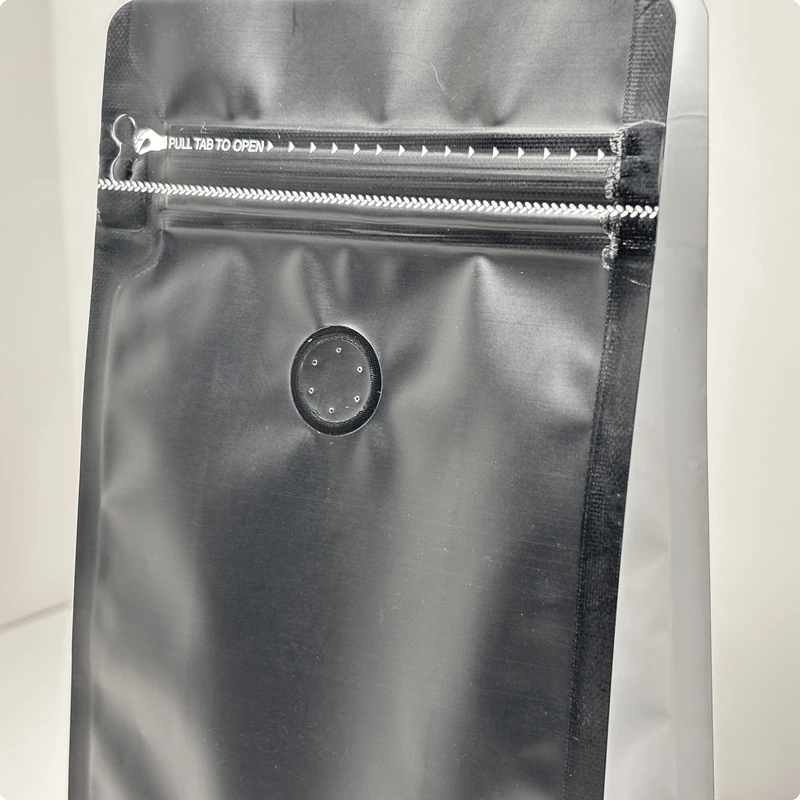
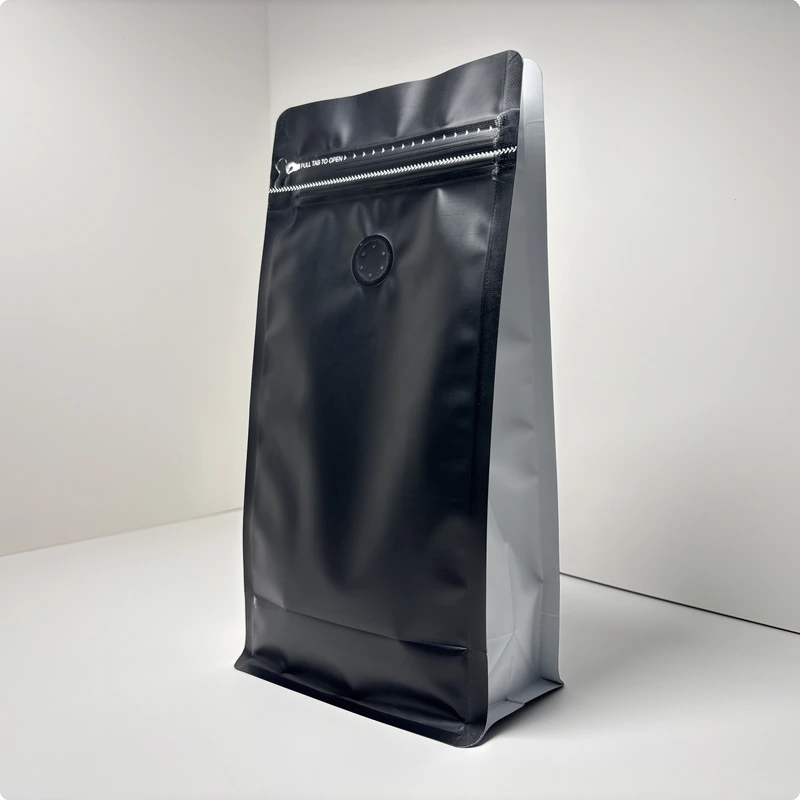
Both formats support one-way degassing valves — the feature that lets fresh-roasted coffee release CO₂ without letting oxygen in. The flat bottom pouch has an edge in valve placement: its wider base and structural rigidity allow the valve to be positioned in more locations, including the bottom panel.
Freshness Protection
Coffee freshness depends on barrier performance. DSS Pack uses high-barrier film laminations delivering:
- OTR: ≤0.5 cc/m²·day (MOCON, ASTM D3985)
- WVTR: ≤0.5 g/m²·day (MOCON, ASTM F1249)
Combined with ISO 9001, FDA, and BRC certification, these barrier levels keep coffee fresh from roast date to cup. Read more about how high-barrier pouches protect snack freshness.
Recommendation
- Flat bottom pouch — for premium retail coffee. The 5-panel design, valve integration, and box-like shape justify a higher shelf price.
- Stand-up pouch — for e-commerce subscriptions, sample packs, and value-tier products where per-unit cost is the priority.
How to Choose: Decision Framework
Choose a Stand-Up Pouch When:
- Cost sensitivity is a priority — you need the lowest per-unit cost
- Your product is under 1 kg — snacks, powders, supplements
- You have frequent SKU changes — smaller runs are more economical
- E-commerce is your primary channel — shipping efficiency matters
- You need hang hole display — pegboard retail
Choose a Flat Bottom Pouch When:
- Shelf impact is critical — crowded retail requires standout packaging
- Your product weighs 3 lb or more — coffee, pet food, rice
- Premium brand positioning is the goal — 5-panel box signals quality
- Multi-language or info-heavy labeling is needed — export brands benefit
- Retail coffee is your focus — industry standard format
Still Not Sure?
DSS Pack’s engineering team can evaluate your specific requirements. Request a quote for a personalized format recommendation.
Frequently Asked Questions
Can a flat bottom pouch stand up without product inside?
Yes. The sealed base is rigid enough to hold its shape empty. This is one of its key advantages over stand-up pouches, which need product inside to stay upright.
Is a doypack the same as a stand-up pouch?
Yes. “Doypack” was originally a trademark but is now a generic industry term for stand-up pouches, especially in Europe.
Which pouch is cheaper per unit?
Stand-up pouches are typically 10–20% less expensive at comparable dimensions, because they use less film. At the 10,000-unit MOQ, the gap narrows but remains significant.
Can both pouches have a resealable zipper?
Yes. Both formats support press-to-close and slider zippers. The specific profile may vary slightly depending on film thickness and pouch structure.
What certifications does DSS have?
ISO 9001, FDA, and BRC. These apply to every order — 10,000 units or 100,000 — from the same certified production lines.
Which pouch is better for e-commerce?
Stand-up pouches — lighter, cheaper per unit, and more shipping-efficient. Flat bottom pouches photograph better for listings but are best for retail shelf display.
For more answers, see our packaging FAQ.
Conclusion
Neither format is “better.” They’re built for different jobs.
The stand-up pouch is your workhorse — cost-efficient, lightweight, perfect for the e-commerce conveyor belt. If you’re selling snacks, supplements, or powders online, this is likely your format.
The flat bottom pouch is your showpiece — more branding space, premium shelf presence, built for retail coffee and heavy products. If your product sits on a shelf next to competitors, this is the format that makes shoppers pick yours.
When evaluating the stand up pouch vs flat bottom pouch decision for your product, the right choice depends on your product weight, retail channel, and budget. Need help deciding between stand up pouch vs flat bottom pouch options? DSS Pack manufactures both — request a quote and we’ll recommend the format that fits your product.