The best candy packaging is the kind your customer never thinks about. The bag opens crisp. The last gummy tastes as good as the first. Not one unit comes back from the retailer marked “stale.” For most snack and confectionery packaging brands, that invisible reliability breaks first. NIQ reports single-serve snacking grew +24.6% as buyers trade big boxes for portable packs. That puts more pouches in more trucks, warehouses, and shelves, and more chances for oxygen, moisture, light, and heat to ruin your product. A failed candy packaging package means a delisted SKU and a returned pallet.
You already know the sting of a spoiled batch. Chocolate bloom got your bars pulled from a chain. Gummies fused into a single brick after three weeks in an 85°F, 80% RH distribution center. This article promises a practical fix: a three-layer system of barrier material, pouch format, and closure that locks shelf life on the shelf and after opening. We cover why snacks spoil, what makes a pouch “high-barrier,” which formats fit which products, how closures protect freshness, a mini case of a cereal bar brand that beat humidity, and a shelf-life playbook you can validate before a full run. For the full range of formats, see our snack packaging and candy packaging solutions.
Key Takeaways
- High-barrier laminates (metallized PET or AlOx-coated film) block both oxygen and moisture at once, the two forces that shorten shelf life most.
- A resealable zipper keeps product fresh after the first open, the moment most packages start to fail.
- The right pouch format, matched with our flexible MOQ and fastest 15-day shipment after confirmation, lets a new snack SKU launch at low cost.
1. Why Snack & Candy Packaging Spoils — The 4 Enemies
Every candy packaging breakdown traces back to four enemies. Defeat them and you design a winning pouch.
How oxygen shortens shelf life
Oxygen is the silent killer of crunch and flavor. Oxidation turns fats rancid, bleaches colors, and flattens aroma. For an oxygen barrier to matter, you need a low Oxygen Transmission Rate (OTR, cc/m²·day). Ordinary polyethylene breathes; a true high-barrier structure cuts that rate 100–1,000×. The payoff is measurable shelf life extension: a product that stales in weeks in basic film stays fresh for months behind a metallized or oxide-coated layer. Exact numbers below.
Why moisture is the #1 enemy for gummies & powder snacks
If oxygen ruins flavor, water ruins texture. For gummy packaging and powdered snacks, moisture is the dominant threat. Gummies are hydroscopic: they pull humidity from the air and weep, then re-crystallize into a sticky clump. Powders cake. Both fail the “would I buy this again?” test on sight. A strong moisture barrier, expressed as Water Vapor Transmission Rate (WVTR, in g/m²·day), is non-negotiable here. This is also where the biggest, most visible returns happen, because the defect is obvious the instant a customer opens the bag.
Light & heat: flavor and color loss
Light drives photo-oxidation; heat accelerates it. UV and visible light fade pigments and turn oils rancid in chocolate and nuts. A printed, opaque outer layer plus sensible logistics handles most of this. A metallized or foil layer blocks light entirely while it blocks gas.
2. What Makes a Pouch “High-Barrier”? (Materials 101)
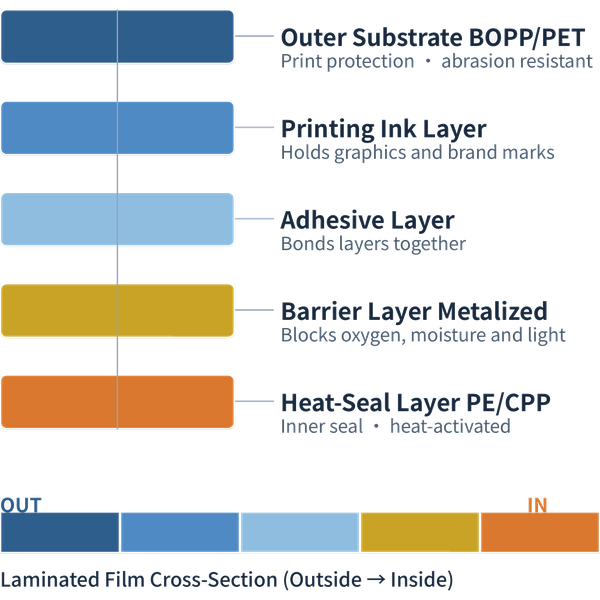
“Barrier” is a stack of films, each doing one job: print layer, barrier layer, seal layer.
PET / metallized PET / AlOx-coated PET
The workhorse outer film is PET (polyester), tough and print-friendly, made a barrier by a deposited metal layer.
- Metallized PET carries a vacuum-deposited aluminum layer. In our MOCON permeation testing (12 µm film, 23 °C, 0% RH), it delivered an OTR of 0.46 cc/m²·day — inside our published ≤0.5 spec — and a WVTR of 0.28 g/m²·day (≤0.5 spec). That is roughly 100× tighter than plain PET.
- AlOx-coated PET uses a transparent aluminum-oxide ceramic layer, giving an OTR of ≤1.5 cc/m²·day and a WVTR of ≤1.0 g/m²·day while staying see-through for a clear-window look.
Both slash WVTR as well as oxygen, and either delivers the oxygen barrier a fat-sensitive snack needs. For brands that want a window but still need protection, AlOx is the elegant compromise. The full MOCON numbers sit in the test-report appendix at the end of this article.
BOPP, PE, and mono-material recyclable films
BOPP (oriented polypropylene) is the classic crisp, glossy, low-cost film. PE (polyethylene) forms the inner seal layer and is the most recycle-friendly polyolefin. Mono-material structures (all-PE or all-PP) are gaining ground for recyclability, a topic the Flexible Packaging Association tracks closely, at some cost to absolute barrier, which we balance per product. Every layer is food grade film, compliant with FDA and BRC.
Want the full decision tree on films, coatings, and recyclability? Read our packaging material guide.
When to add foil or EVOH
When metallized PET is not enough — long-life jerky, premium chocolate in heat, or near-zero oxygen tolerance — step up to aluminum foil (near-zero transmission) or EVOH, a polymer tie-layer with outstanding oxygen blocking. Foil is the gold standard for absolute barrier; EVOH keeps you in a recyclable polyolefin family. We specify these only when the product demands it, so you are not paying for barrier you do not need.
3. Best Pouch Formats for Snacks & Candy
Format is where shelf appeal and protection meet. The wrong shape costs you visibility; the right one sells the product before the customer touches it.
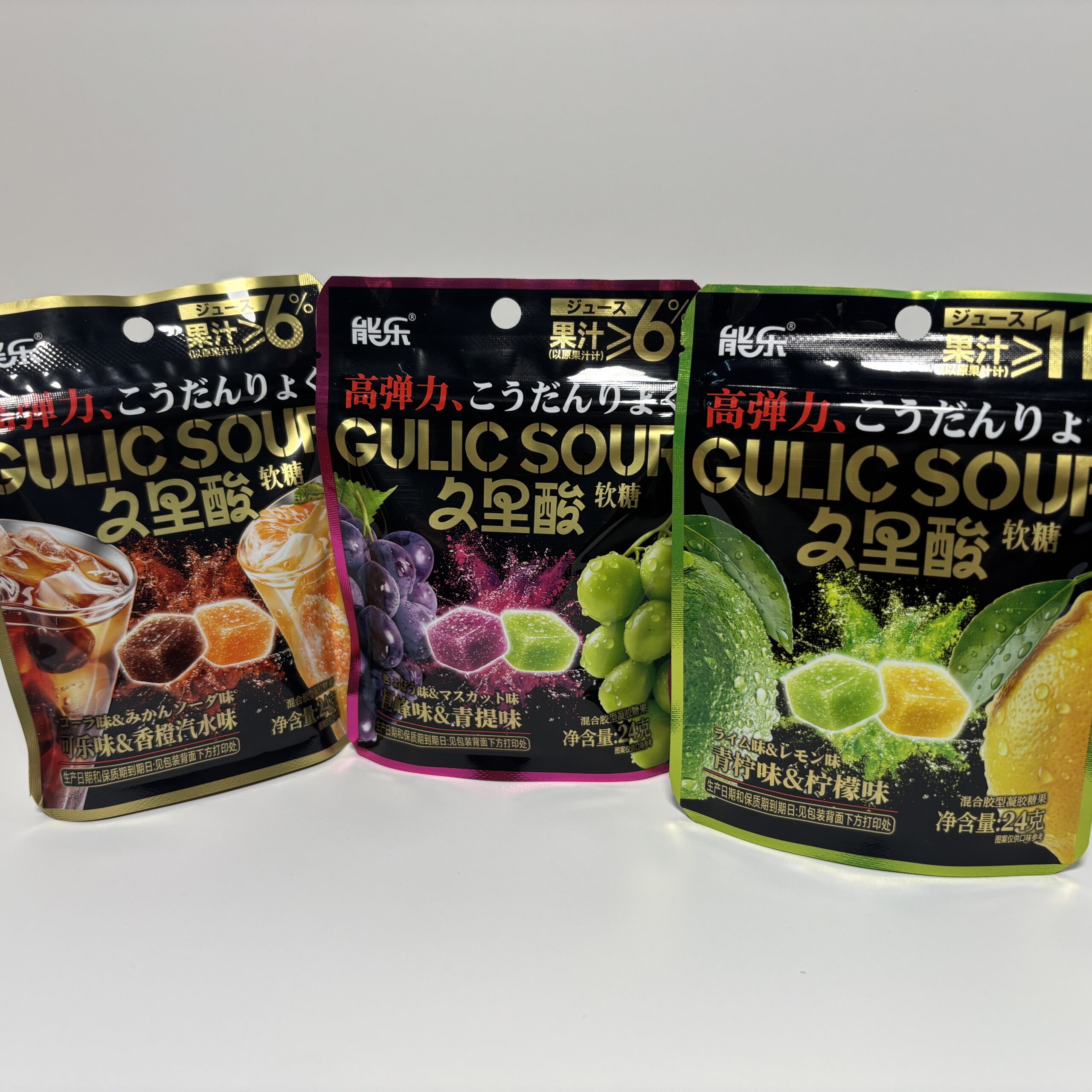
Stand-up pouch — the shelf-ready default
Our custom stand-up pouches are the default for retail snacks and candy. A bottom gusset stands the bag like a billboard, the front panel carries your brand, and a zipper or tear notch adds convenience. For most confectionery SKUs, a stand up pouch is the fastest path from factory to shelf. It ships flat, weighs a fraction of a glass jar, and can cut per-unit freight 30–50% versus rigid packaging.
Flat bottom pouch for premium / large candy
For maximum presence, the flat bottom pouches for candy format delivers. A box-like base stays upright, and five printable panels (front, back, two sides, bottom) give more branding space than any other pouch. Premium truffles, gift candy, and multi-serve lines use it to justify a higher shelf price.
For a detailed comparison of stand-up pouches vs flat bottom pouches — covering cost, shelf presence, capacity, and coffee valve compatibility — see our stand-up pouch vs flat bottom pouch guide.
3-side seal & back seal for sachets / singles
Single-serve and sample packs, the fastest-growing segment behind that +24.6% NIQ number, use 3-side seal pouch or back-seal sachets. These are the classic chocolate bar wrapper and flow-pack inner formats: low material cost, clean lines, perfect for individually wrapped pieces or powder sticks. They sit inside a secondary stand-up or carton for retail sale.
Spout pouch for yogurt-coated / liquid snacks
Yogurt-coated bites, fruit purees, and other semi-liquid snacks need a spout pouch. A flexible body with a fitted cap allows controlled, mess-free dispensing that replaces rigid tubs and cuts plastic weight.
Rollstock film for high-volume brands
Brands running vertical or horizontal form-fill-seal lines at scale use rollstock film, printed, barrier-laminated roll stock that fills at speed on your own machine. It is the most cost-efficient path once volumes justify the equipment.
4. Closures That Protect Freshness After Opening
A package can be perfect until the seal breaks. Then most start to fail. The closure protects the product during the part of its life the brand rarely controls: the customer’s pantry.
Resealable zipper
The resealable snack pouch is now table stakes for repeat-purchase snacks. For candy, a candy pouch with zipper (often called a resealable candy pouch) turns a one-shot treat into a habit your customers come back for, which is what drives repurchase. A press-to-close or slide zipper shuts out air and humidity after every serving, keeping the rest of the bag as fresh as the first bite. We engineer the zipper to the film structure so it survives drop tests and does not leak at the seal ends.
Tear notch + reclosure combo
The cleanest experience pairs a laser or notch tear for a frustration-free first open with a zipper for reclosure. We spec the notch to your film thickness so it tears straight every time.
| Product type | Best barrier | Recommended format | Closure | Why it works |
|---|---|---|---|---|
| Gummies / jelly candy | Metallized PET or AlOx (moisture focus) | Stand-up pouch | Resealable zipper | Stops humidity clumping after open |
| Chocolate / truffles | Foil or metallized PET + light block | Flat bottom pouch | Zipper + tear notch | Blocks bloom-triggering heat/light |
| Powder snacks / sticks | Foil or metallized PET | Rollstock / vertical FFS | Crimp seal | Low WVTR prevents caking |
| Nuts / chips | Metallized PET (oxygen + moisture) | Stand-up pouch | Resealable zipper | Keeps crunch, reseals after every serving |
| Yogurt-coated / liquid | PE-sealable high-barrier | Spout pouch | Spout cap | Controlled dispensing, no leak |
| High-volume bars | Metallized PET rollstock | Flow / HFFS wrap | Crimp / fin seal | Speed and unit cost at scale |
5. Mini Case — How a Cereal Energy Bar Brand Beat Humidity in Southeast Asia
The following is a real client example; brand shared with permission.
A Chinese brand, “熊有心品” (Xiong You Xin Pin), makes cereal energy bars and ships them to humid regions across Southeast Asia. The original pack was a small individual wrapper of BOPP laminated CPP — low cost and clean, but with a weak moisture barrier. On shelf in tropical humidity, a meaningful share of bars absorbed moisture, softened, and lost the crisp bite customers expected.
We rebuilt the structure: BOPP laminated CPP with a metallized layer. The new metallized film cut water vapor transmission to about 20% of the original rate. With no recipe change, the brand extended the product’s crisp texture by roughly three months on shelf. The fix was a material decision at the laminate level, not a reformulation — and it protected the taste customers were buying.
6. Shelf-Life Extension Playbook (Practical Checklist)
Use this as a working checklist when you spec a new snack or candy pack.
Match barrier level to product sensitivity
Start from the product, not the film. High-fat and high-oxygen-sensitive items (nuts, chocolate) need oxygen defense first. Hydroscopic items (gummies, powders) need moisture defense first. Map sensitivity to required OTR/WVTR to film structure. Do not over-specify; every upgrade adds cost.
Use MAP + oxygen scavengers
Modified atmosphere packaging (MAP) replaces pack air with nitrogen to push oxygen near zero at fill. Add an oxygen scavenger sachet or integrated layer and you pull headspace oxygen down to parts-per-million levels, the single most effective move for long shelf life extension on sensitive snacks, especially premium chocolate and dehydrated items. For the underlying material science, Smithers publishes ongoing packaging technology research.
Validate with accelerated shelf-life testing
Never guess. Run accelerated shelf-life testing (raised temperature and humidity over weeks, then sensory and lab checks) to confirm the real-world window before a full run. Use food grade film certified to your market’s contact rules, and document results for retailers and co-packers.
7. How DSS Pack Helps You Launch Faster
Great packaging theory is worthless without a reliable supply partner before the selling season — and that is the gap DSS Pack fills.
Flexible MOQ for growing brands
Our flexible MOQ (from 10,000 pcs) lets a young brand run a credible retail trial without a container-scale commitment. Scale up as you prove velocity. For a complete walkthrough of MOQ tiers and the 10,000-unit sweet spot, see our low MOQ custom flexible packaging guide.
Fastest 15-day shipment after confirmation
Once your structure and artwork are confirmed, we ship in as fast as 15 days — not the 4–6 weeks larger converters quote. Fast enough to hit a launch window or retailer meeting.
Factory-direct engineering support
As a Shantou, China-based candy packaging manufacturer, we offer factory-direct pricing and on-site engineering support. Your specs go straight to the people running the laminator and press, with short communication loops. We hold ISO 9001, FDA, and BRC certification, and ship to 30+ countries.
Ready to see a structure built for your exact product? Request a custom quote and tell us your snack type, portion size, and shelf-life target. We will recommend the optimal film, format, and closure.
8. FAQ
What is the best packaging for snacks to keep them fresh?
The best packaging for keeping snacks fresh is a high-barrier stand-up pouch: a multi-layer laminate (such as metallized PET or AlOx-coated film) that blocks oxygen and moisture, paired with a resealable zipper so the product stays crisp after every open. Match the barrier level to your product’s sensitivity and validate with shelf-life testing.
How long do snacks stay fresh in a stand-up pouch?
It depends on the barrier level and the product. With a standard metallized barrier, expect roughly 6–12 months; with a high-barrier laminate plus MAP, you reach the upper end or beyond. Key factors:
- Product fat and moisture sensitivity
- OTR and WVTR of the film structure
- Whether the pack is nitrogen-flushed (MAP)
- Use of a resealable zipper after opening
- Storage temperature and light exposure
What material keeps gummy candy from clumping?
A metallized or AlOx-coated barrier film with a low WVTR (water vapor transmission rate), paired with a tightly crimped resealable zipper. Gummies are hydroscopic, so moisture control, not oxygen control, is the priority. Metallized PET laminates are the typical choice for gummy packaging.
Is resealable zipper packaging food safe?
Yes. Whether on a resealable snack pouch or a candy pouch with zipper, the closure and film are made from food grade film compliant with FDA and BRC food-contact standards. The zipper is part of the same laminate specification and is selected for safe, repeated contact with the product.
Conclusion
Snack and candy failures are rarely about the recipe. They are about the package. Block oxygen and moisture with a high-barrier candy packaging laminate, choose the format that sells on the shelf, and finish with a closure that protects the product after the first open. Validate it properly, and launch with confidence instead of guesswork.
So here is the short version: get the barrier film right, match the format, and prove it through proper shelf-life testing before you commit to a run. DSS Pack ships in as fast as 15 days after confirmation at flexible MOQ, with factory-direct engineering behind every structure.
Explore our full snack & candy packaging range or request a custom quote and send us your product, portion size, and shelf-life target. We will engineer the candy packaging and snack pouch that keeps your brand fresh, on the shelf, and out of the returns bin.
Appendix: Independent Barrier Test Reports (PET Metallized Film)
The barrier figures above are not brochure claims. They come from permeation tests run on a MOCON analyzer. Below are the measured results for our 12 µm metallized PET film (Sample ID 260430-3B-102) — the same structure referenced throughout this article.
| Parameter | Test condition | Measured result | Published spec |
|---|---|---|---|
| OTR (oxygen transmission rate) | 23 °C, 0% RH, 12 µm | 0.4627 cc/m²·day | ≤ 0.5 cc/m²·day |
| WVTR (water vapor transmission rate) | 38 °C, 90% RH, 12 µm | 0.2847 g/m²·day | ≤ 0.5 g/m²·day |
Instrument: MOCON OX-TRAN® 2/22 (OTR) and MOCON AQUATRAN® 3/38 (WVTR). Methods: ASTM D3985 / ASTM F1249. Tested 2026-05-03; reports printed 2026-05-17.
Download the full single-test reports: